ECB Holds Key Interest Rate Steady... Maintains Accommodative Policy Stance
Short-Term Divergence with US Fed Due to Differences in Economic Recovery Pace
Attention on Whether 'Delta Variant' Concerns Will Be Raised at US FOMC... Key to Future Policy Decisions
[Asia Economy Reporter Minwoo Lee] The European Central Bank (ECB) has kept its benchmark interest rate at 0%. It stated that it will maintain low interest rates until inflation reaches the recently raised target of 2%. The U.S. Federal Reserve (Fed) is also moving toward tolerating inflation, but it shows a different approach regarding tapering (reducing asset purchases). Analysts suggest that how concerns about the spread of the COVID-19 Delta variant are viewed will determine the direction of short-term monetary policy going forward.
ECB Decides to Maintain Benchmark Rate... Continues Easing Stance
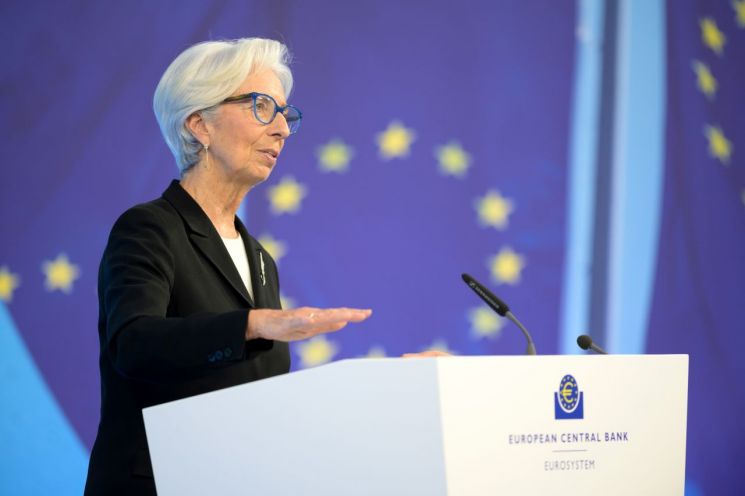
On the 22nd (local time), the ECB held a monetary policy meeting in Frankfurt, Germany, and announced that it would keep the benchmark interest rate at the current 0%. The deposit rate and marginal lending rate were also held steady at -0.50% and 0.25%, respectively. The ECB took a dovish stance, stating it will maintain low interest rates until inflation reaches the 2% target well before the end of the inflation forecast period and there is continued confidence that inflation has stabilized. ECB President Christine Lagarde said at a press conference that "the benchmark interest rate will be raised only when there is confidence that inflation will consistently reach 2%," adding that temporarily allowing inflation to moderately exceed the target is acceptable to achieve this.
Ilhyuk Kim, a researcher at KB Securities, explained, "Regarding the 'well before' mentioned by President Lagarde, she referred to the midpoint of the inflation forecast period (3 years), meaning that inflation is expected to reach 2% within about one and a half years." He added, "The market interpreted this as meaning that policy rate hikes will not begin until 2024-2025."
Considering the ECB's announcement, major central banks worldwide are shifting toward policies that tolerate rising inflation. The Fed introduced an average inflation targeting framework in August last year, allowing temporary inflation increases, significantly changing its monetary policy framework. This was due to concerns that monetary policy space is greatly limited in the new era characterized by low interest rates, low growth, and low inflation since the financial crisis. By appropriately raising inflation expectations, it is evaluated that the benchmark interest rate can be raised higher, creating room to lower rates during economic recessions.
Researcher Kim said, "President Lagarde raised the inflation target earlier this month and revised forward guidance to raise the criteria for interest rate hikes, which is in the same context," analyzing that "from a medium- to long-term perspective, both central banks are moving toward strengthening monetary easing policies."
Different Speeds of Economic Recovery... Divergent Short-term Policy Stances of the U.S. and Europe
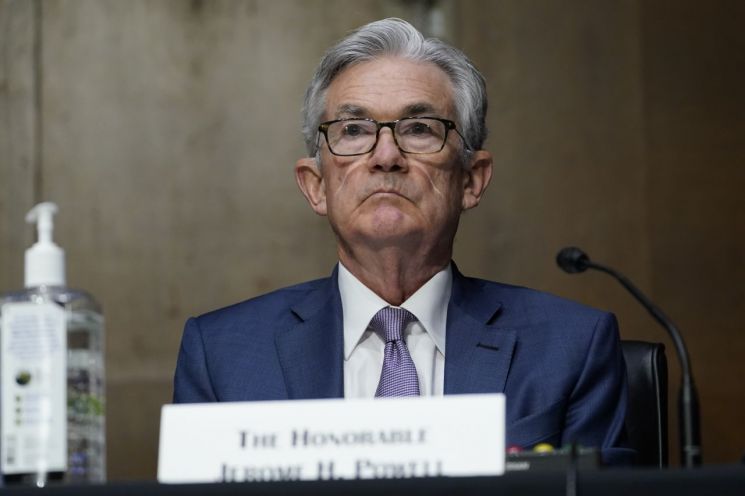 Jerome Powell, Chairman of the U.S. Federal Reserve (Fed), is holding a press conference after the Federal Open Market Committee (FOMC) decided to maintain the zero interest rate on the 16th of last month (local time). [Image source=Yonhap News]
However, in the short term, the policy stances of the two sides differ. The ECB not only raised the criteria for interest rate hikes but also decided to continue the Pandemic Emergency Purchase Programme (PEPP) bond purchases at least until the end of March next year, maintaining the amount at 1.85 trillion euros (approximately 2,508 trillion won). The pace of bond purchases under this program will be maintained at a somewhat higher speed compared to early this year, reaffirming the stance announced in early March.
On the other hand, the Fed is expected to begin serious discussions on tapering at the Federal Open Market Committee (FOMC) meeting next week. This is because the economic situations differ. The U.S. economy is expected to grow by 7% this year, already surpassing pre-pandemic levels. In contrast, the Eurozone (19 countries using the euro) economy is projected to grow by only 4.5% this year and is expected to recover to pre-pandemic levels only next year. The Eurozone's consumer price index rose 1.9% year-on-year last month, while the U.S. saw a 5.4% increase over the same period. Differences in economic conditions and monetary policies between the two countries have highlighted the dollar index, which measures the dollar's value against six major currencies, recently showing strength. After falling below 90 points last month and confirming a bottom, it recently exceeded 93 points.
Ultimately, how prominently concerns about the COVID-19 Delta variant emerge at the FOMC will be key. President Lagarde assessed the day before that the Delta variant is the root cause of changes in uncertainty. Researcher Kim explained, "Although the spread of the COVID-19 Delta variant is strong in the U.S. as well, the Fed rarely publicly expresses concerns about it," adding, "If significant concerns about the Delta variant arise at the FOMC, it could also impact short-term monetary policy."
© The Asia Business Daily(www.asiae.co.kr). All rights reserved.
![Clutching a Stolen Dior Bag, Saying "I Hate Being Poor but Real"... The Grotesque Con of a "Human Knockoff" [Slate]](https://cwcontent.asiae.co.kr/asiaresize/183/2026021902243444107_1771435474.jpg)

















