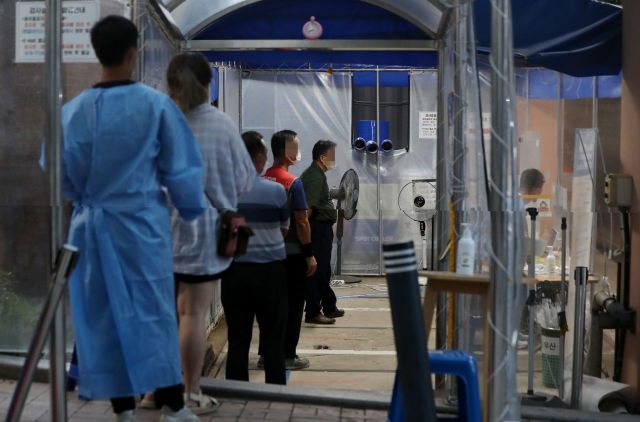
 On the evening of the 21st, citizens visiting the COVID-19 screening clinic set up at Gwanak-gu Public Health Center in Seoul are waiting for specimen testing. (Photo by Yonhap News)
[Asia Economy Reporter Ryu Tae-min] As the fourth wave of COVID-19 spreads in South Korea, the number of new confirmed cases on the 24th recorded in the early 1600s.
The Central Disease Control Headquarters (CDCH) announced that as of midnight on that day, 1,629 new confirmed cases were added, bringing the total to 187,362. This is one less than the previous day (1,630), marking two consecutive days with numbers in the 1600s. Especially, while the spread continues in the Seoul metropolitan area, the number of new confirmed cases has noticeably increased recently in non-metropolitan areas, raising the possibility of a nationwide outbreak.
Non-metropolitan confirmed cases have been in the 500s daily. Among these, the proportion of cases occurring in non-metropolitan regions has been hitting new highs daily, rising to the high 30% range. Accordingly, the government announced the extension of the social distancing Level 4 measures in the metropolitan area for two weeks until July 8th, and plans to finalize strengthened quarantine measures for non-metropolitan areas on the 25th of this month.
The number of new confirmed cases has remained in the four-digit 1000s range for 18 consecutive days since the 7th (1,212 cases). The daily new confirmed cases over the past week were 1,454 → 1,251 → 1,278 → 1,781 → 1,842 → 1,630 → 1,629, fluctuating around 1,200 to 1,800.
The daily average over one week was about 1,552 cases, with the average daily local transmission cases reaching approximately 1,465. Among the new confirmed cases on this day, 1,573 were local transmissions and 56 were imported cases. Local transmission cases decreased by one from the previous day (1,574). By region, Seoul had 462 cases, Gyeonggi 448, and Incheon 81, totaling 991 cases (63.0%) in the metropolitan area.
Non-metropolitan areas reported ▲Busan 114 cases, ▲Gyeongnam 111, ▲Daejeon 68, ▲Daegu 52, ▲Gangwon 46, ▲Jeonbuk 41, ▲Chungnam 34, ▲Chungbuk 29, ▲Jeonnam and Gyeongbuk each 20, ▲Ulsan 18, ▲Jeju 14, ▲Gwangju 9, and ▲Sejong 6, totaling 582 cases (37.0%). Non-metropolitan confirmed cases have remained in the 500s for four consecutive days since the 21st (550 → 546 → 565 → 582), and the 582 cases on this day is the highest record since the fourth wave began.
The proportion of non-metropolitan cases among total local transmissions has exceeded 30% for a week since the 18th (31.6% → 32.9% → 32.9% → 31.9% → 35.6% → 35.9% → 37.0%). The 37.0% itself is the highest since the fourth wave started.
The number of imported confirmed cases was 56, the same as the previous day. Among these, 19 were identified during airport or port quarantine processes. The remaining 37 tested positive while in self-quarantine at their residences or temporary living facilities in regions including Gyeonggi (17), Chungnam (5), Seoul and Incheon (3 each), Busan and Chungbuk (2 each), and Ulsan, Jeonbuk, Gyeongbuk, Gyeongnam, and Jeju (1 each).
Combining local transmissions and imported cases (excluding quarantine), Seoul and Gyeonggi each had 465 cases, and Incheon had 84, totaling 1,014 cases. Confirmed cases were reported across all 17 metropolitan cities and provinces nationwide. The number of deaths increased by 2 from the previous day, reaching a cumulative total of 2,068. The domestic average fatality rate is 1.10%. The number of critically ill patients totaled 254, an increase of 27 from the previous day (227). As daily new confirmed cases continue to pour in four-digit numbers, the number of critically ill patients is also showing a noticeable upward trend.
The number of suspected patients tested at screening clinics and other facilities on the previous day was 42,220, which is 2,167 fewer than the 44,387 tests conducted the day before. The positivity rate calculated by dividing confirmed cases by the number of tests was 3.86% (1,629 out of 42,220), up from 3.67% (1,630 out of 44,387) the previous day. The cumulative positivity rate as of midnight was 1.64% (187,362 out of 11,430,525 tests).
© The Asia Business Daily(www.asiae.co.kr). All rights reserved.

















