2021 Second Supplementary Budget Confirmed by National Assembly
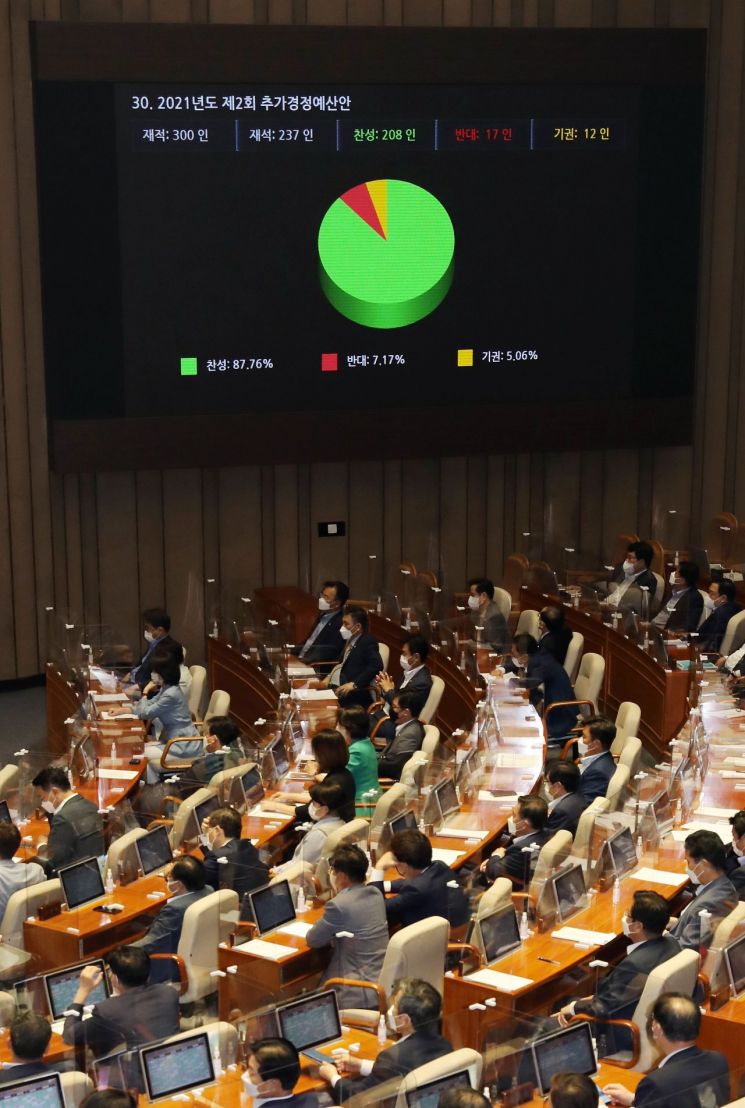
[Sejong=Asia Economy Reporter Kim Hyunjung] The criteria for disaster relief fund payments to overcome COVID-19 have been finalized at the level of the bottom 88% income bracket, expanded from the government's original proposal (bottom 80% income bracket). Although there were claims, mainly from the ruling party, that the scale of cash support should be increased instead of debt repayment, the government’s plan to allocate 2 trillion won for repayment was maintained.
The Democratic Party and the People Power Party approved the second supplementary budget with these contents at the National Assembly plenary session on the 24th. Disaster relief funds will be paid excluding high-income earners. Based on annual income, the criteria are ▲50 million won for single-person households ▲86 million won for dual-income two-person families ▲124.36 million won for dual-income four-person families ▲105.2 million won for single-income four-person families. The estimated number of eligible households is 8.6 million single-person households, 4.32 million two-person households, 3.37 million three-person households, and 4.05 million four-person households, totaling approximately 20.3 million households. Using this method, the range of disaster relief fund recipients expands from the bottom 80% to the bottom 88% income bracket.
Earlier, when the government prepared the second supplementary budget worth 33 trillion won, it allocated about half of the total budget, 15.7 trillion won, to a three-part COVID-19 damage support package. This included the COVID-19 Coexistence National Support Fund (10.4 trillion won), small business damage support (3.9 trillion won), and the Coexistence Consumption Support Fund (credit card cashback, 1.1 trillion won), all cash support programs. At that time, the Coexistence National Support Fund was targeted at the bottom 80% income bracket.
As a result, by expanding the target by 8 percentage points based on income, a compromise was reached at a level below the midpoint between the ruling party’s claim (100% payment) and the government’s plan (80% payment). Some criticize this as an ambiguous standard that neither allows for rapid nationwide payment nor secures resources through clear selective payments to provide stronger support for small business owners and vulnerable groups. Gyeonggi Province Governor Lee Jae-myung appeared on YTN's 'News Night' the day before and criticized the 88% baseline, saying, "Paying just 250,000 won to exclude 12% is a huge administrative cost and a loss," adding, "I don’t understand why we are doing something inefficient, uneconomical, and contrary to experience."
On the other hand, the budget originally allocated for national debt repayment was maintained at the scale of 2 trillion won as in the government’s original plan. Initially, the ruling party had argued that the debt repayment amount should be reduced or even if not repaid, the support funds for small business owners and vulnerable groups should be increased.
This appears to have been considered in light of recent international credit rating agencies maintaining South Korea’s sovereign credit rating, premised on efforts to maintain fiscal soundness such as debt repayment, as it could negatively affect global credit ratings and the government bond market.
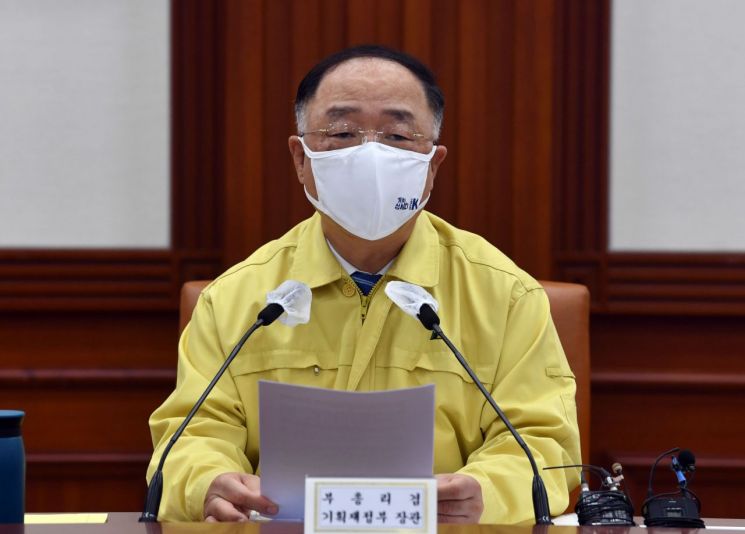
In fact, on the 21st (local time), Fitch maintained South Korea’s credit rating at an all-time high of AA- and cited "improvements in fiscal indicators" as one of the reasons. Fitch stated, "The second supplementary budget is funded by additional tax revenue, does not issue additional deficit bonds, and partially repays government bonds, which will improve medium- to short-term fiscal indicators beyond previous forecasts." It also explained, "South Korea’s sound fiscal management history mitigates pressure from increasing national debt, and fiscal rules will provide a foundation to further strengthen fiscal management." Deputy Prime Minister Hong also told reporters after the recent G20 Finance Ministers meeting, "(Fitch) recognized the willingness to make efforts as fiscal policy plays a role," adding, "In this situation, it is burdensome to cancel the 2 trillion won repayment."
© The Asia Business Daily(www.asiae.co.kr). All rights reserved.
![Clutching a Stolen Dior Bag, Saying "I Hate Being Poor but Real"... The Grotesque Con of a "Human Knockoff" [Slate]](https://cwcontent.asiae.co.kr/asiaresize/183/2026021902243444107_1771435474.jpg)

















