Government Issues High-Point Warning to Curb Buying,
But Housing Price Outlook Indicators Rise Across the Board,
Supply Decreases with Fewer Seoul Move-Ins and Construction Starts
[Asia Economy Reporter Kim Hyemin] Various leading indicators that show future housing price prospects have all risen simultaneously. Supply indicators, which represent the current and 3-4 years later housing volume to be released, have also deteriorated. Although the government is warning daily about the peak of housing prices and encouraging restraint in purchasing, the indicators are actually moving in the opposite direction.
According to the Korea Real Estate Board on the 22nd, the 'Sales Supply-Demand Index' showing apartment buying sentiment in Seoul has been on an upward trend for three consecutive months. It rose from 109 in April to 121 last month. When this index exceeds 100, it means that demand exceeds supply by that amount.
The Purchase Dominance Index surveyed by KB Kookmin Bank targeting brokerage offices also rose by 7.9 points from the previous month to 103.7 last month, surpassing the baseline of 100 again. This index ranges from 0 to 200, and when it exceeds 100, it means more respondents answered that buyers outnumber sellers. A Purchase Dominance Index above 100 is interpreted as a signal that housing prices are rising.
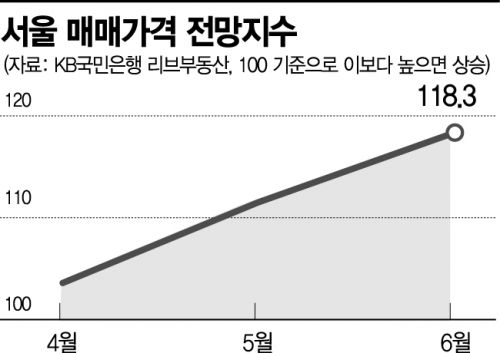
As buying sentiment grows, the outlook for sales prices is also rising. KB Kookmin Bank Liv Real Estate's Seoul sales outlook index rose from 103.6 in April to 111.5 in May and 118.3 in June. This reflects brokers' housing price forecasts, and a value above 100 means more respondents expect prices to rise.
The housing auction market's housing winning bid rate (compared to appraisal price), which is read as a leading indicator of housing prices, also jumped to 119% last month, the highest since statistics began in 2001.
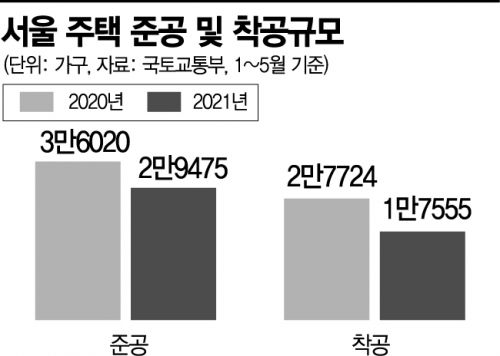
Warning signs have also been lit for supply, which affects housing prices. Both the scale of completed housing, representing current supply volume, and the scale of housing starts, representing the volume to be released in 3-4 years, show weaker performance compared to the past. According to the Ministry of Land, Infrastructure and Transport, the total number of completed housing units in Seoul up to May this year was 29,475, which is 6,545 units less than the same period last year. In particular, the scale of housing starts, indicating near-future housing supply, decreased from 27,724 units to 17,555 units during the same period, with a decrease approaching 10,000 units. According to Real Estate 114, the apartment move-in volume in Seoul, which was close to 50,000 units last year, is expected to decrease to 30,000 units this year and 20,000 units next year. This means that permits and approvals were not actively issued 2-4 years ago.
Housing construction permits, which affect housing supply 3-4 years later, were counted at 30,915 units up to May this year. Although this is higher than the recent 5-year average (29,377 units), it is insufficient to compensate for the decrease in completed and started housing volumes.
Deputy Prime Minister and Minister of Economy and Finance Hong Nam-ki mentioned the possibility of housing price overvaluation at the real estate market inspection meeting held the day before, but experts forecast strong housing prices in the second half of the year as well. Professor Shim Gyo-eon of Konkuk University's Department of Real Estate said, "Supply is not increasing, and the jeonse (long-term deposit lease) crisis continues," adding, "It is a situation where a price rise at any time would not be surprising."
© The Asia Business Daily(www.asiae.co.kr). All rights reserved.
![Clutching a Stolen Dior Bag, Saying "I Hate Being Poor but Real"... The Grotesque Con of a "Human Knockoff" [Slate]](https://cwcontent.asiae.co.kr/asiaresize/183/2026021902243444107_1771435474.jpg)


















