Seoul City Approves Redevelopment Plan for Jongno-gu Gongpyeong-dong Districts 15 and 16
Largest Scale in Korea... Scheduled for Release in 2025
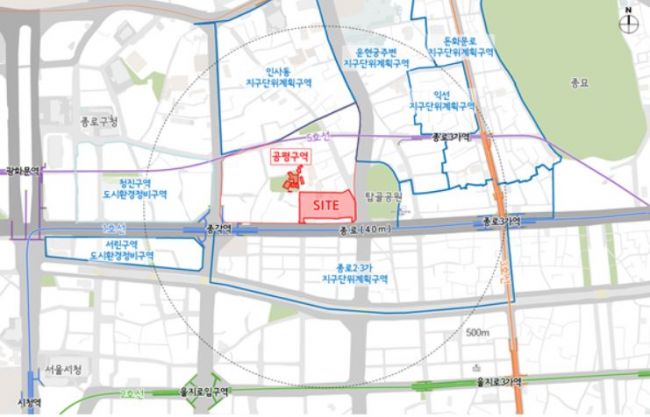
[Asia Economy Reporter Kim Hyemin] A redevelopment project in Gongpyeong-dong, Jongno-gu, Seoul, where metal movable type was excavated, will see the construction of the country's largest-scale relic exhibition hall. The development project is expected to proceed smoothly by fully preserving cultural assets and providing incentives through donation and surrender.
On the 21st, Seoul City held the 9th Urban Planning Committee meeting and announced on the 22nd that it decided on a maintenance plan to create an exhibition hall with a total area of 4,745㎡ within the Gongpyeong-dong 15 and 16 redevelopment zones around 87 Insadong, Jongno-gu.
This size is 9.4 times larger than the Yukujeon Museum (505㎡) located in the city center, 5.38 times larger than the Gun-gi-si relic exhibition room (882㎡) in Seoul City Hall, and 1.25 times larger than the Gongpyeong 1, 2, and 4 district relic exhibition hall (3,818㎡).
The Gongpyeong 15 and 16 districts underwent redevelopment after being selected as Seoul City's urban and architectural innovation pilot project site in 2019. A 'mixed-type' maintenance method, harmonizing preservation and redevelopment, was introduced in the area, and the project progressed rapidly, having already obtained project implementation approval and selected a construction company last year.
However, since March last year, cultural heritage investigations uncovered buried cultural assets of high preservation value such as drainage channels, old roads, and residential areas. Recently, metal artifacts reflecting the Donggukjeongun-style notation from the time of the creation of Hunminjeongeum, as well as astronomical clocks and water clocks demonstrating Joseon's scientific excellence, were excavated, leading to a temporary suspension of the project.
The Cultural Heritage Administration judged that preservation of the excavated relics was necessary. Accordingly, Seoul City revised the maintenance plan to create an exhibition hall through donation and surrender while providing incentives by increasing the floor area ratio. This so-called 'Gongpyeong Rule' was first applied in 2015 to Gongpyeong-dong 1, 2, and 4 districts, and this is the second time.
As a result, the floor area ratio will increase from the existing 803% to 1052%, and the building height will rise from 70m (8 basement floors to 17 above-ground floors) to 104m (8 basement floors to 25 above-ground floors). The exhibition hall will be located entirely on the first basement floor of the new building where the relics were first excavated. Accessibility and visual openness will be maximized so that it is integrally connected with the ground-level neighborhood living facilities without separation. The building is scheduled to be completed in 2025.
Seo Seongman, Head of the Balanced Development Headquarters, said, "Through this decision, not only will the deteriorated downtown be revitalized, but the excavated historical relics and artifacts will organically communicate with the downtown commercial facilities, creating an urban space befitting a historical and cultural city center."
© The Asia Business Daily(www.asiae.co.kr). All rights reserved.
![Clutching a Stolen Dior Bag, Saying "I Hate Being Poor but Real"... The Grotesque Con of a "Human Knockoff" [Slate]](https://cwcontent.asiae.co.kr/asiaresize/183/2026021902243444107_1771435474.jpg)











