Hong Nam-ki Chairs the 41st Emergency Economic Central Countermeasures Headquarters Meeting and the 13th Korean New Deal Ministerial Meeting
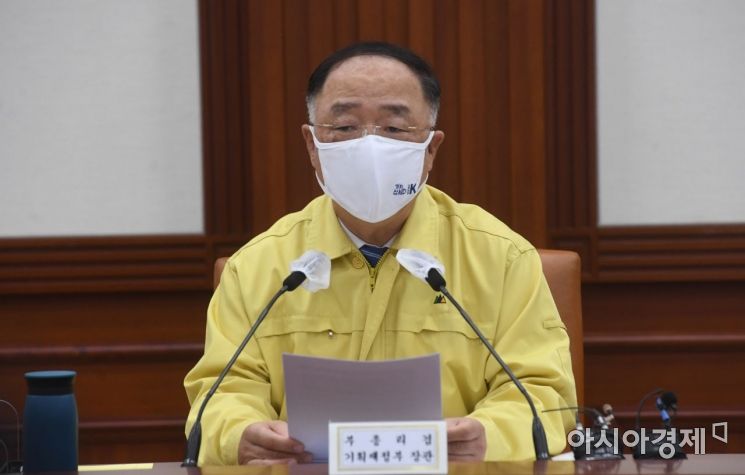 Hong Nam-ki, Deputy Prime Minister and Minister of Economy and Finance, is attending the Emergency Economic Central Countermeasures Headquarters meeting held at the Government Seoul Office in Jongno-gu, Seoul on the 22nd. Photo by Kim Hyun-min kimhyun81@
[Sejong=Asia Economy Reporter Moon Chaeseok] The government has designated three major sectors?semiconductors, batteries, and vaccines?as national strategic technologies and decided to support more than 2 trillion won in facility investment funds by 2023 to accelerate economic recovery.
Hong Nam-ki, Deputy Prime Minister and Minister of Economy and Finance, presided over the "41st Emergency Economic Central Countermeasures Headquarters Meeting and the 13th Korean New Deal Ministerial Meeting" at the Government Seoul Office on the 22nd, stating, "We will designate semiconductors, batteries, and vaccines as the three major national strategic technology sectors and select 65 detailed core technologies and facilities for focused support."
Deputy Prime Minister Hong added, "We plan to reflect a significant increase in tax credits for research and development (R&D) and facility investments in these three industries in this year’s tax reform plan, which will be announced on the 26th."
Earlier, on the 28th of last month, the government designated semiconductors and others as national strategic technologies through the "Second Half of 2021 Economic Policy Direction," announcing plans to expand fiscal support and significantly strengthen tax incentives for R&D and facility investments. This measure is a follow-up to the economic policy direction.
Additionally, as a follow-up task to the Korean New Deal 2.0 implementation, the government announced plans to prepare and implement measures to activate proactive business restructuring and support fair labor transition.
Notably, the government acknowledged that structural adjustments in carbon-intensive industries such as coal-fired power generation and internal combustion engine vehicles are inevitable in the process of achieving 2050 carbon neutrality, and pledged to minimize the resulting shocks.
Deputy Prime Minister Hong said, "We will establish and implement specialized industrial structure response training by 2025 for 100,000 workers expected to face employment reductions in coal-fired power generation and internal combustion engine vehicle industries," adding, "We will reform employer training by increasing the support rate for basic digital remote training from 50% to 90% and expand the number of beneficiaries from 276,000 annually this year to 1 million annually by 2025."
He continued, "In regions with a concentration of internal combustion engine vehicle businesses such as Gyeonggi, Gyeongnam, Busan, Ulsan, and Jeonbuk, we will support large-scale industrial complex remodeling for manufacturing innovation and future vehicle transition," and added, "In areas where coal-fired power plants are closed, we will proactively promote alternative industries such as the establishment of liquefied natural gas (LNG) power generation complexes."
The government also announced plans to strengthen financial and tax support to accelerate the pace of business restructuring.
Deputy Prime Minister Hong stated, "We will include structural adjustments due to external factors such as digital transformation and carbon neutrality in business restructuring and conversion, and revise related laws," adding, "We will grant special regulatory exemptions under the Fair Trade Act to companies approved for business restructuring due to carbon neutrality and establish regulations to support joint business restructuring and conversion between large and small enterprises and among small enterprises." Here, the special regulatory exemption under the Fair Trade Act refers to a policy that suspends the application of restrictions on actions among holding companies, subsidiaries, and sub-subsidiaries for three years.
He also said, "We will significantly strengthen incentives such as deferral of corporate tax on capital gains when proceeds from asset sales are used for new investments," and "We will newly establish a 500 billion won financial support program exclusively for business restructuring companies this year."
© The Asia Business Daily(www.asiae.co.kr). All rights reserved.
![Clutching a Stolen Dior Bag, Saying "I Hate Being Poor but Real"... The Grotesque Con of a "Human Knockoff" [Slate]](https://cwcontent.asiae.co.kr/asiaresize/183/2026021902243444107_1771435474.jpg)
















