Examining ESG Strategies and Outcomes of Four Major Financial Institutions
Clear Achievements through Active Efforts in Environmental and Social Sectors
Governance Sector Shows Minimal Specific Goals and Results
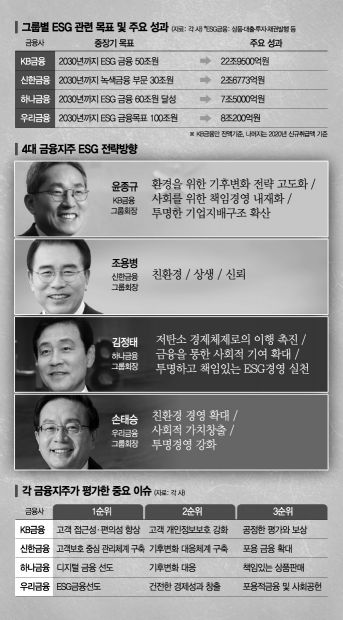
[Asia Economy Reporters Sunmi Park, Seungseop Song] The curtain has risen on the ESG (Environmental, Social, Governance) management performance war among the four major domestic financial holding companies. The chairmen of these financial groups, who unanimously shout ESG as the keyword for sustainable management, are confident that they are achieving record-high profits every year while delivering concrete results in the three ESG areas. However, compared to the aggressive strides made in the environmental and social sectors, the governance sector shows relatively fewer concrete performance figures and goals, indicating that there is still a long way to go.
According to the sustainable management reports released on the 22nd by the four major financial holding companies?KB, Shinhan, Hana, and Woori (Shinhan released an ESG report)?each company has set ESG finance (products, loans, investments, bonds) targets worth tens of trillions of won by 2030. The performance against these targets was around 10% based on new transaction amounts last year alone.
KB Financial has established a mid-to-long-term goal of achieving 50 trillion won in ESG finance by 2030 and recorded a performance of 22.95 trillion won last year, nearly half of the target based on outstanding balances. Shinhan Financial’s ESG goal is to provide eco-friendly financial support worth 30 trillion won in the green finance sector by 2030. Last year alone, it achieved green finance support results totaling 2.6773 trillion won, including 315.3 billion won in new eco-friendly loans, 659.7 billion won in eco-friendly project financing (PF), and 1.7023 trillion won in eco-friendly investments.
Hana Financial and Woori Financial have set plans to provide 60 trillion won in loans, investments, and fundraising in the green and sustainable sectors by 2030, and 100 trillion won in ESG finance by 2030, respectively. Hana Financial posted results last year of 4.4 trillion won in new loans, 1.39 trillion won in new investments, and 680 billion won in bonds based on new transaction amounts. Woori Financial recorded a performance equivalent to 8% (8.02 trillion won) of its target last year.
ESG is the keyword that the chairmen of the four major financial holding companies regard as the core of sustainable management. Shinhan Financial Chairman Jo Yong-byeong stated, "The answer to resilience in an uncertain management environment lies in ESG."
Setting Carbon Neutrality Goals and Active COVID-19 Support
The four major financial holding companies share common features in setting carbon neutrality goals in the environmental sector and emphasizing financial support performance related to COVID-19 in the social sector. As of May, KB Financial’s new loans and repayment deferrals executed for companies and small business owners struggling due to COVID-19 amounted to 19.388 trillion won.
Shinhan Financial issued ESG bonds worth 542.5 billion won at the holding company level to support COVID-19 efforts, with Shinhan Bank and Shinhan Card issuing bonds worth 392.1 billion won and 145.9 billion won, respectively. Woori Financial provided 1.6 billion won through COVID-19 pre-workout special measures and 409.3 billion won through the credit loan 119 program.
In the innovative finance sector aimed at fostering the Korean New Deal project and innovation ecosystem promoted by the Moon Jae-in administration, bold investment plans have emerged. KB Financial will support 10 trillion won by 2025 for the ‘Green New Deal’ and ‘Digital New Deal,’ two of the ten major tasks of the Korean New Deal. Woori Financial plans to invest a total of 50 trillion won by 2025 to ensure the success of the Korean New Deal and nurture innovative growth companies.
On the other hand, items related to governance showed relatively unclear performance figures and investment goals or minimal achievements.
For KB Financial, of the 22 trillion won spent on ESG products, investments, and loans, only 370 billion won was related to governance. In materiality assessments conducted by each group company, governance often ranked low.
In Shinhan Financial’s materiality assessment, "Establishing fair and ethical governance" ranked last at 10th place. For Hana Financial, topics such as "anti-corruption," "anti-competitive behavior," and "diversity and equal opportunity" were among the lower topics. The glass ceiling for women was also found to be firmly in place. Among the approximately ten board members in each company, there were either no women or only one to two women.
© The Asia Business Daily(www.asiae.co.kr). All rights reserved.
![Clutching a Stolen Dior Bag, Saying "I Hate Being Poor but Real"... The Grotesque Con of a "Human Knockoff" [Slate]](https://cwcontent.asiae.co.kr/asiaresize/183/2026021902243444107_1771435474.jpg)
















