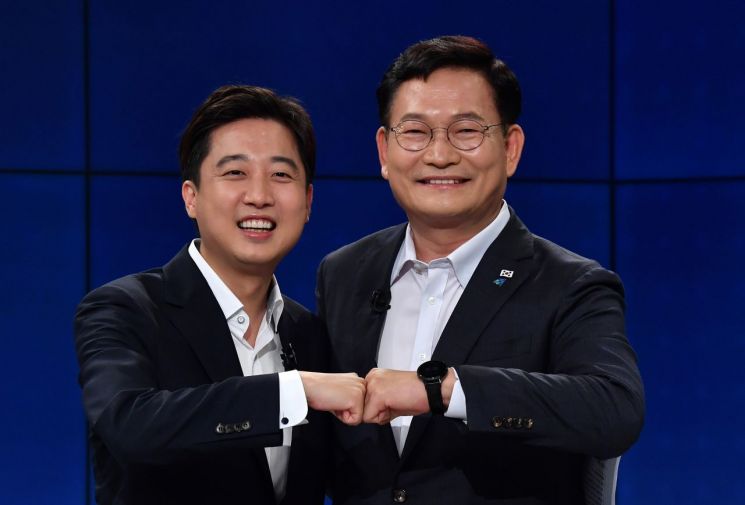
 People Power Party leader Lee Jun-seok (left) and Democratic Party leader Song Young-gil are taking a commemorative photo after finishing the party leader debate battle on "Joo Young-jin's News Briefing" held at SBS Broadcasting Center in Mok-dong, Yangcheon-gu, Seoul on the afternoon of the 21st. [Image source=Yonhap News]
[Asia Economy Reporter Park Jun-yi] Song Young-gil, leader of the Democratic Party of Korea, rebutted the 'abolition of the Ministry of Unification' proposed by Lee Jun-seok, leader of the People Power Party, stating, "Considering the symbolism of the Ministry of Unification and the fact that unification is a national principle in our constitution, caution is necessary." He also expressed that the Ministry of Unification should exist due to the 'special relationship' between South and North Korea.
On the 21st, during a ruling and opposition party leaders' debate battle on SBS's 'Joo Young-jin's News Briefing,' Song said, "Regarding the Ministry of Unification, Leader Lee seems to suggest integrating it into the Ministry of Foreign Affairs."
He explained, "According to the 1991 Basic Agreement on South-North Relations agreed upon during the Roh Tae-woo administration, South and North Korea are not in a state of inter-state relations but are in a provisional special relationship moving toward unification."
He continued, "If South-North issues are defined under the Ministry of Foreign Affairs, then the origin rules for the Kaesong Industrial Complex and Wonsan would no longer apply. The basis for origin recognition in the Korea-US and Korea-China FTAs would also be abolished," adding, "Because South-North relations are a special relationship, the Ministry of Unification is necessary," explaining why the Ministry of Unification should be maintained.
Regarding Leader Lee's claim that the person in charge of South-North relations has not been the Minister of Unification, Song responded that it is a matter of 'management,' stating, "Former Minister of Unification Jeong Dong-young led South-North relations while serving as a standing member of the National Security Council (NSC) and met directly with Kim Jong-il, the North Korean National Defense Commission Chairman."
In response, Leader Lee argued that it is better to consolidate departments through work coordination rather than having the Ministry of Unification exist as an independent department. He cited the cases of Taiwan and North Korea, explaining, "Taiwan also has an organization called the Mainland Affairs Council. North Korea also has a committee organization called 'Chopyeongtong'."
He added, "Our government operates 18 ministries, and there is a tendency for departments to increase one by one whenever the administration changes," and stated, "We need to continuously reevaluate functions and roles to determine whether they are necessary."
© The Asia Business Daily(www.asiae.co.kr). All rights reserved.
![Clutching a Stolen Dior Bag, Saying "I Hate Being Poor but Real"... The Grotesque Con of a "Human Knockoff" [Slate]](https://cwcontent.asiae.co.kr/asiaresize/183/2026021902243444107_1771435474.jpg)
















