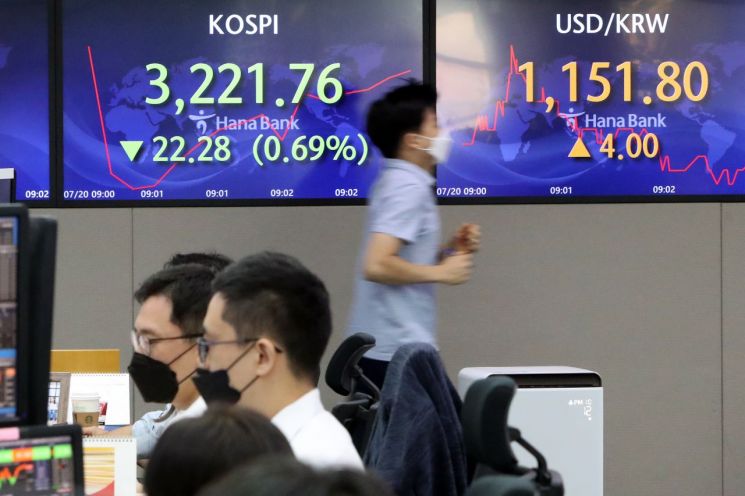
[Asia Economy Reporter Ji Yeon-jin] On the 21st, the domestic stock market failed to escape the shock of the spread of the COVID-19 Delta variant. The KOSPI, which opened higher following a strong rebound in the U.S. stock market the previous day, turned downward during the morning session due to a flood of sell orders from foreign investors, marking its fourth consecutive day of decline. The KOSDAQ also continued its weak trend.
The KOSPI index closed at 3,215.19, down 16.79 points (0.45%) from the previous day. Although individual investors net bought stocks worth approximately 763.5 billion KRW, foreign investors and institutions net sold 526 billion KRW and 272.4 billion KRW respectively, driving the index down.
Notably, the weakness was pronounced among large-cap stocks heavily sold by foreign investors. Kakao dropped sharply by 4.61%, and NAVER also fell by 2.51%. On this day, foreign investors net sold over 910,000 shares of Kakao, marking the largest sell-off since the 24th of last month. Samsung Electronics (-0.63%), SK Hynix (-1.27%), Samsung Biologics (-1.33%), LG Chem (-0.61%), and Celltrion (-2.01%) all declined consecutively. Only Samsung SDI (0.27%) and Hyundai Motor (0.44%) posted slight gains.
Lee Kyung-min, a researcher at Daishin Securities, explained, "Although the U.S. stock market showed a strong rebound overnight, the domestic market, which performed relatively well the previous day, showed weak rebound strength in the early session. News that COVID-19 cases exceeded 1,700 early in the session, a slight decline centered on the Nasdaq in the U.S. futures market, and the won-dollar exchange rate rising to 1,151 KRW led to foreign investors and program trading sell-offs, causing a reversal to a decline."
The KOSDAQ index also closed down 1.61 points (0.13%) at 1,042.03. Individual investors net bought stocks worth 215.7 billion KRW, while foreign investors and institutions sold stocks worth 109 billion KRW and 101.3 billion KRW respectively.
In the KOSDAQ market, Kakao Games rose 5.36% on expectations of significant earnings improvement due to the success of a new game, and SK Materials surged 6.85% following news of its entry into the secondary battery business. Conversely, Pearl Abyss plunged 7.58% after news of the delay in the release of its new game, Red Desert, and Celltrion Healthcare (-0.86%), Celltrion Pharm (-2.55%), and Seegene (-1.75%) also closed lower.
Park Kwang-nam, a researcher at Mirae Asset Securities, stated, "Despite a rise at the start influenced by the U.S. market rebound and favorable domestic export indicators, the market turned downward as foreign selling expanded in both spot and futures markets during the session. The shipbuilding industry rose on expectations of exceeding the annual shipbuilding order target, and companies like Korea Zinc and SK Materials recorded gains on hopes of entering the secondary battery materials market."
© The Asia Business Daily(www.asiae.co.kr). All rights reserved.
![Clutching a Stolen Dior Bag, Saying "I Hate Being Poor but Real"... The Grotesque Con of a "Human Knockoff" [Slate]](https://cwcontent.asiae.co.kr/asiaresize/183/2026021902243444107_1771435474.jpg)
















