World's First Application of Brainwave Technology in the Automotive Field
Following Heartbeat and Pupil Tracking, the Most Advanced Biometric Signal Technology
[Asia Economy Reporter Ki-min Lee] Hyundai Mobis has succeeded in developing autonomous driving technology that can check the driver’s condition by measuring brainwaves. This is the world’s first application of brainwave measurement technology, considered one of the most challenging areas among biometric signals, to the automotive field. Hyundai Mobis plans to dominate the vehicle healthcare market based on data secured through the pilot application of this technology.
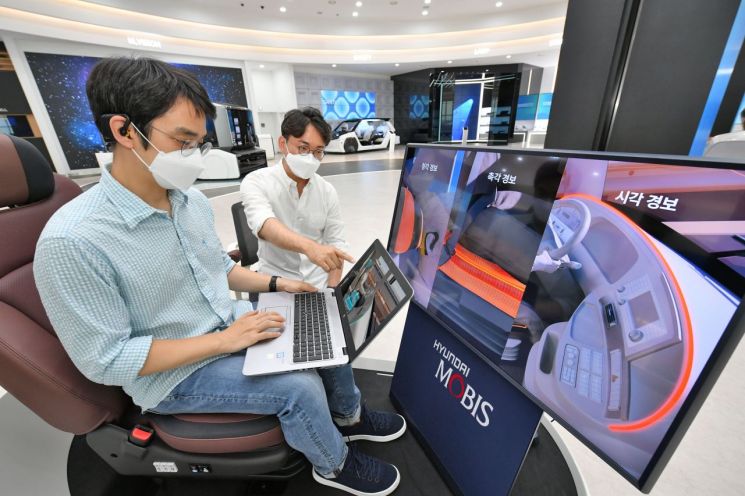
On the 21st, Hyundai Mobis announced that it will apply the world’s first brainwave-based healthcare technology, M.Brain, to public buses in Gyeonggi Province. M.Brain is a monitoring system that measures the driver’s condition in real time by wearing an earset-type sensor that detects brainwaves flowing around the ear.
M.Brain is linked with a smartphone application (app) to alert the driver of decreased attention. It also operates accident reduction technology that gives warnings through various sensory organs such as visual (LEDs around the driver’s seat), tactile (vibrating seat), and auditory (headrest speaker). Hyundai Mobis conducted three years of research and development (R&D), including the introduction of machine learning, to interpret what the brainwave signals mean.
Hyundai Mobis explained that it aims to lead the global vehicle healthcare market based on the database (DB) secured this time. Currently, vehicle healthcare technology is emerging as a key safety and convenience technology for passengers, called In-Cabin. At the stage of full autonomous driving, various healthcare and entertainment services for passengers are expected to appear separately from recognizing the driving environment outside the vehicle. The industry expects that ultimately, integrated brainwaves and other biometric signals will evolve into customized services that understand passengers’ psychology. For example, if a passenger’s biometric signals indicate a need for rest, an artificial intelligence (AI) virtual assistant would switch the vehicle interior to sleep mode. Moreover, in emergency situations concerning a passenger’s health, technology could be developed for the vehicle to autonomously find and arrive at the nearest emergency room.
In line with this, Hyundai Mobis has achieved results in developing vehicle healthcare technology using biometric signals. In 2018, it unveiled the driver detection and rescue system DDREM (Departed Driver Rescue & Exit Maneuver), which can prevent drowsy driving accidents. In 2019, it succeeded in developing the pupil-tracking driver monitoring system (DSW), and last year, the radar-based rear occupant alert system (ROA) for detecting infants and young children in the back seat. Bio healthcare technology will also be applied first to public transportation.
Seung-hwan Lee, head of Hyundai Mobis’s Advanced Research Sector, emphasized, “In addition to passenger safety and convenience technologies needed at the full autonomous driving stage, we have begun to achieve results in the digital healthcare field. Sustainable growth is expected in various fields such as smart cities and purpose-built vehicles (PBV) in the future.”
© The Asia Business Daily(www.asiae.co.kr). All rights reserved.
![Clutching a Stolen Dior Bag, Saying "I Hate Being Poor but Real"... The Grotesque Con of a "Human Knockoff" [Slate]](https://cwcontent.asiae.co.kr/asiaresize/183/2026021902243444107_1771435474.jpg)
















