If a reported property is traded to a third party after the report, contract cancellation
Real estate price manipulation... Ministry of Land prepares follow-up measures
Self-praise of 'housing stability support' in the Lease 3 Act
Experts say "Positive evaluation cannot be made with just one or two indicators"
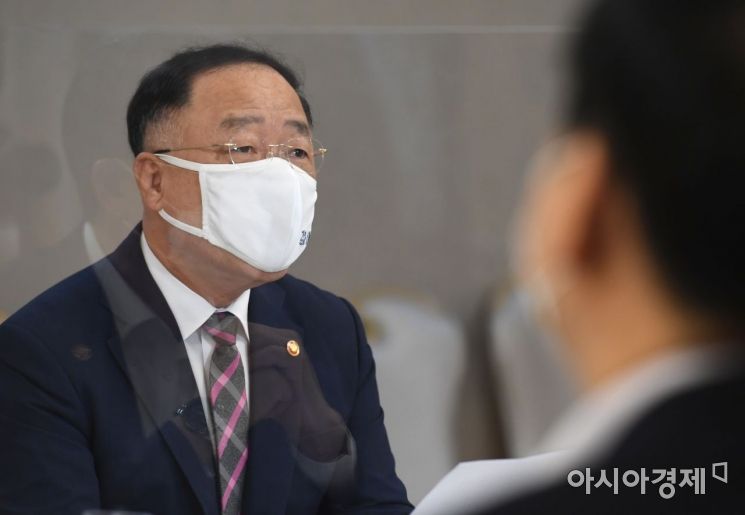 Hong Nam-ki, Deputy Prime Minister and Minister of Economy and Finance, is delivering opening remarks at the 26th Real Estate Market Inspection Meeting of Related Ministers held on the morning of the 21st at the Government Seoul Office in Jongno-gu, Seoul. Photo by Hyunmin Kim kimhyun81@
[Asia Economy Reporter Moon Jiwon] A case of manipulating real estate prices through false transaction reports, known as ‘real transaction price boosting,’ has been detected for the first time. The government has judged that such actions destabilize housing prices and plans to implement follow-up measures including criminal investigations and fines. Regarding the three lease laws, the government evaluated that they have helped stabilize housing for low-income households over the past year and explained that it will seek ways to firmly establish the system.
On the 21st, Hong Nam-ki, Deputy Prime Minister and Minister of Strategy and Finance, held the 26th Real Estate Market Inspection Meeting at the Government Seoul Office and announced, "We have detected actual cases of so-called ‘real transaction price boosting’ that manipulate prices through false transaction reports for the first time." The government has so far defined and cracked down on four major real estate market disturbances: △ illegal use of non-public/internal information △ price manipulation such as fictitious sales and false price quotes △ illegal brokerage and disruption such as false contracts △ illegal resale and fraudulent subscription.
Among these, ‘real transaction price boosting’ has been pointed out as needing regulation due to its significant market impact, but actual detection was rare. Through this investigation, the government confirmed illegal acts where licensed real estate agents and internal employees of sales companies raised prices through false transactions, sold to third parties, and then canceled existing contracts.
Regarding the three lease laws including the right to request contract renewal, the rent ceiling system, and the rent reporting system, Deputy Prime Minister Hong emphasized, "We confirmed that many tenants of Seoul apartments have benefited from the implementation of these systems." According to a government survey of the top 100 apartments in Seoul, the lease renewal rate was only 57.2% on average in the year before the system was implemented, but it rose to 77.7% as of last May. Hong added, "The average residence period of tenants increased from about 3.5 years to approximately 5 years," noting that "the housing stability of tenants has greatly improved."
However, the industry criticizes the government for once again highlighting only the positive aspects of the policy while ignoring the market reality. Since the implementation of the three lease laws, jeonse (long-term deposit lease) prices have skyrocketed, and currently, housing prices are rapidly rising not only in Seoul and the metropolitan area but also in local areas such as Jeju and Gangwon, yet the government has portrayed only a ‘rosy picture.’
Professor Shim Gyo-eon of Konkuk University’s Department of Real Estate said, "It is difficult to view the system as positive just because the renewal rate has increased," adding, "Many people are struggling due to the sharp rise in jeonse prices after the implementation of the three lease laws, and the government should not evaluate the market situation as improved based on one or two favorable indicators."
© The Asia Business Daily(www.asiae.co.kr). All rights reserved.

















