CS Wind and Other Wind Power Stocks Rise for Two Consecutive Days
US and EU Green Policies Boost... Foreign and Institutional Investors Also Buying
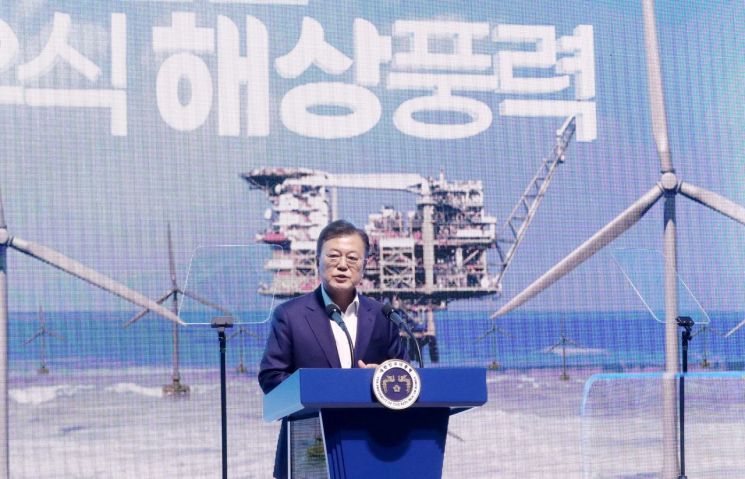 President Moon Jae-in attended and spoke at the 'Ulsan Floating Offshore Wind Power Strategy Report' held on the afternoon of May 6 at the 3D Printing Knowledge Industry Center in Nam-gu, Ulsan Metropolitan City. [Image source=Yonhap News]
[Asia Economy Reporter Minwoo Lee] As the heatwave continues, investment sentiment is pouring into the eco-friendly wind power industry. With favorable policies coinciding, foreign and institutional investors appear to be buying at low points.
On the morning of the 21st, CS Wind, considered the 'leader stock' related to wind power generation, recorded a price of 89,200 KRW, up 2.65% from the previous day. The day before, it closed with a 7.42% increase in a single day, marking the largest gain this year. Showing strength for two consecutive days, CS Wind's stock price surpassed the 89,000 KRW level for the first time since February 15.
Foreign investors' buying momentum was also strong. They purchased 26.4 billion KRW worth in a single day, ranking as the second-largest net purchase day this year. On this day, it also ranked 6th among all net purchase stocks. Additionally, institutions joined the buying spree, acquiring 23.8 billion KRW worth in one day, ranking 4th among all institutional net purchases. This is also the largest single-day net purchase record by institutional investors for CS Wind. Other wind power-related stocks such as Samkang M&T continued their upward trend following the previous day.
With abnormal weather signs such as the 'late monsoon' and heatwaves occurring consecutively, investment sentiment seems to be focusing on climate change-related stocks like wind power generation. Amid a flood of favorable policies domestically and internationally, low-price buying interest has flowed into CS Wind. According to major foreign media, the U.S. Democratic Party is discussing imposing a carbon border tax on developing countries that are passive in carbon reduction. The European Union (EU) already announced on the 14th that it will impose a carbon border tax from 2026 on five sectors with high carbon emissions, including steel and aluminum. Domestically, the announcement of about ten eco-friendly policies in the second half of the year, such as the 'Basic Plan for Hydrogen Economy Implementation (Hydrogen Economy Roadmap 2.0)' and the 'K-Circular Economy Innovation Roadmap,' is also a positive factor.
Researcher Byunghwa Han of Eugene Investment & Securities said, "All economic agents are pressured to reduce carbon emissions as quickly as possible, so domestic renewable energy companies such as wind power will expand their markets both domestically and internationally and continue high growth," adding, "In the next 10 years, competition for the 'Green Shift' will determine the survival of countries and companies."
© The Asia Business Daily(www.asiae.co.kr). All rights reserved.

















