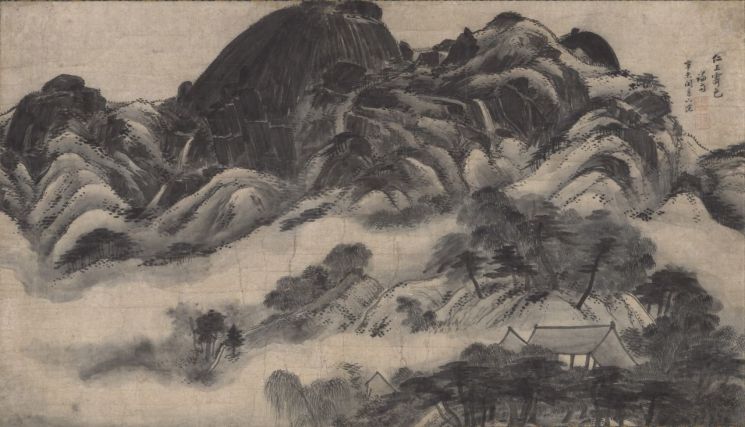
Inwangjesaekdo, Gyeumdong Bosal Samjon Ipsang, Cheonsu Gwaneum Bosaldo, etc.
The art collection of the late Lee Kun-hee, chairman of Samsung Group, is unveiled. It will be showcased in the special exhibition "The Lee Kun-hee Collection," held by the National Museum of Korea and the National Museum of Modern and Contemporary Art starting from the 21st. This large-scale exhibition is the first since the Samsung family donated over 23,000 pieces of Lee's collected works to the nation in April. A total of 135 masterpieces and artifacts, considered the cream of the collection, will be displayed. Six particularly notable pieces are highlighted here.
"Inwangjesaekdo (仁王霽色圖)" by Geomjae (謙齋) Jeong Seon (鄭?)?a powerful brushwork landscape painting
A true-view landscape painting (Jingyeong Sansu, depicting real mountains and rivers from the late Joseon period). It portrays the rocky cliffs of Inwangsan Mountain, soaked by a midsummer shower, with a heavy brushstroke and bold composition that convey a sense of weight. Completed using the "Jeokmukbeop" (積墨法) technique, which layers ink tones one after another, it captures the clouds lying low beneath the mountain and the dense ink-painted trees on a horizontally extended canvas, revealing a modern sensibility. The composition, which nearly fills the entire canvas, exemplifies Jeong Seon's favored "Milmiljibeop" (密密之法) technique, instantly immersing viewers into the scene. It is truly a masterpiece demonstrating the individuality and capability of traditional Korean painting.
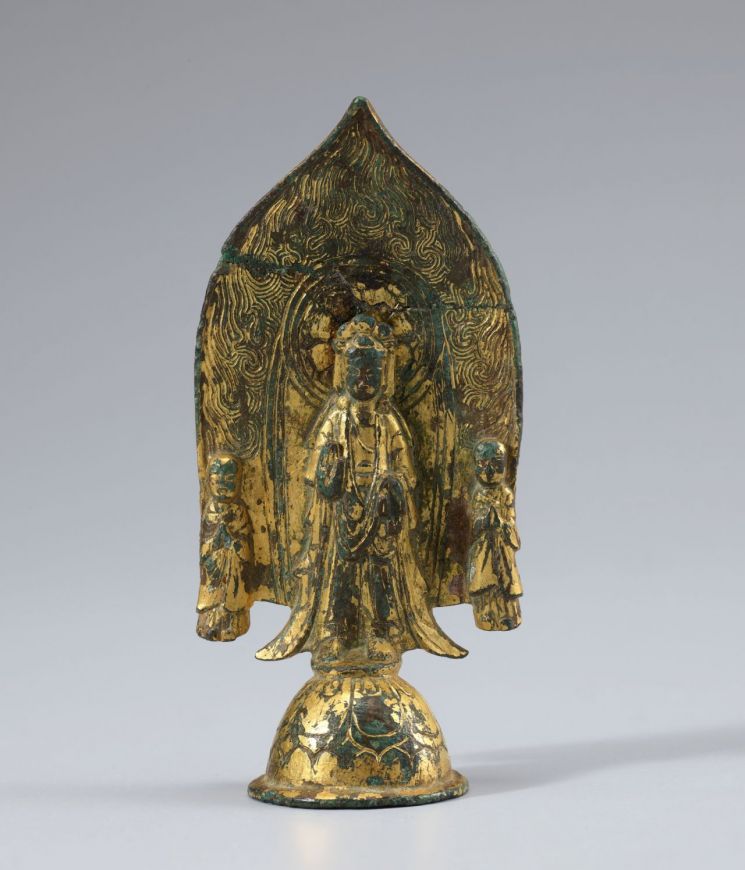
"Gilt-bronze Bodhisattva Triad Standing Statue (金銅菩薩三尊立像)" unearthed in Buyeo, Chungnam
A bodhisattva statue featuring a single halo (光背) with a triad of figures arranged within it. The Buddha body, halo, and pedestal are cast as one piece (Ilju Jobum, 一鑄造品). It is estimated to have been made in the late 6th century. The crossed X-shaped drapery, fin-like hanging folds on both sides, and the style of the crown reflect influences from the Northern Wei dynasty of China. The simplified folds and details give it a more rigid yet natural feel. The pedestal is engraved with large lotus flower patterns in double lines. These features are more delicately rendered than similar gilt-bronze statues such as the Jeongjiwonmyeong Gilt-bronze Shakyamuni Standing Statue or the Gilt-bronze Maitreya Bodhisattva Bansang.
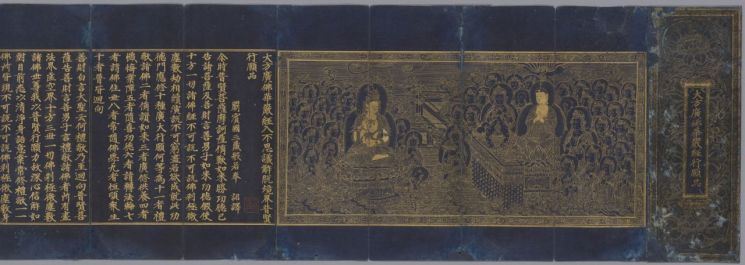 Gamgigeumni Daebanggwangbulhwahameongyeong Puhyeonhaengwonpum (Gamji Geumnyeo Daebanggwangbul Hwageomgyeong Puhyeon Haengwonpum)
"Gamji Geumni Daebangwangbul Hwaeomgyeong Bohyeonhaengwonpum (紺紙金泥 大方廣佛華嚴經普賢行願品)"?Avatamsaka Sutra handwritten in gold on indigo paper
A Buddhist scripture painted with gold powder mixed with animal glue. It is made to be unfolded like a folding screen. It is said that the late Goryeo period triple-grand official, Yeongin-gun Iyaseonbulhwa, published it to pray for his family’s peace. The cover depicts a treasure-flower pattern (Bosanghwamun, 寶相花文) in gold and silver mud, and the title "Daebangwangbul Hwaeomgyeong Haengwonpum" is written in gold powder. The transformation painting (Byeonsangdo, 變相圖), which symbolically illustrates the scripture’s content or doctrine, depicts the scene where the child Seonjae meets the Bodhisattva Bohyeon. It is considered the finest among Goryeo sutra manuscripts. On the back, the inscription "Haengwonpum Byeonsang Mungyeonghwa (行願品變相 文卿畵)" reveals that a person named Mungyeong painted it.
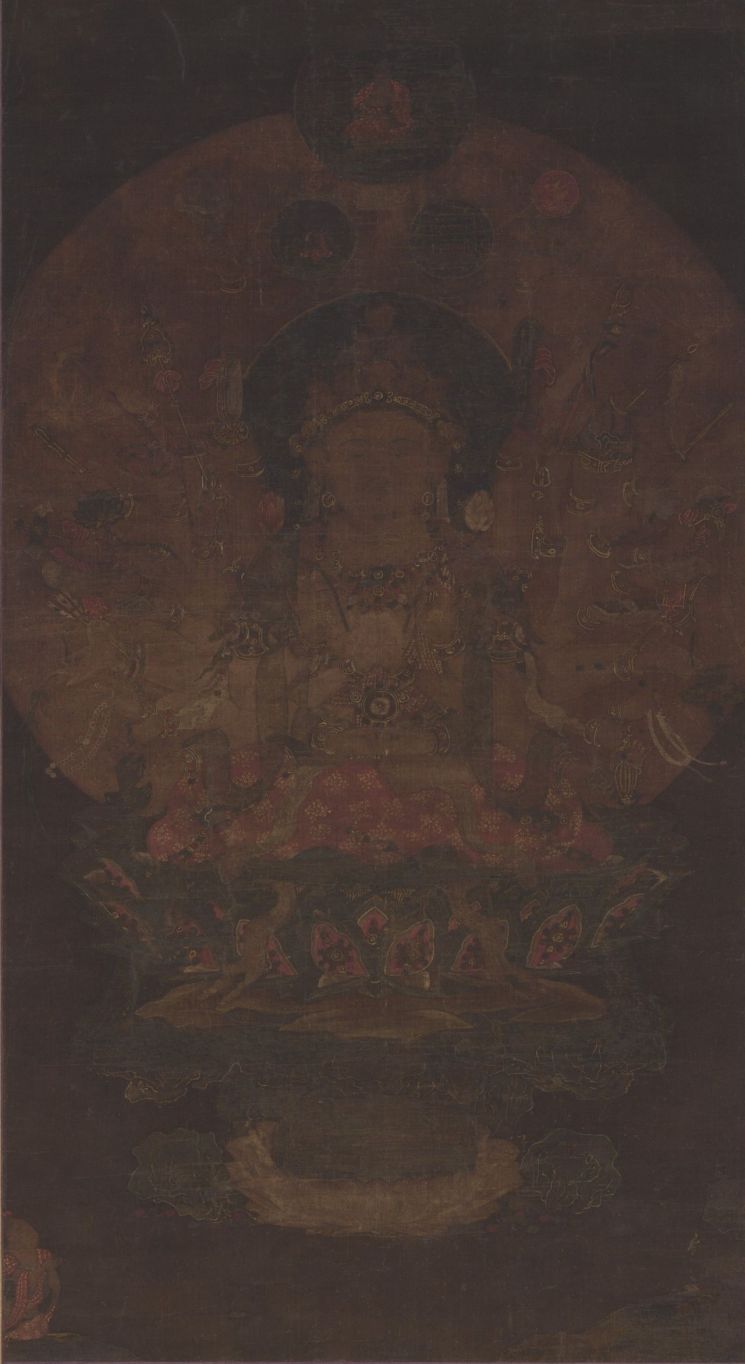
"Cheonsugwaneumbosaldo (千手觀音菩薩圖)"?Thousand-armed Avalokitesvara Bodhisattva with eyes on each hand
A Goryeo Buddhist painting symbolizing the compassionate power of the Thousand-armed Avalokitesvara who saves sentient beings. The Avalokitesvara holds about forty different ritual objects in its hands, with small hands bearing eyes densely arranged between them. Although the painting has significantly discolored over time, the Avalokitesvara iconography is depicted with vivid colors and delicate brushwork, demonstrating excellent artistic sense. The harmonious combination of diverse colors and gold mud (Geumni, 金泥), along with the dignified and refined expression style, reflects the typical characteristics of Goryeo Buddhist paintings, embodying both religiosity and artistry.
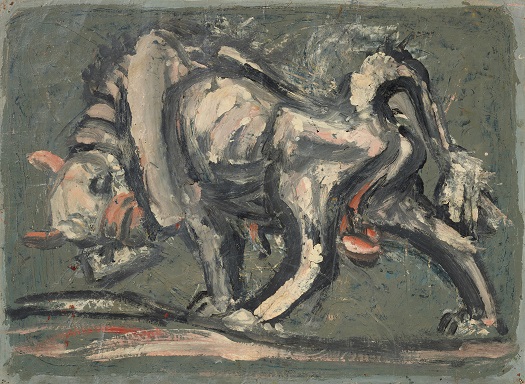
"White Ox"?Lee Jung-seop’s steadfast expression of national sentiment
A work that curators desperately sought during the 2016 Deoksugung exhibition "Lee Jung-seop: A Century of Myth" but had to give up as its whereabouts were unknown. The white ox is understood as Lee Jung-seop’s self-portrait and a symbol of the Korean people. The rough line drawing and the ox’s dynamic posture can be seen as an expression of personal emotion or interpreted as a national symbol reflecting the white-clad Korean ethnicity. The white ox in this work is neither aggressive nor weak. Lee Jung-seop painted it using the strong "Gureukbeop" (鉤勒法) technique, which outlines the form with lines first and then fills in color?a traditional method also found in Goguryeo tomb murals.
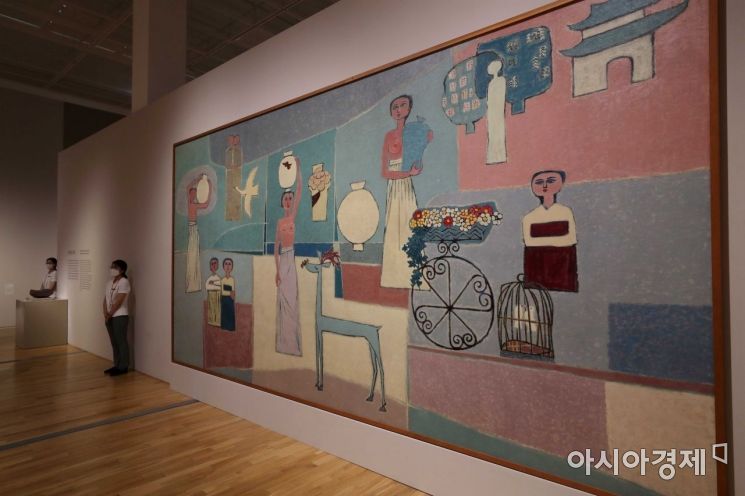 The press preview for the 'MMCA Lee Kun-hee Collection Special Exhibition: Masterpieces of Korean Art' was held on the 20th at the National Museum of Modern and Contemporary Art Seoul in Jongno-gu, Seoul. Kim Whanki's work 'Women and Jars' is on display. Photo by Moon Honam munonam@
"Women and Jar"?all the things Kim Whanki loved to paint
A representative work of Kim Whanki from the 1950s. On a pastel-toned background divided into color fields, simplified forms of deer, women, white porcelain jars, and deer are depicted. These are all elements Kim Whanki frequently painted. Especially, the half-naked woman holding a ceramic jar appears often in works from a similar period. Positioned frontally or in profile, she creates a refined atmosphere. The deer standing proudly in the center of the canvas seems to symbolize the artist himself. The composition of the color fields is considered to have influenced the later pointillist compositions that appeared in his works.
© The Asia Business Daily(www.asiae.co.kr). All rights reserved.
![Clutching a Stolen Dior Bag, Saying "I Hate Being Poor but Real"... The Grotesque Con of a "Human Knockoff" [Slate]](https://cwcontent.asiae.co.kr/asiaresize/183/2026021902243444107_1771435474.jpg)


















