DGIST Presents Electrical Stimulation and Monitoring Technology for Treating Neurological Disorders
Rich Potential for Enhancing High-Level Cognitive Functions and More
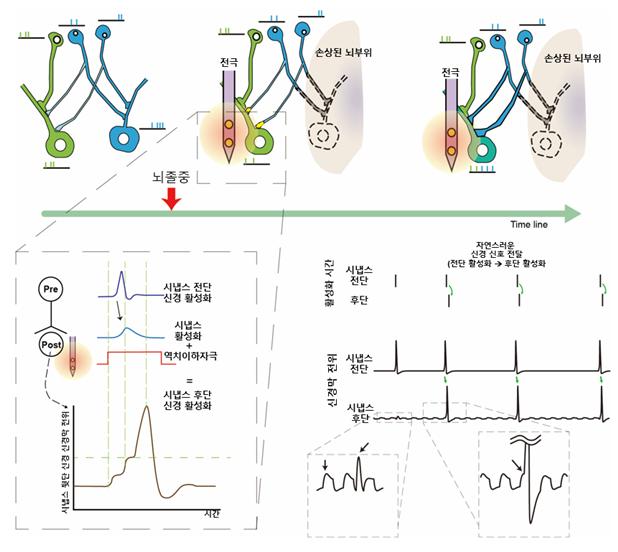 Overview of Brain Nerve Activation Regulation and Brain Plasticity Modulation through Subthreshold Stimulation. Image provided by DGIST
[Asia Economy Reporter Kim Bong-su] A technology that can treat brain neurological diseases such as stroke and Parkinson's disease through electrical stimulation has been developed.
Daegu Gyeongbuk Institute of Science and Technology (DGIST) announced on the 20th that a joint research team led by Ji-woong Choi, head of the Brain Engineering Convergence Research Center, Jae-eun Jang, professor of Information and Communication Convergence, and Moe-il Moon, professor of Brain and Cognitive Science, developed electrical stimulation and monitoring technology for healing brain neurological diseases. The research team explained, "It is expected to greatly assist the development of future brain neurological technologies by overcoming the technical limitations of existing brain stimulation treatment research."
Recently, as the average lifespan has increased, the incidence of various brain neurological diseases has also risen. Accordingly, brain neurological electrical stimulation methods for treating brain diseases and studying brain functions are gaining attention. Brain electrical stimulation is a technology that controls the activation of neurons through externally applied electrical stimulation.
Currently, most brain electrical stimulation research primarily uses suprathreshold stimulation, which induces artificial neural activation above the threshold. However, this stimulates unwanted areas within the complex brain neural network, causing side effects. When continuous stimulation is required, more battery capacity is needed, leading to increased surgical procedures for battery replacement inside the body, posing difficulties.
The research team devised a subthreshold electrical stimulation (STES) technology that stimulates brain neural activation at 30% of the power of threshold stimulation. Based on brain neural modeling, the team verified stability through various methods such as neural stimulation simulation and animal experiments. Through this, they developed for the first time a technology that induces brain neural plasticity, which plays an important role in stroke rehabilitation.
In particular, by applying stimulation at an intensity lower than the power required for neural activation, they confirmed that battery usage time can be extended and side effects minimized by stimulating only localized areas. The research team stated that this technology has rich potential not only to regulate neural activation and guide brain neural circuits in desired directions but also to enhance higher cognitive functions such as learning.
Center Director Ji-woong Choi said, "Unlike forced neural activation, this technology amplifies activation at the synaptic terminal to induce natural physiological neural activation, offering advantages of fewer side effects and lower energy consumption." He added, "It is expected to be actively utilized as a brain neural stimulation technology that overcomes the limitations of existing medical technologies through the convergence research results of experts in electronic engineering and brain science."
The research results were published online on the 8th in Scientific Reports, a sister journal of Nature.
© The Asia Business Daily(www.asiae.co.kr). All rights reserved.
![Clutching a Stolen Dior Bag, Saying "I Hate Being Poor but Real"... The Grotesque Con of a "Human Knockoff" [Slate]](https://cwcontent.asiae.co.kr/asiaresize/183/2026021902243444107_1771435474.jpg)
















