[Asia Economy Reporter Changhwan Lee] As the future car market, including eco-friendly vehicles and autonomous vehicles, is expected to grow rapidly, there is a claim that the training of specialized personnel to support this is urgent.
On the 19th, the Korea Automotive Research Institute released a report titled "Key Tasks for Future Car Industry Structure Transformation, Human New Deal," stating that the paradigm shift in the automotive industry is accelerating the market restructuring centered on future cars such as eco-friendly vehicles and autonomous vehicles.
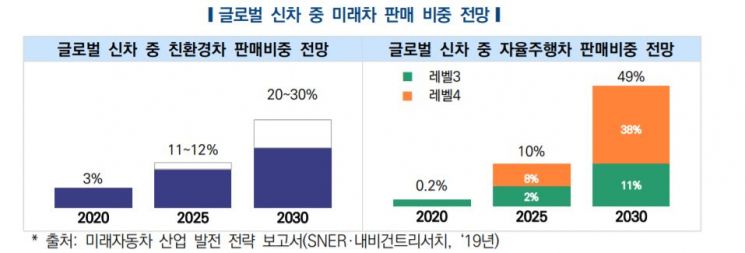
The institute predicted that the global eco-friendly vehicle market will grow to account for 20-30% (approximately 57.7 million units) of new car sales by 2030. It also forecasted that the Level 3 and above autonomous vehicle market will account for 49% of new car sales by 2030.
The Korean government has also set goals through the "2050 Carbon Neutral Declaration" and the "Future Car Expansion Strategy," aiming for a cumulative supply of 7.85 million eco-friendly vehicles by 2030 and commercialization of Level 4 autonomous vehicles by 2027.
Accordingly, although the current internal combustion engine-centered automotive industry structure is inevitably shifting to a future car-centered one, it is pointed out that the domestic automotive industry's response is weak. In particular, it is expected that difficulties will increase for small and medium-sized parts companies, which have less capacity to respond than completed car manufacturers.
Unlike the internal combustion engine parts industry, which has a localization rate of 99%, the future car parts industry lacks localization rate and technological level, and the related supply chain is weak.
Urgent Need for Future Car Human Resource Development
The institute emphasized that human resource development for future cars is urgent to support the successful transition of the automotive parts industry to future car business.
One of the main reasons why most companies, despite recognizing the necessity and growth potential of future cars, have not actively started research and development on future cars is the lack of specialized personnel.
Therefore, it was argued that the government and industry should actively cultivate new master's and doctoral-level personnel in key fields such as future car control and software (SW), and steadily promote support policies such as nurturing 90,000 talents in new growth industries including future cars.
It was also added that close support for industry transition to future car sectors such as software and artificial intelligence (AI), where labor demand is increasing through job conversion of current workers, as well as various approaches such as job-related education and university linkage, are required.
Jihyung Lee, a researcher at the Research Strategy Headquarters of the Korea Automotive Research Institute, said, "To solve the core task of manpower supply and training in the process of future car industry transformation, inclusive human resource policies are needed not only to cultivate new personnel in future car fields such as AI and SW but also to support job conversion of existing internal combustion engine personnel to future car roles."
© The Asia Business Daily(www.asiae.co.kr). All rights reserved.
![Clutching a Stolen Dior Bag, Saying "I Hate Being Poor but Real"... The Grotesque Con of a "Human Knockoff" [Slate]](https://cwcontent.asiae.co.kr/asiaresize/183/2026021902243444107_1771435474.jpg)











