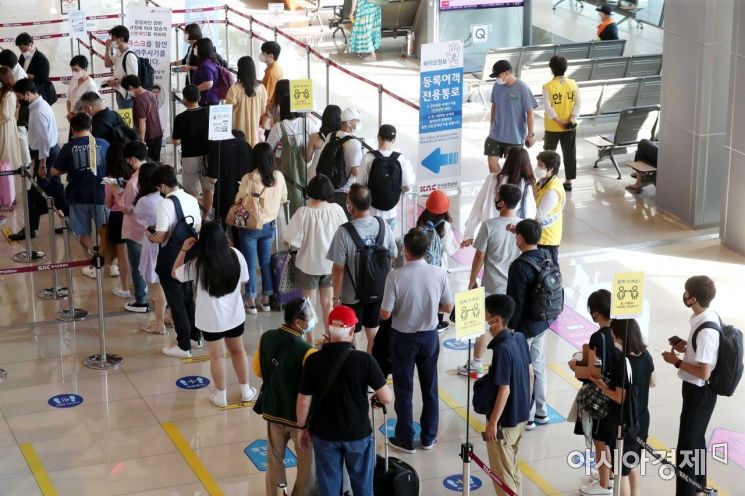
 The momentum of the 4th wave of COVID-19 is intensifying. While around 1,000 patients are being reported in the metropolitan area, the number of confirmed cases in non-metropolitan regions has also risen to the 400s, showing signs of nationwide spread. On the 16th, the domestic terminal at Gimpo Airport in Gangseo-gu, Seoul, was bustling with travelers. Photo by Moon Honam munonam@
[Asia Economy Reporter Seo So-jeong] As the domestic COVID-19 '4th wave' shows signs of widespread expansion nationwide, the government is pushing to limit private gatherings to 'fewer than 5 people' in non-metropolitan areas. An announcement regarding the private gathering standards for non-metropolitan areas is expected as early as the 18th.
On the 16th, Lee Ki-il, the 1st Controller of the Central Disaster and Safety Countermeasures Headquarters (Director of Health and Medical Affairs at the Ministry of Health and Welfare), stated at the regular COVID-19 briefing, "Recently, 75% of COVID-19 confirmed cases have occurred in the metropolitan area and 25% in non-metropolitan areas. While the metropolitan area is stagnant, cases are gradually increasing in non-metropolitan areas," adding, "There will be a meeting this afternoon with local governments to discuss the ('ban on private gatherings of 5 or more people' unification) plan, and we will listen to opinions sufficiently."
Earlier that morning, during the Central Disaster and Safety Countermeasures Headquarters meeting, Prime Minister Kim Boo-kyum said, "Currently, the metropolitan area is under Level 4 social distancing, but in non-metropolitan areas, the allowed number of private gathering participants varies by region?4, 6, or 8 people?causing confusion," and requested, "Local governments should discuss unifying the private gathering limit in non-metropolitan areas to 4 people."
At the 3:30 PM video conference meeting of bureau-level officials that day, many local governments agreed to the request to ban private gatherings of 5 or more people, but some expressed opposition. Gwangju, Jeonnam, and Gangwon decided to follow the Central Disaster and Safety Countermeasures Headquarters' decision, while Gyeongnam requested support measures to compensate for losses suffered by self-employed individuals.
In Chungnam, many basic local governments asked for consideration of regional characteristics, and Daegu reportedly hopes to maintain the current system. Daejeon, Sejong, and Chungbuk are already enforcing the ban on private gatherings of 5 or more people, and Jeju will apply this measure starting on the 19th.
If the ban on gatherings of 5 or more people is applied, non-metropolitan areas will effectively return to the pre-restructured social distancing state. Accordingly, there are criticisms that the forced introduction of the new social distancing system in non-metropolitan areas two weeks ago was premature, unlike in the metropolitan area.
Regarding this, Son Young-rae, head of the Social Strategy Division at the Central Disaster and Safety Countermeasures Headquarters, explained, "Regulation of private gatherings is a measure to regulate individual quarantine behavior. Since these aspects are mixed, discussions with local governments are underway to unify them as much as possible," adding, "What is currently being discussed is not an issue concerning the entire social distancing system."
© The Asia Business Daily(www.asiae.co.kr). All rights reserved.

















