The Highest Nationwide Price Sold at SK Energy Gas Station in Jung-gu, Seoul
Gasoline Prices to Rise for a While... Expected to Stabilize from Early August
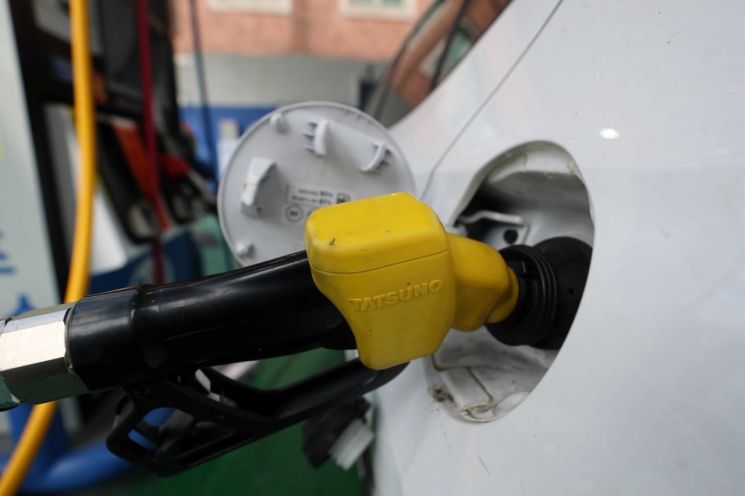 According to Opinet, the oil price information service of Korea National Oil Corporation, as of 11 a.m. on July 16, the price of gasoline sold at the SK Energy gas station located in Jung-gu, Seoul, was recorded at 2,499 KRW per liter. This is the highest price not only in Seoul but also nationwide. A gas station in downtown Seoul. Photo by Mun Ho-nam munonam@
[Asia Economy Reporter Hwang Yoon-joo] The average price of gasoline sold at gas stations in the Seoul area has surpassed 1,700 KRW per liter for the first time in 2 years and 9 months, with a gas station selling gasoline at 2,499 KRW per liter emerging. Considering that international oil prices have continued a sharp upward trend since June 4 (Dubai crude basis) when they surpassed $70, domestic gasoline prices are expected to rise for at least another two weeks.
According to the Korea National Oil Corporation's oil price information service Opinet on the 16th, the gasoline selling price at SK Energy located at 30 Tongil-ro, Jung-gu, Seoul, recorded 2,499 KRW per liter as of 10 a.m. that day. This gas station was found to have the highest gasoline selling price not only in Seoul but nationwide based on Opinet data.
The average gasoline price at Seoul gas stations was 1,696.6 KRW per liter last week and was recorded at 1,712.4 KRW per liter this week (July 12?16 morning). It is the first time in 2 years and 9 months (second week of November 2018) that the average gasoline price at Seoul gas stations has surpassed 1,700 KRW per liter.
The sharp rise in gasoline prices in the Seoul area is due to the faster-than-expected increase in international oil prices. Until recently, expectations that oil demand would exceed supply were driven by upward revisions of the European economic outlook, the failure to reach an agreement on easing production cuts after OPEC+ (Organization of the Petroleum Exporting Countries (OPEC) member countries and non-OPEC consultative group), and a decrease in U.S. crude oil inventories. These factors caused international oil prices to rise sharply, and the gasoline price in Seoul, the most expensive area domestically, also surpassed an average of 1,700 KRW per liter. If this trend continues, domestic oil prices are expected to maintain an upward trend for another 2 to 3 weeks.
However, the upward trend is expected to slow down from early next month. This is due to the assessment that the recovery of oil demand worldwide will be delayed more than expected because of the spread of the COVID-19 Delta variant. Also, as OPEC+ has made progress in discussions on production cuts, Dubai crude slightly declined to $72.23 per barrel after its recent peak (on the 6th), and West Texas Intermediate (WTI) also fell to $71.65 after its peak (on the 13th).
Cho Sang-beom, head of the public relations team at the Korea Petroleum Association, said, "Domestic gasoline prices reflect international market prices with a 2 to 3 week lag, so prices will rise additionally for 2 to 3 weeks," but added, "Since OPEC+ agreed to ease production cuts yesterday and international oil prices are falling, if international gasoline prices continue to decline, domestic prices are likely to stabilize."
© The Asia Business Daily(www.asiae.co.kr). All rights reserved.
![Clutching a Stolen Dior Bag, Saying "I Hate Being Poor but Real"... The Grotesque Con of a "Human Knockoff" [Slate]](https://cwcontent.asiae.co.kr/asiaresize/183/2026021902243444107_1771435474.jpg)
















