Revised Industrial Accident Compensation Act Enforced... Mandatory Employment Insurance Enrollment for Riders
Industry "Income Exposure Burden... Surge in Departure of Riders with Side Jobs"
Ruling and Opposition Parties Push Bills to Protect Riders and Strengthen Platform Companies' Responsibility
Consumer Burden Increases Unless Platform Fees Are Reduced
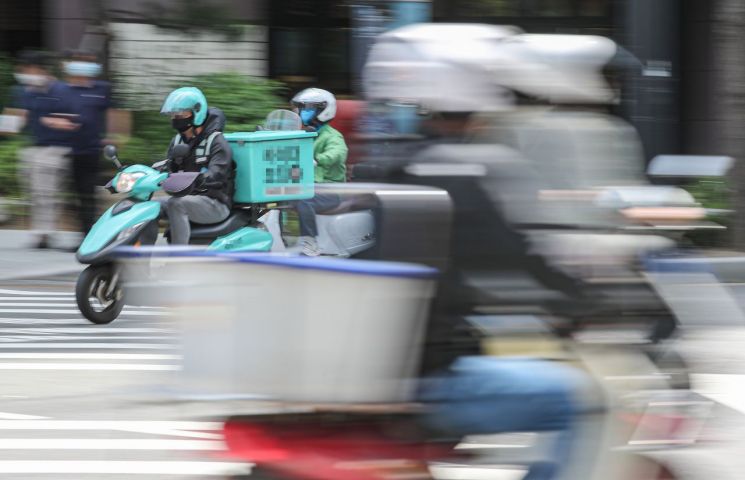
Mr. A, who runs a pizza shop in Changwon, Gyeongnam, heard last month from a delivery agency that the basic delivery fee would increase from 3,000 won to 3,500 won. With additional charges for nighttime and rainy weather surcharges, the delivery fee can increase by up to 1,400 won per order. This is due to the increased burden on business owners following the strengthened mandatory subscription to industrial accident insurance for delivery workers (riders) starting from the 1st of this month. The problem is that delivery agencies in this region are all raising their delivery fees simultaneously. Another delivery agency argued, "In a situation where riders are already scarce, a competitor raised their delivery fees first, and we had no choice but to raise ours to avoid losing riders." Mr. A plans to cover the increased delivery fees out of his own pocket for now, but he feels uncertain about how long this will be sustainable.
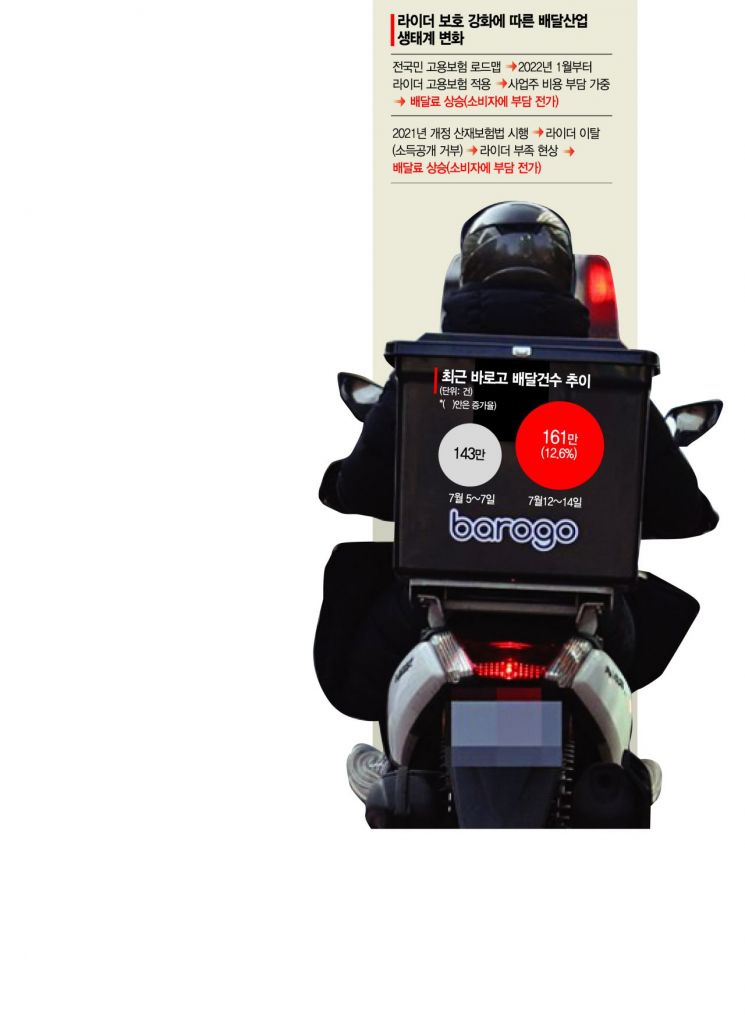
As the government and the National Assembly have rolled up their sleeves to protect riders' rights, an unintended consequence of 'delivery fee increases' is emerging in the industry. This is the result of looking at only one side without understanding the delivery platform market, which suffers from a chronic shortage of riders. According to the law of supply and demand, if supply cannot keep up with demand, prices (delivery fees) inevitably rise. With the simultaneous implementation of bills strengthening platform business owners' responsibilities and the industrial accident and employment insurance subscription system for riders, the cost burden passed on to consumers is expected to increase.
Due to the resurgence of COVID-19, social distancing in the metropolitan area was raised to level 4 starting from the 12th, causing a surge in delivery order demand. According to the delivery agency Barogo, the number of completed deliveries increased by 12.6%, from 1.43 million orders over three days from the 5th to the 7th, to 1.61 million orders from the 12th to the 14th. A Barogo official stated, "We have already surpassed 100 million delivery completions recorded last year in the first half of this year," adding, "Due to the impact of the COVID-19 resurgence, delivery orders are expected to reach a record high this month."
The problem is that since the revised Industrial Accident Insurance Act took effect on the 1st of this month, rider attrition is accelerating. The reasons for exemption from industrial accident insurance application for special-type workers (teukgo) and platform workers have been limited, effectively making industrial accident insurance subscription mandatory. For example, for a rider with a monthly wage of 1,599,400 won, applying the industrial accident insurance rate of 1.9% results in an insurance premium of 30,380 won, which is split evenly between the rider and the business owner. However, the income tax burden due to income disclosure is greater than the monthly insurance premium. An industry insider explained, "When riders subscribe to industrial accident insurance, their income is automatically recorded, and they have to pay income tax. Until now, in a situation where riders were scarce, branch managers had no choice but to accept riders' covert requests not to report income, but now that is no longer possible."
The rider supply shortage is even more severe in provincial areas. He said, "It has become even harder to find riders in provinces with smaller populations than the metropolitan area," adding, "Many two-job riders who worked mainly in factories during the day and did delivery work in the evening are quitting due to the burden of income exposure."
The government's 'National Employment Insurance Roadmap' plans to include riders as mandatory subscribers to employment insurance starting from January next year, raising concerns about additional cost burdens. Unless platform companies voluntarily reduce their commissions, delivery fees will inevitably rise. Another delivery agency official predicted, "Platform companies are required to report insured qualifications and withhold and pay employment insurance premiums. With strengthened government regulations, the vicious cycle of rider shortages and delivery fee increases will repeat."
Both ruling and opposition parties have introduced legislation to strengthen platform business owners' responsibilities to protect rider safety and rights. If these bills pass the National Assembly, they are expected to have a significant impact on the delivery market. On the 14th, a public hearing was held at the National Assembly's Environment and Labor Committee to discuss the Platform Worker Protection Act (led by Representative Jang Cheol-min of the Democratic Party) and the Special-Type Worker Protection Act (led by Representative Im I-ja of the People Power Party), revealing differences between labor and management. The Platform Worker Protection Act focuses on protecting workers' rights and strengthening business owners' responsibilities by prioritizing labor laws based on the worker status of platform workers. The Special-Type Worker Protection Act mainly includes legal protections such as 30-day prior notice before contract termination and prohibition of discriminatory treatment for special-type and platform workers.
At the hearing, Professor Kwon Oh-sung of Sungshin Women's University stated, "I believe the term 'special-type worker' itself should disappear," expressing the view that special-type workers should be protected within the category of workers. On the other hand, Lee Jun-hee, a team leader at the Korea Employers Federation, criticized, "This is regulation for the sake of regulation that does not reflect reality at all," calling it "a very outdated, 20th-century regulation." He pointed out, "It is impossible to predict in which direction and to what extent cost pass-through will occur."
© The Asia Business Daily(www.asiae.co.kr). All rights reserved.



















