 As of mid-October 2020. Since then, Assemblyman Jo Myeong-hee of the People Power Party also took the lead in proposing an amendment to the Telecommunications Business Act aimed at prohibiting app market operators from forcing payment methods and resolving related disputes.
[Asia Economy Reporter Joselgina] On the 15th, the National Assembly's Science, Technology, Information and Broadcasting and Communications Committee will discuss the 'Google Gapjil Prevention Act (Amendment to the Telecommunications Business Act)' to block Google's unilateral fee policy changes. The ruling party, which holds the majority of seats, has clearly stated its intention to pass the bill within this month even without the opposition's cooperation, so it is expected that the decision on whether to put the bill on the agenda for the plenary session will be made on this day.
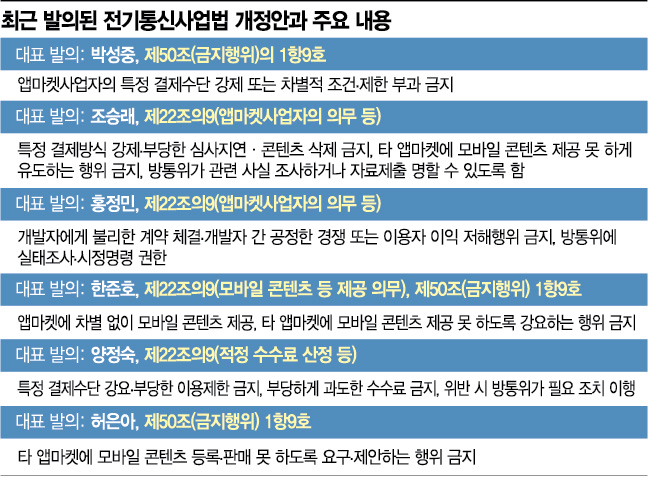
The Google Gapjil Prevention Act, which was the biggest issue in last year's government audit, currently has seven bills pending. The main points prohibit acts of 'gapjil' (abuse of market dominance) such as forcing developers to use specific payment methods by app market operators or inducing them not to register content on other app markets.
◆Agenda Adjustment Committee Today...Decision on Plenary Session Agenda
According to the National Assembly's Science and Technology Committee, the committee will hold the second meeting of the Agenda Adjustment Committee at 2 p.m. on this day to decide whether to put the Google Gapjil Prevention Act on the plenary session agenda.
If the agenda referred to the Agenda Adjustment Committee is approved by two-thirds or more of the members, it can be put on the plenary session agenda. Currently, among the six members of the committee, Democratic Party lawmakers Jo Seung-rae, Jeong Pil-mo, Han Jun-ho, and independent lawmaker Yang Jeong-suk have expressed support, making the bill likely to pass. Opposition People Power Party lawmakers are refusing to participate in the meeting due to the TBS audit request issue, so they are expected to be absent again, as in the first Agenda Adjustment Committee meeting.
If the Agenda Adjustment Committee approves the bill, it will then be sequentially submitted to the plenary session, the Legislation and Judiciary Committee, and the plenary session. Currently, it is expected that the plenary session, Legislation and Judiciary Committee, and plenary session will pass the bill smoothly.
The ruling party plans to pass the bill within this month even if it has to do so alone, as the timing for enforcing in-app payments is approaching. Considering the time required for enacting enforcement ordinances, the bill must be passed within this month to complete legislation before October. Earlier, Google decided to enforce in-app payments (payments within apps) for app developers listed on its app market, Google Play, starting in October, taking a whopping 30% commission in the process.
A total of seven bills were proposed last year in the National Assembly's Science and Technology Committee to block Google's unilateral fee gapjil. Unlike the Democratic Party, which insists on swift processing, the opposition People Power Party has expressed a cautious stance, citing concerns about trade friction and overlapping regulations.
However, recently, the atmosphere that the bill's passage is urgent has spread. Even within the opposition, there is a sentiment that the in-app payment introduction should not be left as is. The burden from Google's fee increase will inevitably return to domestic creators and consumers of webtoons, web novels, and the entire digital content industry.
◆Reviewing the Bills Under Discussion...Ban on In-App Payments, Equal Access to Content, etc.
The core of the existing bills is the ban on in-app payments. The bills proposed in the second half of last year by lawmakers Park Seong-jung, Jo Seung-rae, Yang Jeong-suk, and Jo Myeong-hee include provisions preventing app market operators from forcing specific payment methods. The bills by Jo Seung-rae, Han Jun-ho, and Heo Eun-ah include prohibitions on app market operators forcing or inducing app operators not to register on other app markets.
Additionally, the bills by Jo Seung-rae and Hong Jeong-min establish legal grounds for the Korea Communications Commission to conduct fact-finding investigations, request data submission, or issue corrective orders. Furthermore, Han Jun-ho's bill reflects the concept of 'equal access to content,' requiring mobile content to be provided without discrimination to all app markets when content from mobile content operators above a certain scale is provided to a specific app market operator.
Currently, the Science and Technology Committee has completed an integrated working draft centered on the seven previously proposed bills. The Agenda Adjustment Committee will discuss whether to put this bill on the plenary session agenda or to submit it after partial amendments. A committee official said, "Since it has been discussed for a long time, the likelihood of approval is high."
Accordingly, the integrated bill is expected to focus on prohibiting forcing specific payment methods in app markets and banning app market operators from forcing or inducing registration restrictions on other app markets. Measures such as temporarily introducing or recommending the 'equal access to content' concept, which was introduced to create fair competition conditions for new broadcasters during the launch of IPTV, into the app market may also be included.
This reflects a sense of crisis that proper competition is impossible with market power alone. Due to Google Play's overwhelming dominance, with a domestic market share of 70%, the domestic app market has long become a tilted playing field. The committee is considering introducing this only for operators above a certain scale, excluding small and medium developers, to expand user choice and create an environment for fair competition.
Concerns about potential trade friction with the United States, which some feared, are also assessed to be low. Earlier, Regina Cobb, a member of the Arizona House of Representatives who proposed a similar bill in the U.S., and the Coalition for App Fairness (CAF) in the U.S. have distanced themselves from concerns about trade friction due to the passage of the Google Gapjil Prevention Act. The Korea Communications Commission, responsible for protecting internet service users, has also decided to support the bill's passage in the National Assembly. The Ministry of Science and ICT has also expressed its willingness to actively accept it.
© The Asia Business Daily(www.asiae.co.kr). All rights reserved.
![User Who Sold Erroneously Deposited Bitcoins to Repay Debt and Fund Entertainment... What Did the Supreme Court Decide in 2021? [Legal Issue Check]](https://cwcontent.asiae.co.kr/asiaresize/183/2026020910431234020_1770601391.png)
















