Pulmuone's 'Jeongmyeon' and 'Jeong Bibim Myeon'
Rapidly Rising Awareness Through Word of Mouth
Samyang's 'Delicious Ramen' Counterattack
Four-Way Battle with Ottogi and Nongshim
[Asia Economy Reporter Seungjin Lee] Competition in the vegan (vegetarian) market within the food industry is heating up. The vegan population is rapidly increasing, especially among the MZ generation (Millennials + Generation Z), and with growing interest in health due to COVID-19, more consumers are paying attention to vegan foods.
Pulmuone’s Vegan Strategy Pays Off
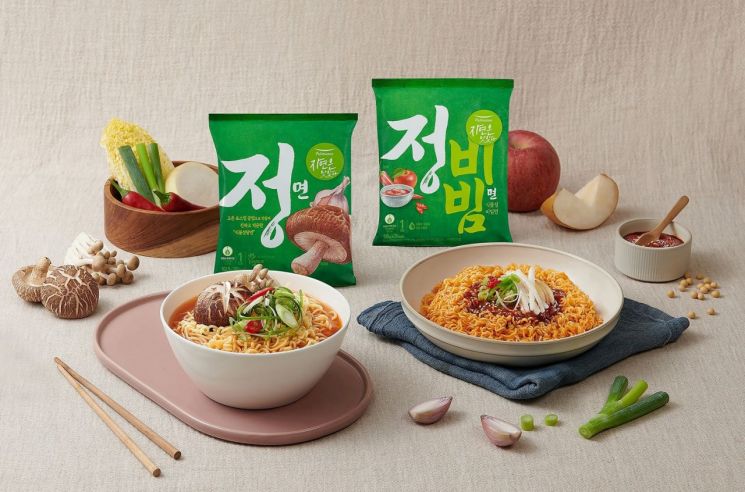
On the 14th, Pulmuone announced that sales of its vegan-certified ‘Jeongmyeon’ and ‘Jeong Bibimmyun’ have surpassed 5 million packs. Jeongmyeon, launched in August last year, reached cumulative sales of 2 million packs within 4 months and exceeded 4.2 million packs this month. ‘Jeong Bibimmyun’ recorded sales of 1 million packs in about 3 months. This rapid increase in recognition is attributed to word-of-mouth spreading first among vegans. Both products have obtained vegan food certification from the Korea Vegan Certification Institute, distinguishing them from existing vegetarian ramen.
In particular, Jeongmyeon has shown steady monthly sales since its launch, displaying a different pattern from typical new products. Most new products experience a sharp increase in sales for about six months after launch, then sales drop to less than half. However, in the context of heightened health awareness due to COVID-19, obtaining vegan certification has increased consumer trust, which is considered a key factor.
The Korea Vegan Certification Institute is an official organization responsible for vegan certification and assurance of food and cosmetics. Vegan certification is granted only to products that do not use animal-derived raw materials, are managed to prevent cross-contamination, and have not been tested on animals. The certification process is notably more stringent than overseas vegan certifications.
Samyang Foods also responded with the launch of vegan ramen. In March, Samyang Foods released ‘Delicious Ramen Vegan,’ which also received vegan certification from the Korea Vegan Certification Institute. They applied eco-friendly packaging to target environmentally conscious younger generations. As a result, the vegan ramen market has formed a four-way competition including Ottogi’s ‘ChaeHwang’ and Nongshim’s ‘Vegetable Ramen,’ both registered with the UK Vegan Society.
Vegetarian Brands Launched One After Another
Recently, Pulmuone established a ‘Plant-based Food Business Strategy’ and plans to launch new products in six categories: ▲plant-based high-protein foods ▲plant-based low-carbohydrate foods ▲plant-based meat ▲plant-based beverages and drinkable foods ▲plant-based fermented dairy ▲plant-based convenience foods. Pulmuone, which has already released vegan kimchi and vegan-certified alternative yogurt, plans to introduce about 20 additional new products including ‘plant-based meat.’
Nongshim Group began full-scale operations of its ‘Vege Garden’ business earlier this year. Vege Garden is a brand that applies plant-based meat manufacturing technology developed by Nongshim Research Institute and Taekyung Nongsan, a Nongshim Group affiliate, to ready-to-eat foods. Vege Garden offers a total of 27 product lineups including plant-based meat, frozen prepared foods, instant convenience foods, sauces, seasonings, and plant-based cheese, with plans to continuously expand plant-based products.
Korea Yakult has entered the vegan market with ‘Harusikdan Grain.’ Harusikdan uses only plant-based ingredients and has received vegan certification from the Korea Vegan Certification Institute. Korea Yakult plans to expand its product range to strengthen its position in the vegan market.
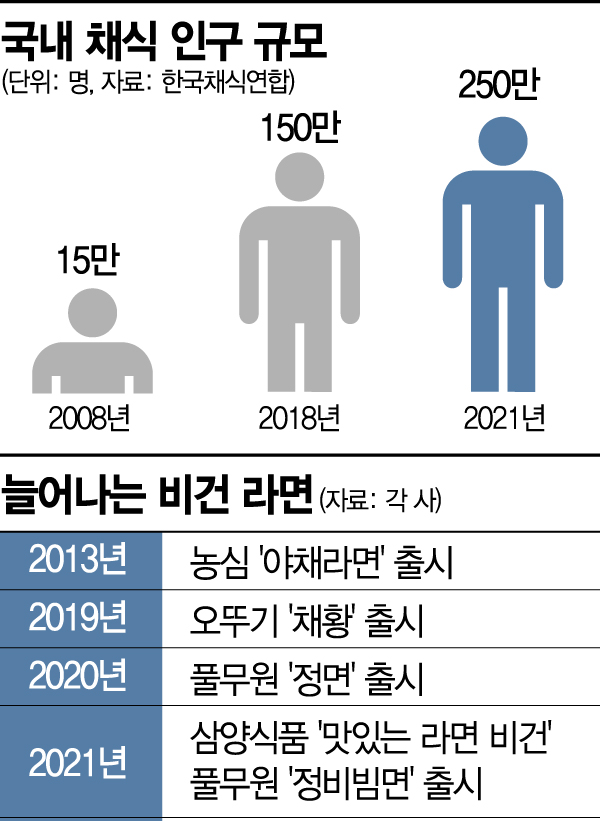
Meanwhile, according to the Korea Vegetarian Union, the domestic vegetarian population increased tenfold from 150,000 in 2008 to 1.5 million in 2018. Recently, it is estimated to be about 2.5 million, roughly 4% of the total population. Including ‘flexitarians,’ who usually do not eat meat but consume it in unavoidable situations such as company dinners, the vegetarian population is presumed to be even larger.
© The Asia Business Daily(www.asiae.co.kr). All rights reserved.
![Clutching a Stolen Dior Bag, Saying "I Hate Being Poor but Real"... The Grotesque Con of a "Human Knockoff" [Slate]](https://cwcontent.asiae.co.kr/asiaresize/183/2026021902243444107_1771435474.jpg)

















