Ministry of Industry Holds 3rd Meeting of Carbon Neutral Fuel (e-fuel) Research Association
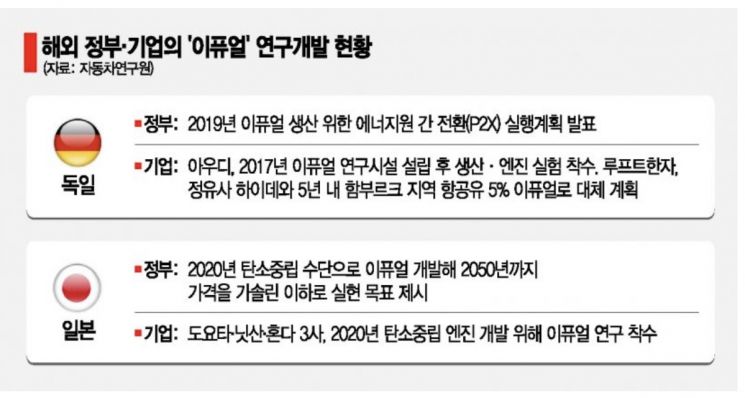
[Sejong=Asia Economy Reporter Kwon Haeyoung] The public and private sectors have joined forces to develop carbon-neutral fuel (e-fuel) for internal combustion engine vehicles. The Carbon Neutrality Committee, the government-wide control tower for carbon neutrality policies, is deliberating whether to completely phase out internal combustion engine vehicles by 2050. Using eco-friendly e-fuel can realize carbon neutrality while maintaining the internal combustion engine vehicle ecosystem.
On the 14th, the Ministry of Trade, Industry and Energy held the 3rd meeting of the e-fuel research group via an online video conference. Launched in April, this research group meets regularly every month to review and discuss e-fuel, which is emerging as a means to achieve carbon neutrality.
At the 3rd meeting, the Korea Petroleum Management Service shared 'Cases of applying synthetic fuel to internal combustion engines,' and Hyundai Motor Company presented on 'The effectiveness of e-fuel from the perspective of internal combustion engines.' E-fuel is compatible with existing internal combustion engine vehicle infrastructure, making it highly useful as a carbon-neutral fuel until electric vehicle infrastructure is fully established. However, the current technology level results in high production costs, which is a drawback in terms of economic feasibility.
The Korea Energy Agency shared proposals from the petroleum and transportation industries regarding the promotion of e-fuel through a presentation on 'Policy tasks for the expansion of e-fuel,' including research and development (R&D) support and the introduction of incentives.
Joo Young-jun, Director of the Energy Resources Office at the Ministry of Trade, Industry and Energy, stated, "E-fuel technology can contribute to carbon neutrality not only in the transportation sector but also in other industries such as petrochemicals and power generation. We will conduct thorough reviews from various perspectives, including comparisons and analyses with other alternative fuels and technologies, to identify the most efficient means to achieve carbon neutrality."
Previously, at the first meeting of the e-fuel research group, discussions were held on ▲global trends and domestic conditions of e-fuel ▲advantages and development potential of e-fuel. Opinions were also expressed that CO2 capture methods and economic feasibility improvements are key challenges for the commercialization of e-fuel. At the second meeting, discussions focused on ▲CO2 capture methods ▲securing production economic feasibility, and the need for government R&D support to improve policies such as RFS and technology enhancement was raised.
© The Asia Business Daily(www.asiae.co.kr). All rights reserved.

















