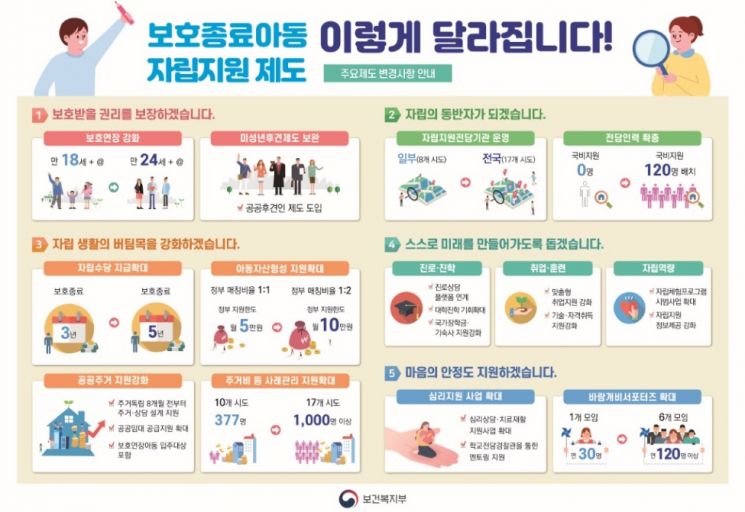
 Infographic on Measures to Strengthen Support for Children Aging Out of Care (Photo by Ministry of Health and Welfare)
[Asia Economy Reporter Chunhee Lee] The age at which child protection ends will be extended from the current 18 years to up to 24 years. To support the successful independence of children aging out of care, independence allowances will be paid for up to five years after leaving care.
On the 13th, the government announced the "Strengthening Support Measures for Children Aging Out of Care" jointly with related ministries at the Cabinet meeting chaired by Prime Minister Kim Boo-kyum. It is estimated that about 2,500 children exit care annually at the age of 18. However, these individuals show lower indicators compared to their peers in terms of monthly wages, unemployment rates, university enrollment rates, and suicide ideation rates.
Therefore, the vision of this plan is "Five Years on the Path to Independence for Children Aging Out of Care, Accompanied by Warm and Inclusive Policies," aiming to enable these children to prepare for independence on an equal starting line in life.
The biggest change is the extension of the protection age. The current age of 18 at which protection ends will be institutionalized to allow extension up to 24 years old based on the individual's will. Additionally, if children leave facilities and live independently during the extended protection period for university enrollment or job preparation, a plan to directly provide livelihood benefits to them is also being considered. The intention is to guarantee the right to protection so that children aging out of care can prepare for independence while still receiving state protection during the transition.
Monthly independence allowances of 300,000 KRW to secure income safety nets for children aging out of care will also be expanded. Currently, payments are made only within three years after leaving care, but starting next month, the payment period will be extended to within five years after leaving care. Furthermore, the government matching rate for the Didim Seed Fund, which supports asset formation, will be increased from 1:1 to 1:2 starting next year, and the support limit will be raised to 100,000 KRW per month. As a result, the average accumulated amount is expected to increase from the current 4.47 million KRW to about 10 million KRW. In addition, local governments are recommended to gradually expand the independence settlement funds, currently at a minimum of 5 million KRW, to strengthen initial settlement support.
In terms of housing safety nets, the supply of rental housing will be expanded. A total of 2,000 public rental housing units will be supported by next year. If children must leave due to unavoidable circumstances such as military service, the period will not be counted within the five-year protection extension period, improving the system. Also, children whose protection is extended from 18 to 24 years old will be included as eligible for public housing support, enabling rental housing supply.
To support this, dedicated independence support institutions and personnel will be expanded. Currently, these institutions operate only in eight metropolitan cities including Seoul, Busan, and Gyeonggi-do, but will be expanded to all 17 metropolitan cities and provinces nationwide. By next year, 120 dedicated independence support personnel will be deployed nationwide to provide emotional support through regular face-to-face meetings, counseling, and various independence-related information to children aging out of care.
Various opportunities to strengthen independence capabilities for successful self-reliance will also be expanded. To guarantee university admission opportunities, the government will promote expanded selection from a social consideration perspective, prioritize support and selection for national scholarships and work-study scholarships, and expand dormitory admissions such as Happy Dormitories.
Regarding employment, reflecting the characteristics of children aging out of care, they will be included as eligible beneficiaries in the National Employment Support System’s specific groups and Youth Challenge Support Project to actively support and connect them to actual employment.
Additionally, opportunities for specialized technical training, expansion of pilot programs for independence experience to strengthen independent living skills, and enhanced financial education will be implemented concurrently.
The overall system related to children aging out of care will also be revised. The current Child Welfare Act provisions will be specified to clarify the legal basis for independence support tasks, and based on survey results, the name ‘children aging out of care’ will be changed to terms such as ‘youth preparing for independence’ as part of ongoing efforts.
Prime Minister Kim said, "The core of this measure is to institutionally support children aging out of care so that they are given equal starting opportunities with their peers and can successfully achieve practical independence," adding, "Not only the state but the entire society must become a strong support system so that children aging out of care can grow into proud members of our society and become independent."
© The Asia Business Daily(www.asiae.co.kr). All rights reserved.

















