Ministry of Science and ICT to Present at Performance Report Meeting on the 12th
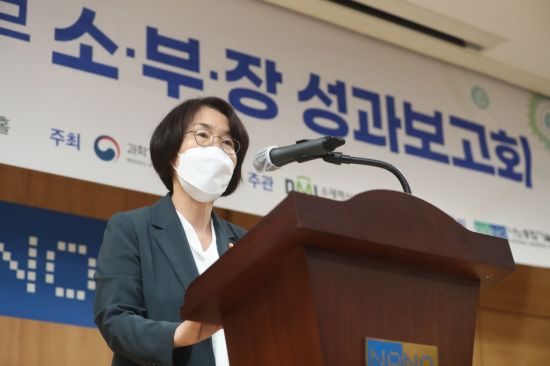 Minister Lim Hye-sook of the Ministry of Science and ICT is giving a speech at the Materials, Parts, and Equipment (SoBuJang) Research and Development Performance Report on the 12th. Photo by Ministry of Science and ICT
[Asia Economy Reporter Kim Bong-su] As a result of the government’s focused investment in so-called So-Bu-Jang (Materials, Parts, and Equipment) research and development (R&D) to resolve supply chain instability, some materials that were previously 100% imported have been localized, and significant technological development achievements have been made.
The Ministry of Science and ICT announced this on the 12th during the So-Bu-Jang R&D support project performance report meeting. Notably, they succeeded in localizing rare earth materials for permanent magnets, fine plating materials for semiconductors, and core materials for hydrogen fuel cells.
In the case of rare earth elements such as Nd (Neodymium), which are materials for permanent magnets used in motors, they are currently 100% imported. However, the Korea Institute of Materials Science, together with Seongrim Advanced Industry, developed a technology to replace 30% of Nd with Cerium (Ce) (reducing motor use by more than 10% in the short term), and Seongrim Advanced Industry is currently establishing a domestic factory to manufacture permanent magnets using this technology.
Also, copper plating materials necessary for all semiconductor chip production are currently 100% imported. The Korea Institute of Industrial Technology advanced existing technology and developed a plating solution capable of forming the world’s highest-performance high-flat copper bumps. This technology has been transferred to a private company and is currently being evaluated in domestic major semiconductor production lines.
Furthermore, core materials for hydrogen fuel cells such as fluorine-based electrolyte membranes, electrode catalysts, electrode carbon, and gaskets are all 100% imported. The Korea Energy Technology Research Institute is leading the development of localization and alternative technologies for each material. Some core materials have already been transferred to company H with a technology fee of 1 billion KRW and are on the verge of commercialization.
A total investment of about 1.34 trillion KRW was made, including 924.1 billion KRW last year and 417.3 billion KRW this year, resulting in scientific and technological achievements such as 2,171 SCI-level papers, 1,570 patent applications, and 466 patent registrations. In addition to direct and indirect sales (32.7 billion KRW) and investments (72.6 billion KRW), economic outcomes were generated including 164 technology transfers, 10 billion KRW in technology fees, and 36,403 corporate support services. There were also achievements in workforce training with 7,541 people trained and 27 cases of direct and indirect import substitution support.
The Ministry of Science and ICT plans to expand the number of national core material research groups from the current 57 to 100 by 2025 to secure and advance source technologies for 100+85 key items in major industries. Additionally, to secure source technologies for advanced materials expected to be promising in 10 years, they will select 50 future advanced materials across 10 major future issues and continue research steadily. Through support via the National Materials Research Data Center, they aim to reduce So-Bu-Jang related research time and costs by more than 50%.
Minister Lim Hye-sook of the Ministry of Science and ICT said, "We will continue to unite efforts for steady support toward core technology self-reliance and make bold investments to secure future advanced materials."
© The Asia Business Daily(www.asiae.co.kr). All rights reserved.
![Clutching a Stolen Dior Bag, Saying "I Hate Being Poor but Real"... The Grotesque Con of a "Human Knockoff" [Slate]](https://cwcontent.asiae.co.kr/asiaresize/183/2026021902243444107_1771435474.jpg)
















