Heatwave lasts 14 days, tropical nights 9 days... 3 days longer than previous 48 years
Heatwave highest in Daegu (27.6 days), Hapcheon (24.3 days), Miryang (22.8 days)
Tropical nights most frequent in Seogwipo (31.0 days), Jeju (29.9 days)
 On August 18 last year, when a heatwave advisory was issued, a sparrow was quenching its thirst at a drinking fountain in Hyochang Park, Yongsan-gu, Seoul. Photo by Hyunmin Kim kimhyun81@
[Asia Economy Reporter Han Jinju] It has been revealed that the number of days and frequency of heatwaves and tropical nights have increased over the past decade.
On the 12th, the Korea Meteorological Administration (KMA) announced that the number of heatwave and tropical night days in the recent 10 years (2011?2020) were 14 days and 9 days respectively, which is more than 3 days higher than the past 48-year (1973?2020) average of 10.1 days and 5.7 days.
The KMA explained, "There is a rising trend in the frequency of heatwaves and tropical nights over the past 10 years, especially high during July and August."
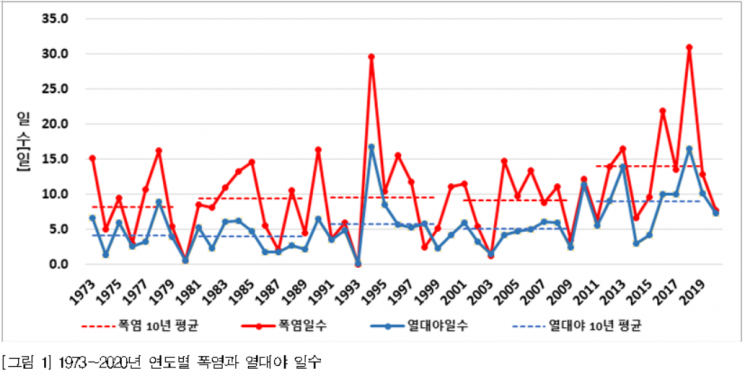
By region, the number of heatwave days was mainly concentrated in inland Gyeongsang Province, such as Daegu (27.6 days), Hapcheon (24.3 days), and Miryang (22.8 days). Tropical nights occurred frequently in Seogwipo (31.0 days) and Jeju (29.9 days). Additionally, southern regions such as Pohang (19.4 days), Daegu (18.5 days), Busan (17.1 days), and Mokpo (16.5 days) also showed high frequencies.
The year with the most heatwave days was 2018 (31.0 days). Following years were ▲1994 (29.6 days) ▲2016 (22.0 days) ▲2013 (16.6 days) ▲1990 (16.4 days). The number of tropical night days was highest in ▲1994 (16.8 days) ▲2018 (16.6 days) ▲2013 (14.0 days) ▲2010 (11.5 days) ▲2019 (10.2 days).
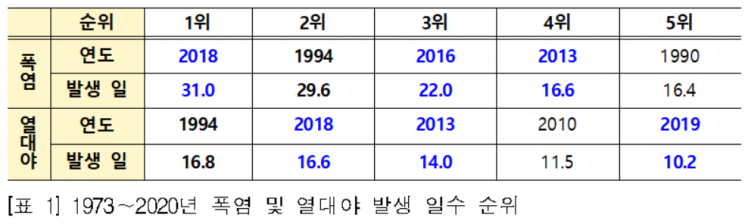
Among the top 5 years with the highest number of heatwave and tropical night days, three years?2018, 2013, and 2010?were included. Heatwaves and tropical nights occur when the lower atmosphere of Korea is covered by the hot and humid North Pacific High and the upper atmosphere by the hot and dry Tibetan High.
In 2018, the hot and dry Tibetan High and the hot and humid North Pacific High developed unusually stronger than average and expanded to the Korean Peninsula. Both the upper and lower layers of the atmosphere over Korea were covered with hot air, causing an extreme heatwave. In 2018, the year with the most heatwave days, the number of heat-related illness patients was 4,526, the highest since 2010.
The KMA operates a heatwave impact forecast system that classifies heatwave damage levels and warnings into four stages along with heatwave alerts.
On the same day at 10 a.m., the KMA issued heatwave warnings for Gyeonggi, Gangwon, Chungnam, Chungbuk, Jeonnam, Jeonbuk, Gyeongbuk, Jeju, and Daejeon. Heatwave advisories were also announced for most areas including Gyeongnam.
© The Asia Business Daily(www.asiae.co.kr). All rights reserved.
![Clutching a Stolen Dior Bag, Saying "I Hate Being Poor but Real"... The Grotesque Con of a "Human Knockoff" [Slate]](https://cwcontent.asiae.co.kr/asiaresize/183/2026021902243444107_1771435474.jpg)


















