"Goal of Next-Generation Vaccine to Solve Stability and Safety Issues of Existing mRNA Vaccines in the Body"
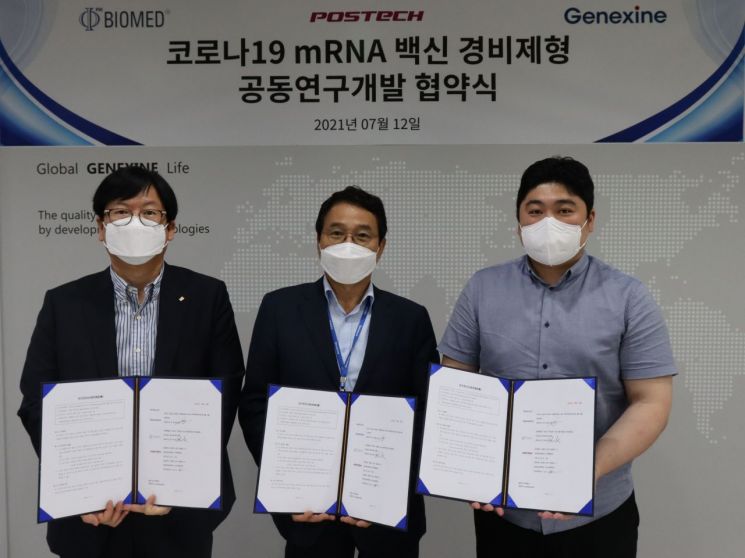 (From left) Han Se-kwang, CEO of WhyBioMed; Sung Young-chul, CEO of Genexine; and Oh Seung-soo, professor at Pohang University of Science and Technology, are signing an agreement at Genexine headquarters in Seongnam, Gyeonggi Province. (Photo by Genexine)
[Asia Economy Reporter Jihee Kim] Genexine announced on the 12th that it has signed a joint research agreement with HuaibioMed, a company specializing in bio-diagnostic and therapeutic system development, and the Industry-Academic Cooperation Foundation of Pohang University of Science and Technology (POSTECH) to begin joint research for the development of next-generation messenger ribonucleic acid (mRNA) vaccines.
This agreement aims to develop a COVID-19 mRNA vaccine equipped with optimal design and next-generation delivery systems that can address the in vivo stability and safety issues pointed out in existing mRNA vaccines. The technologies and intellectual property rights arising from the joint research will be co-owned.
Han Segwang, CEO of HuaibioMed, who will lead the joint research and development with Genexine, is a nano-medicine expert who has conducted collaborative research with the team of Professor Robert Langer at the Massachusetts Institute of Technology (MIT), the founder of Moderna. Professor Oh Seungsoo of the Department of Materials Science and Engineering at POSTECH is a former member of the Harvard Medical School research team advising Moderna scientifically.
Professor Oh’s research team will conduct studies to maximize the preventive efficacy of vaccines through the design and detailed engineering of mRNA used in COVID-19 preventive vaccines. HuaibioMed will develop a new lipid nanoparticle (LNP) platform technology for mRNA vaccine delivery that can overcome the limitations of existing LNPs. Genexine plans to lead the collaboration with the two institutions based on its experience and know-how in developing existing COVID-19 DNA preventive vaccines.
The next-generation mRNA vaccine to be developed through the joint research is expected to be a next-generation vaccine capable of effectively delivering mRNA vaccines in vivo using hyaluronic acid lipid carriers. Considering administration convenience, it will be developed in formulations suitable not only for injections but also for intranasal administration. In particular, when administered intranasally in combination with Genexine’s core pipeline GX-I7 (sustained-release interleukin-7), it maximizes the immune response in the mucosal area where the vaccine is administered, preventing viral infection.
Hyaluronic acid is a polymer naturally present in the body with excellent biocompatibility. It is safe and effective in enhancing the stability of LNP formulations. According to the company, it is possible to develop formulations that improve safety by reducing side effects such as anaphylaxis and hepatotoxicity, which are drawbacks of LNPs used in existing mRNA vaccines, while also allowing storage at various temperatures.
Seong Youngcheol, CEO of Genexine, said, “Both DNA vaccines and mRNA vaccines are nucleic acid-based vaccines that do not directly handle infectious agents, so they have excellent safety and can be developed quickly at low cost. Genexine will strive to secure various vaccine technologies to prepare for future infectious diseases, including the endemic COVID era, rather than sticking to a single platform.”
© The Asia Business Daily(www.asiae.co.kr). All rights reserved.
![Clutching a Stolen Dior Bag, Saying "I Hate Being Poor but Real"... The Grotesque Con of a "Human Knockoff" [Slate]](https://cwcontent.asiae.co.kr/asiaresize/183/2026021902243444107_1771435474.jpg)
















