V-Shaped Rebound on Reconstruction Expectations
Last Week's 0.15% Marks Highest in 1.5 Years
Rising Trend from Gangnam Area to Outskirts
[Asia Economy Reporter Kangwook Cho] Despite the government's repeated warnings of a 'housing price peak,' the upward trend in Seoul housing prices shows no signs of stopping. In particular, the recent surge in housing prices is rapidly spreading not only in major areas such as Gangnam in Seoul but also to the outskirts of the metropolitan area. As uncertainty about expanding housing supply grows and trust in government policies declines, market anxiety is proving difficult to calm down.
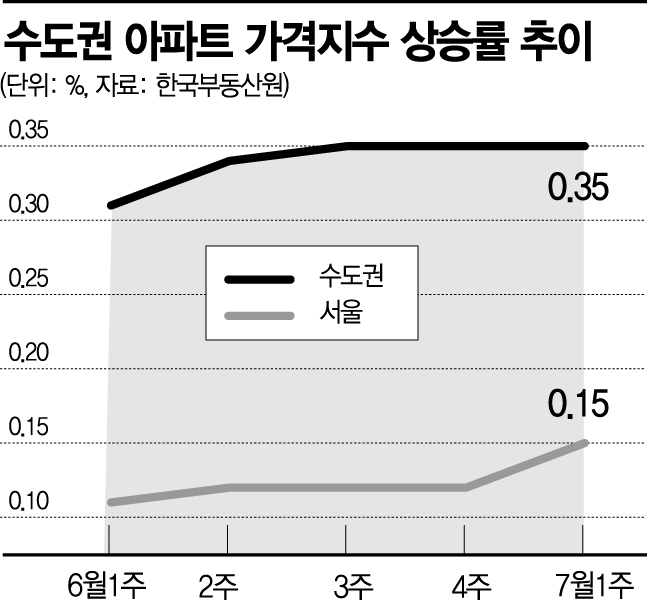
According to the Korea Real Estate Board on the 12th, apartment prices in Seoul have continued to rise at a rate of 0.1% for eight consecutive weeks, increasing the pace of growth. After the announcement of the 2·4 supply plan, the weekly increase in Seoul apartment prices dropped to 0.05% in the first week of April but rebounded sharply in a 'V' shape due to expectations of eased reconstruction regulations following the Seoul mayoral by-election. The weekly increase has been growing recently, reaching 0.15% last week, marking the highest level in a year and a half.
Recently, Seoul housing prices have been rising with ultra-high-end complexes in Gangnam leading the way, followed by mid- to low-priced apartments pushing upward. According to the monthly housing trend statistics from KB Kookmin Bank's Liv Real Estate, the average apartment sale price per square meter in Gangnam-gu was 23.35 million KRW last month, up 5.64 million KRW compared to two years ago (17.7 million KRW). For an 85㎡ apartment, this means a price increase from about 1.5 billion KRW to 1.98 billion KRW over two years, nearly a 500 million KRW rise. Following Gangnam-gu, Seocho-gu's apartment price per square meter was 20.74 million KRW, and Songpa-gu was 16.99 million KRW, with the three Gangnam districts occupying the top three spots.
Apartment prices in the outskirts of Seoul and the metropolitan area have also surged, buoyed by the benefits of the Great Train Express (GTX) project. Based on KB's average apartment sale price per square meter, the area with the largest price increase in Seoul during the first half of this year was Dobong-gu, with a 17.5% rise over six months. This was followed by Nowon-gu (16.1%), Dongjak-gu (12.9%), Guro-gu (11.7%), and Gangdong-gu (11.4%), highlighting the pronounced rise in outer areas. The relatively lower housing prices compared to Gangnam and central districts have attracted real demand from people in their 20s and 30s, leading mid- to low-priced complexes to engage in a 'price matching' trend.
The fever of soaring housing prices has spread to Gyeonggi Province and Incheon as well. According to weekly statistics from the Real Estate Board, the metropolitan cities and provinces with the highest apartment price increases this year up to last week were Incheon (12.35%) and Gyeonggi (10.81%), which are 4.4 to 5.0 times higher than Seoul's increase rate of 2.45%. In Gyeonggi, apartment prices surged mainly in areas with GTX and other transportation benefits, such as Uiwang-si (23.63%), Siheung-si (22.00%), Ansan-si (20.20%), and Dongan-gu in Anyang (19.07%). In Incheon, Yeonsu (18.60%) and Seo-gu (12.97%) also saw rapid price increases.
Contrary to the government's forecast that prices will 'stabilize soon,' not only sale prices but also jeonse (long-term lease) prices continue to strengthen nationwide. Last week, the nationwide apartment jeonse price increase widened from 0.17% to 0.19%. In Seoul, the increase expanded from 0.10% to 0.11%, maintaining a rise above 0.1% for two consecutive weeks. This marks 106 consecutive weeks of price increases.
© The Asia Business Daily(www.asiae.co.kr). All rights reserved.

















