[Asia Economy Reporters Kim Hyewon, Lee Seungjin] As COVID-19 has prolonged for over a year, it was found that 8 out of 10 self-employed workers in neighborhood commercial districts experienced a decrease in sales in the first half of this year. With neighborhood commercial districts pushed into a dead end, an analysis suggests that during the two weeks of the implementation of social distancing level 4, the dining industry alone will see a sales drop of at least 850 billion KRW.
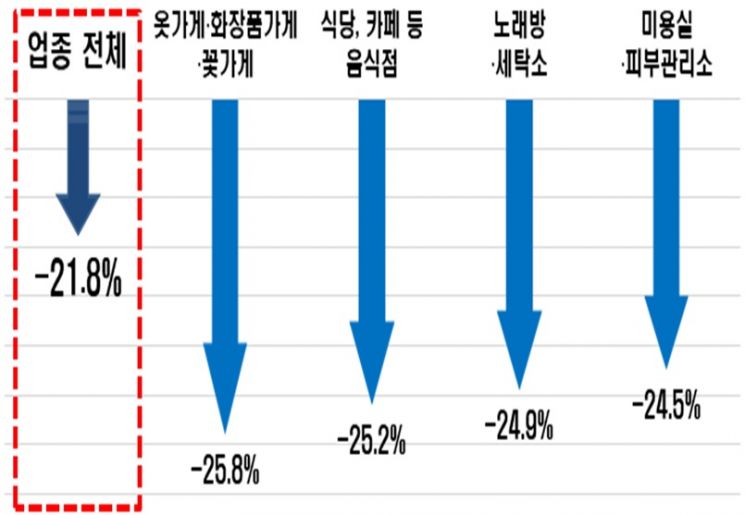
On the 12th, the Korea Economic Research Institute commissioned market research firm Mono Research to conduct the "2021 First Half Neighborhood Commercial District Status and Second Half Outlook Survey" targeting self-employed workers in neighborhood commercial districts (521 respondents). The results showed that 78.5% of respondents reported a decrease in sales in the first half of this year, with an average decline of 21.8% in monetary terms.
By industry, the sales decline rates were as follows: clothing stores, cosmetics, and flower shops (25.8%), restaurants and cafes (25.2%), other businesses such as karaoke rooms and laundromats (24.9%), beauty salons and skincare (24.5%), and grocery retailers including supermarkets, convenience stores, and butcher shops. The most frequently cited reason for the sales decline was the worsening neighborhood commercial district economy due to the prolonged COVID-19 situation (58.2%).
The operating cost that self-employed workers found most burdensome was rent (41.7%), followed by labor costs (31.5%), raw material costs (12.7%), taxes (10.6%), and public utility fees such as electricity and water (2.7%). Among these, self-employed workers without employees identified rent (50.4%) as the biggest burden, while those with employees pointed to labor costs (43.4%) as the greatest concern.
Regarding net profit, a practical profitability indicator, 73.5% of self-employed workers in neighborhood commercial districts reported a decrease in net profit compared to the previous year in the first half of this year. The average decrease was 17.7% in monetary terms. Causes for the net profit decline included sales decrease (56.6%), raw material cost increase (13.6%), labor cost increase (13.0%), utility fee increase (7.2%), and rent increase (6.7%).
The social distancing level 4, implemented for two weeks starting today, is a direct blow to the neighborhood commercial district economy. According to an analysis by the Seoul Institute based on Shinhan Card’s store sales data, the largest sales impact occurred from August 24 to September 13 last year, when social distancing level 2.5 was enforced during the second wave of COVID-19. During that period, weekly sales dropped by 423.3 billion KRW compared to the same period the previous year. In just two weeks, this amounted to a loss of 846.6 billion KRW in sales. By industry, Korean cuisine saw the largest decline, followed by other dining sectors and Western cuisine, indicating that the entire dining industry is vulnerable to the effects of COVID-19.
Under the current social distancing level 4, private gatherings are limited to only two people after 6 p.m., a stricter restriction than the previous level 2.5, making further sales declines inevitable. Yoon, a man in his 30s who operates a pork barbecue restaurant in Seoul, said, "Since dinner sales make up most of the revenue at barbecue restaurants and many customers come in groups of 3 to 4, I expect virtually no dinner sales for the next two weeks." He added, "Other nearby businesses are in the same situation." A Seoul Institute official stated, "When social distancing was raised to level 2.5 last year, the floating population decreased by 13,000 people," and added, "Since the current level 4 has expanded restrictions compared to last year, greater losses are expected."
© The Asia Business Daily(www.asiae.co.kr). All rights reserved.

















