IBS Center for Nanostructured Physics Discovers 3D Topological Dirac Semimetal Material KZnBi
Expected to Advance Exploration of New Topological Materials and Quantum Computing Research
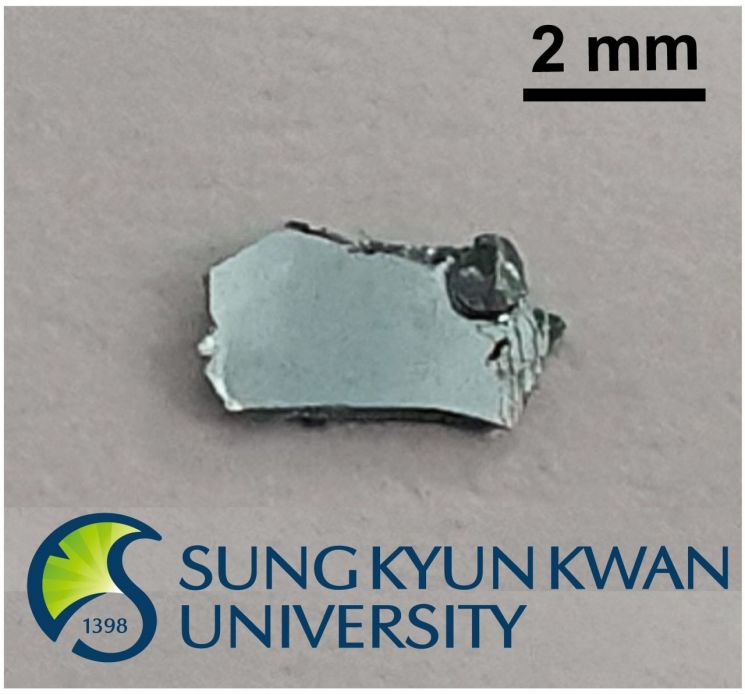 3D topological Dirac semimetal material KZnBi discovered by the Nano-Structure Physics Research Group at the Institute for Basic Science (IBS). Photo by IBS
[Asia Economy Reporter Kim Bong-su] Domestic researchers have discovered a material that exhibits zero electrical resistance under normal conditions, without the need for ultra-low temperatures or vacuum states, removing one of the obstacles to the commercialization of quantum computers.
Quantum computers utilize quantum entanglement to enable parallel processing of data. They are expected to perform calculations that would take hundreds of years with conventional methods in just a few seconds. However, they still require stringent conditions such as ultra-low temperatures or vacuum states, making their production very difficult.
According to the Institute for Basic Science (IBS) on the 12th, an international joint research team led by Research Fellow Kim Seong-woong of the Center for Nanostructured Physics recently discovered a new three-dimensional topological Dirac semimetal material (KZnBi) that exhibits superconductivity with zero electrical resistance even under normal atmospheric pressure (ambient pressure), paving the way to overcome this barrier. To implement qubits (a superposed state where 0 and 1 coexist) in quantum computers, existing materials require superconducting states achieved through ultra-low temperatures or vacuum conditions.
However, the research team found that KZnBi can conduct current without power consumption (superconductivity) under normal atmospheric pressure (ambient pressure). The team was inspired by the planar honeycomb structure of graphene, a two-dimensional material hosting Dirac particles. Based on this, they succeeded in synthesizing the three-dimensional layered planar honeycomb structured material KZnBi. Through angle-resolved photoemission spectroscopy experiments and theoretical calculations, they revealed the presence of massless Dirac particles in three-dimensional space.
Furthermore, they confirmed the occurrence of ambient pressure superconductivity on the surface of the three-dimensional topological Dirac semimetal KZnBi. Through critical magnetic field measurements, they discovered that the superconducting properties on the surface of KZnBi differ from those of conventional superconductors. Until now, superconductivity in discovered three-dimensional topological Dirac semimetal materials was either absent or appeared only under very high pressure.
However, this study discovered KZnBi, a material with zero electrical resistance at about 1 atmosphere pressure, similar to normal atmospheric pressure. It is expected to be applied not only to the exploration of new topological materials but also to the development of topological material-based technologies essential for quantum computer research.
Research Fellow Kim Seong-woong said, “By applying the formation principles of two-dimensional graphene materials, which are representative Dirac materials, we discovered a material that was previously completely unpredictable,” adding, “This new quantum material discovery, which surpasses the limitations of previous research, will provide new directions for topological superconductors and quantum computer research.”
This research was published on the 28th of last month in the physics journal Physical Review X (IF=12.577).
© The Asia Business Daily(www.asiae.co.kr). All rights reserved.

















