Even if Coal Power Plants Are Halted and the Share of Renewable Energy Increases,
Greenhouse Gas Emissions Are Projected at 18 to 25.8 Million Tons
Carbon Neutrality Committee to Approve Final Plan by End of October
[Asia Economy Reporter Joo Sang-don] Although global efforts to reduce carbon emissions are intensifying, the reality is not easy. Like major advanced countries, our government is also aiming for carbon neutrality (net zero emissions) by 2050. However, its own scenario indicates that achieving this goal even 30 years from now will be difficult.
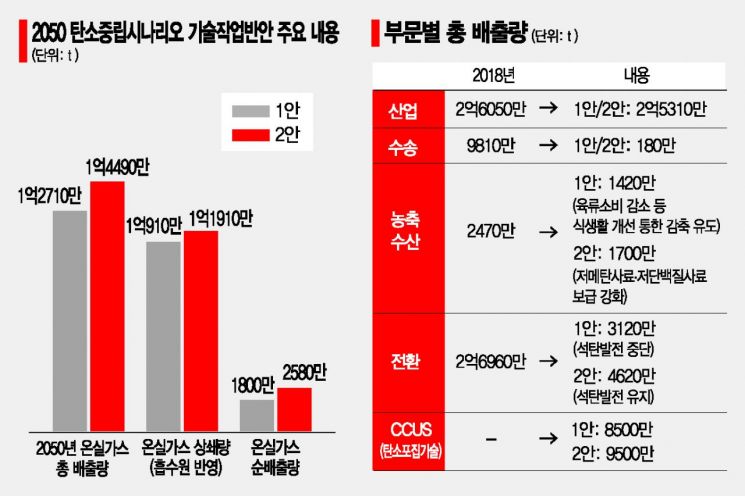
According to the "2050 Carbon Neutrality Scenario Technical Working Group Draft (Government Proposal)" released on the 12th, the net greenhouse gas emissions in 2050 are predicted to be between 18 million and 25.8 million tons. Considering the target and the current technological capabilities, even if all coal power plants cease operation and the share of renewable energy generation rises to 61%, this level of carbon emissions is inevitable.
A government official stated, "The government proposal assumes that even if greenhouse gas emissions are minimized in each sector and offset through absorption sources, a certain amount of greenhouse gases will inevitably remain. However, this is a draft submitted by the government to the Carbon Neutrality Committee, and whether the final plan will include a net-zero (net zero emissions) scenario is a matter for the committee to decide."
The government presented two 2050 carbon neutrality scenarios in the report. In Scenario 1, the total emissions in 2050 are 127.1 million tons, but the offset amount is judged to be 18 million tons less at 109.1 million tons. In Scenario 2, total emissions are 144.9 million tons, but it is expected that 119.1 million tons can be reduced.
As a specific measure, the government proposed fully introducing hydrogen reduction steelmaking technology in the steel industry, a major domestic carbon-intensive sector, and reducing emissions by 79.6% through technologies that reduce heat loss in industrial processes and replacement of aging facilities. In the transportation sector, the share of electric and hydrogen vehicles will be raised to 76%, and the remainder will be significantly reduced by using e-fuels produced by electrolyzing water with electricity generated from renewable energy and mixing it with carbon dioxide.
The biggest issue in the government’s scenario is whether to maintain coal power generation. Scenario 1 assumes a complete halt of coal power plants, reducing emissions in the transition sector from 269.6 million tons to 31.2 million tons, an 88.4% reduction. Scenario 2 considers the unavoidable continuation of privately owned coal power plants that have received government permits, resulting in 46.2 million tons of greenhouse gas emissions.
There is widespread expectation that the Carbon Neutrality Committee will raise the carbon reduction targets beyond the government’s proposal. Since the committee members tend to take a relatively tough stance, it is expected that the reduction scale in each sector will be further strengthened to align with the goal of "carbon neutrality." However, the committee is carefully considering key issues such as the share of renewable energy and the technological and economic feasibility of e-fuels proposed by the government, the maintenance of coal power plants, and the feasibility of carbon capture, utilization, and storage (CCUS). Recently, there was a heated debate over whether to recognize e-fuels as a carbon reduction method. The committee plans to prepare a draft plan this month, gather opinions from various sectors, conduct public discussions and surveys, and review and approve the final plan around the end of October.
© The Asia Business Daily(www.asiae.co.kr). All rights reserved.

















