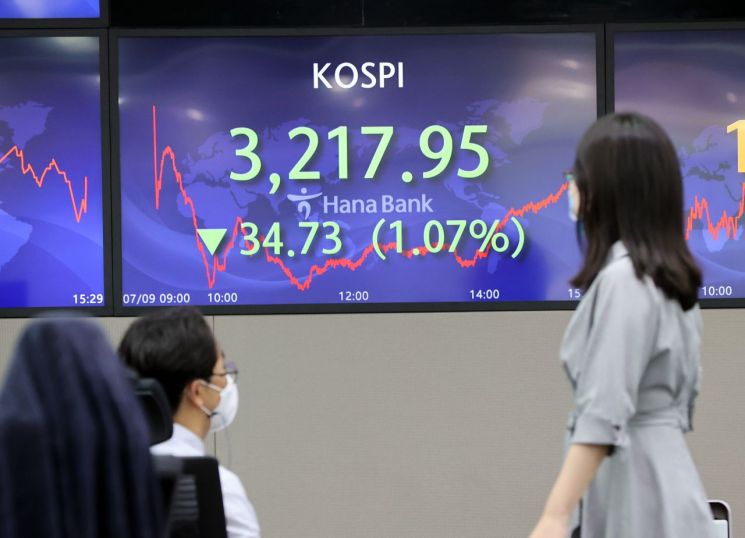
[Asia Economy Reporter Lee Seon-ae] The domestic stock market started higher on the 12th. The upward revision of corporate earnings for Q2, favorable economic indicators, and the global market situation are interpreted as driving the rise.
On the day, the KOSPI opened at 3,227.51, up 9.56 points (0.30%↑). The KOSDAQ started the session at 1,030.36, up 1.43 points (0.14%↑).
This is attributed to the New York stock market on the 9th (local time) overcoming fears of the Delta variant spread in just one day and setting new records. The Dow Jones Industrial Average rose 1.30% from the previous close, the Standard & Poor's (S&P) 500 index increased by 1.13%, and the tech-heavy Nasdaq index closed up 0.98%. All three major indices set all-time highs based on closing prices. It was just a week since they simultaneously hit new peaks on the 2nd. Travel and banking stocks, which had seen significant declines, led the rebound on this day.
As of 9:14 a.m., individual investors were net buyers of about 11.8 billion KRW and 107.7 billion KRW in the KOSPI and KOSDAQ markets, respectively. Foreign investors were net buyers of 37.1 billion KRW in the KOSPI market but sold 90.5 billion KRW worth in the KOSDAQ market. Institutions were net sellers in both markets, selling 12.9 billion KRW and 16.9 billion KRW, respectively.
By sector in the KOSPI, medical precision equipment (+0.94%), paper and wood (+0.71%), and transportation equipment (+0.59%) showed strength, while pharmaceuticals (-0.01%) declined.
By sector in the KOSDAQ, paper and wood (+1.75%), general electrical and electronics (+0.74%), and publishing and media reproduction (+0.53%) were strong, while entertainment and culture (0.00%) and food and tobacco (0.00%) were flat or declining.
Seojeonghoon, a researcher at Samsung Securities, said, "Due to the combined effect of stock price adjustments and the depreciation of the Korean won, technical indicators for the KOSPI on a dollar-converted basis are showing oversold signals," adding, "This is a zone where sufficient rebound buying can flow in."
Kim Dae-jun, a researcher at Korea Investment & Securities, said, "Although concerns about further declines remain as the risk factors have not been completely resolved, excessive worries should be avoided," and evaluated, "China's monetary easing and the rebound in the U.S. stock market are factors that revive the shrinking risk asset preference."
© The Asia Business Daily(www.asiae.co.kr). All rights reserved.

















