Zigbang Survey Results: 49.4% Expect 'Increase', 32% Expect 'Decrease'
Proportion Expecting Increase Declines Compared to Last Year-End
Strong Expectations for Rise in Economy, Sale and Jeonse Prices
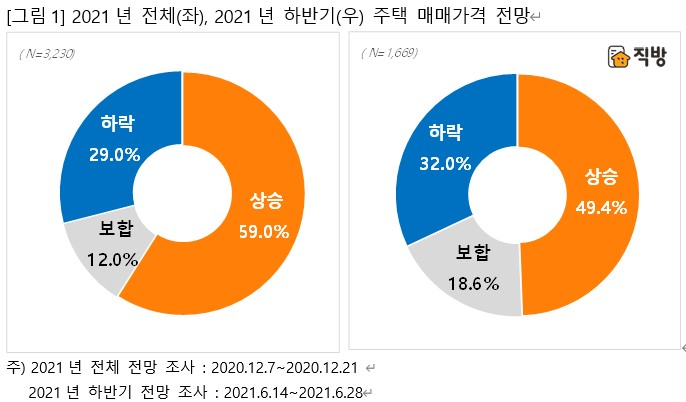
[Asia Economy Reporter Onyu Lim] It was found that 5 out of 10 citizens expect housing sale prices to rise in the second half of this year.
On the 12th, Zigbang surveyed 1,669 users on their outlook for housing sale prices in the second half of 2021, and 49.4% (825 people) responded that prices would rise. On the other hand, 32% expected a decline, and 18.6% anticipated stability. Zigbang added, "Compared to the survey at the end of last year, which forecasted a 59% rise in 2021 sale prices, this figure is somewhat lower."
By region, the highest proportion expecting a rise was in Gyeonggi at 53.1%. Incheon was 52.0%, provinces 47.6%, Seoul 47.3%, and the five major metropolitan cities in the provinces 43.6% expected an increase.
Regarding homeownership status, homeowners had more optimistic views on price increases. Among homeowners, 56.5% forecasted a rise, whereas among non-homeowners, 44.4% expected a decline, which was higher than those expecting an increase.
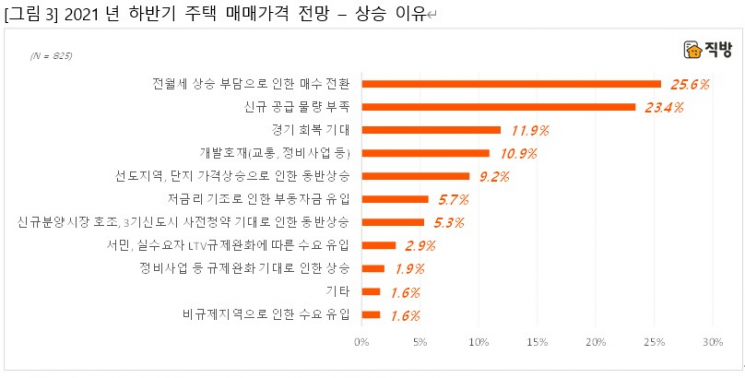
The main reason for expecting housing sale prices to rise was "switching to buying due to the burden of rising monthly rent and jeonse (long-term deposit lease)" at 25.6%. This was followed by △lack of new supply (23.4%) △expectations of economic recovery (11.9%) △development benefits such as transportation and maintenance projects (10.9%).
The main reason for expecting housing sale prices to fall was "thinking that the current price level is high" at 47.6%. This was followed by △shrinkage in sales demand (14.8%) △real estate loan regulations (12.8%) △strengthening of tax policies such as property tax and capital gains tax (10.9%). There were also opinions regarding the "possibility of interest rate hikes."
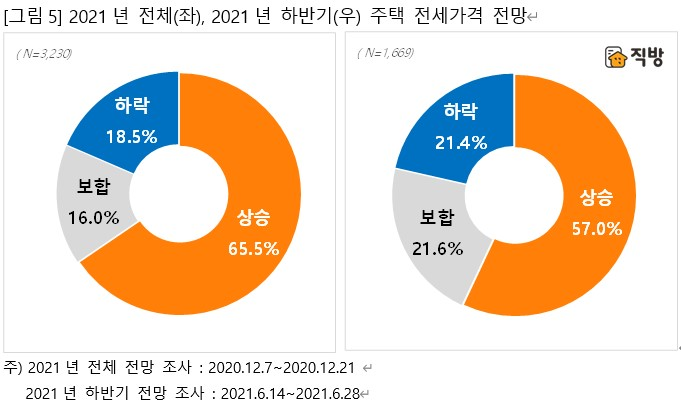
Regarding housing jeonse prices in the second half of the year, 57.0% of all respondents expected them to rise. 21.6% chose stability, and 21.4% expected a decline. Zigbang added, "Similar to the sales outlook, the proportion expecting a rise is lower than the 65.5% who forecasted an increase in housing jeonse prices at the end of last year."
Following sales, the proportion expecting jeonse prices to rise was highest in Gyeonggi at 58.9%, followed by Incheon at 57.5%, Seoul at 56.4%, the five major metropolitan cities in the provinces at 55.6%, and provinces at 53.8%.
Differences in responses were also observed based on homeownership status. Among homeowners, 64.3% expected jeonse prices to rise, while among non-homeowners, 46.0% expected an increase. Among non-homeowners, 31.8% anticipated a decline.
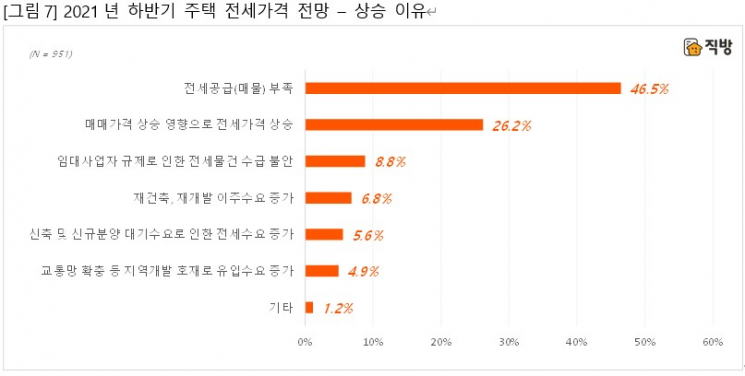
The main reason for expecting jeonse prices to rise was "shortage of jeonse supply (listings)" at 46.5%, followed by △jeonse price increase due to rising sale prices (26.2%) △supply instability of jeonse properties due to regulations on rental business operators (8.8%).
The main reason given by respondents expecting jeonse prices to fall was "increase in jeonse volume" at 25.4%, followed by △increase in supply due to new move-ins (20.7%) △policy effects such as expansion of public rental housing (17.0%).
Regarding monthly rent prices in the second half of the year, 52.7% of all respondents expected an increase. Meanwhile, 29.9% expected stability, and 17.4% anticipated a decline.
By region, the highest proportion expecting a rise was in the five major metropolitan cities in the provinces (55.6%). Gyeonggi was 54.9%, Incheon 52.8%, and Seoul 50.6% expected increases. Provinces had a relatively lower proportion of 47.1% expecting a rise. By homeownership status, homeowners had a higher proportion expecting an increase at 59.5% compared to non-homeowners at 42.4%.
The main reason for expecting monthly rent prices to rise was "increased demand for switching to monthly rent due to rising sale and jeonse prices" at 37.9%. This was followed by △shortage of monthly rent supply (listings) (25.6%) △tax burden transfer due to property tax and comprehensive real estate tax (14.9%) △supply instability of monthly rent properties due to regulations on rental business operators (8.4%).
On the other hand, the reasons given by respondents expecting monthly rent prices to fall were △increase in monthly rent volume (23.0%) △policy effects such as expansion of public rental housing (16.8%) △continued preference for jeonse leading to decreased monthly rent demand (16.5%) △increase in monthly rent volume due to landlords switching to monthly rent (15.8%) △decreased monthly rent demand due to stabilization and increased supply of jeonse prices (15.5%).
Ham Young-jin, head of Zigbang Big Data Lab, said, "From July, loan regulations have been eased for non-homeowners and low-income real demanders, and pre-subscription for the 3rd new towns has begun." He added, "This is a regulatory easing and supply policy focused on real demand rather than investment, which is expected to be an additional variable for housing prices in the second half of the year." He emphasized, "In addition, it is necessary to pay attention to real estate policy pledges announced by candidates ahead of next year's presidential election."
© The Asia Business Daily(www.asiae.co.kr). All rights reserved.
![Clutching a Stolen Dior Bag, Saying "I Hate Being Poor but Real"... The Grotesque Con of a "Human Knockoff" [Slate]](https://cwcontent.asiae.co.kr/asiaresize/183/2026021902243444107_1771435474.jpg)


















