Daegu Gyeongbuk Institute of Science and Technology Develops First Dry Transfer Printing Method
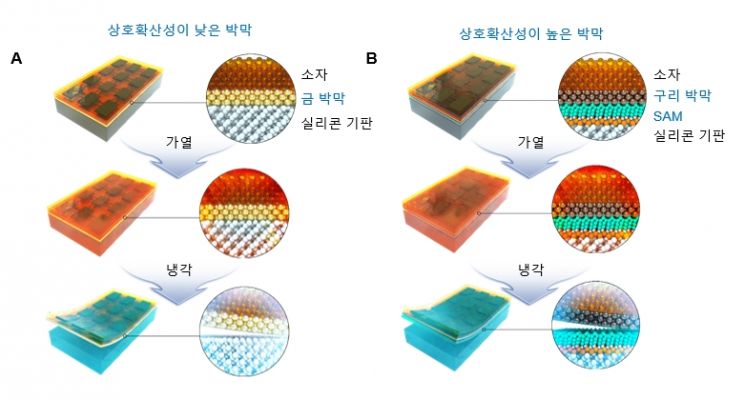 Schematic diagram of dry transfer printing technology using thermal expansion. The DGIST research team developed a semiconductor device printing process that is 10,000 times faster than existing methods. Photo by DGIST
[Asia Economy Reporter Kim Bong-su] Domestic researchers have developed a new process technique capable of semiconductor printing ranging from tens of nanometers as small as dust particles to the size of A4 paper. It is expected to dramatically increase semiconductor device productivity with a process that is up to 10,000 times faster and more accurate than existing methods.
Daegu Gyeongbuk Institute of Science and Technology (DGIST) announced on the 12th (Monday) that Professor Jang Kyung-in’s team, in collaboration with Professor Ra Jong-cheol of the Korea Brain Research Institute and Dr. Geum Ho-hyun of the Korea Institute of Industrial Technology, has developed a new transfer printing method for semiconductor and device fabrication for the first time.
Transfer printing is an essential semiconductor manufacturing process that moves devices fabricated on different substrates onto a new substrate for integration, widely used in the production of complex electronic devices. Recently, with the advancement of wearable devices and curved display technologies, there is a growing demand for advanced semiconductor device fabrication techniques, highlighting the need for more accurate and rapid transfer printing methods.
The conventional wet transfer printing method involves fabricating devices on a substrate, then using an etching solution to dissolve the underlying layer before transferring the devices onto a new substrate. However, when the substrate’s layer area is large, the etching process takes a long time, and there is a possibility of device shape distortion, limiting mass production. Recently developed dry transfer printing techniques, designed to replace this, offer better performance than the wet method but still face many limitations such as lack of process versatility, the need for expensive equipment, and difficulties in mass production.
The research team developed a new dry transfer printing method that stably and rapidly separates devices from the substrate by utilizing the difference in thermal expansion coefficients, which represent the volume change values of two adjacent materials due to temperature increase. They fabricated thin films of gold (Au) and silicon (Si) or copper (Cu) and silicon (Si) stacked together, which have large differences in thermal expansion coefficients. When heated to high temperatures, strong forces concentrated at the interface between the two materials caused cracks, successfully separating the devices from the substrate.
Through physical modeling and simulations, the research team further demonstrated that this method can be widely applied to wireless communication systems, complex structures such as cardiovascular sensors, gas sensors, and optogenetics devices. Notably, compared to the conventional wet transfer printing method, the process time is reduced by more than 10,000 times, and precise transfer printing is possible.
Professor Jang Kyung-in said, “This technology can be applied to industries requiring precision and mass production, such as biosensors and semiconductor device fabrication, which were impossible with existing wet transfer printing technology. It also enables fast and stable high-precision device fabrication even in small-scale laboratory facilities. We will continue to develop this technology to be applied in more fields in the future.”
The research results were published online on the 9th in ‘Science Advances,’ a sister journal of the international academic journal Science.
© The Asia Business Daily(www.asiae.co.kr). All rights reserved.

















