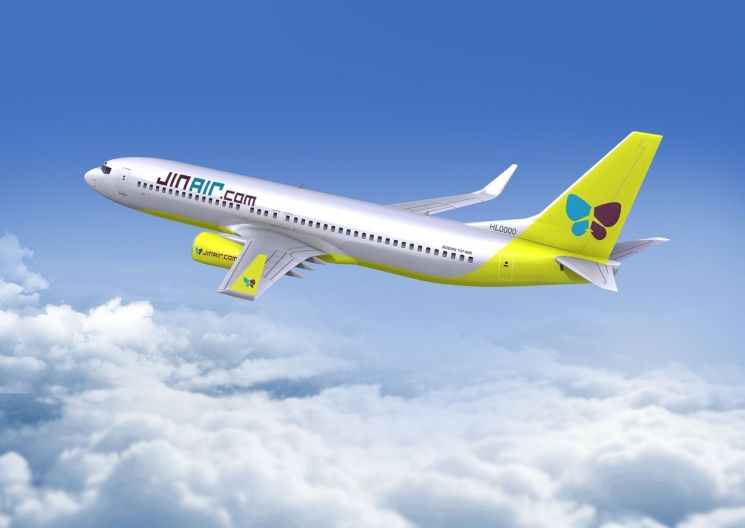
[Asia Economy Reporter Dongwoo Lee] Jin Air's cargo transportation volume has decreased for the fourth consecutive month. This contrasts with domestic low-cost carriers (LCCs) steadily increasing their cargo volumes since the COVID-19 pandemic.
According to the Ministry of Land, Infrastructure and Transport's aviation information system on the 11th, Jin Air's cargo volume last month totaled 2,073 tons, a 54.7% decrease compared to February (3,207 tons), which was the highest this year. During the same period, Jin Air fell to third place in domestic LCC cargo transportation rankings, behind Jeju Air (2,594 tons) and T'way Air (2,439 tons).
The industry attributes the sharp decline in Jin Air's cargo volume to the temporary suspension of operations of the B777-200ER aircraft used as cargo planes due to engine defects. Earlier in February, the U.S. Federal Aviation Administration (FAA) issued an emergency inspection order related to engine failures on Boeing 777-200 aircraft, and domestic airlines voluntarily suspended operations of the affected models.
Jin Air, in particular, suffered a significant impact from the suspension as it was the first domestic LCC to convert passenger planes into dedicated cargo planes as part of its COVID-19 exit strategy. Although the company also operates B737 models, these require manual loading of cargo and have limited capacity, making it difficult to meet transportation cost targets.
Jin Air explained that the B737 aircraft lack essential cargo transport equipment such as temperature control systems and vibration-free carts in the cargo hold, limiting them to carrying only simple items like clothing or certain fruits, which makes profitability difficult to expect.
The suspension of cargo transport operations is leading to worsening management conditions. The financial sector forecasts that Jin Air will continue to post losses of around 53 billion KRW in the second quarter, following a first-quarter revenue of 43.9 billion KRW and an operating loss of 60.1 billion KRW.
The financial burden due to deteriorating profitability is also increasing. Jin Air's first-quarter capital erosion ratio was 42.4%, approaching the 50% management threshold in the KOSPI market, and its debt ratio rose from 467% at the end of last year to 1,794% during the same period, placing it in a partial capital erosion state.
Jin Air plans to further strengthen its domestic passenger segment through promotions, but it is difficult to expect significant profitability due to intense price competition in the saturated domestic passenger market.
A Jin Air representative said, "The prolonged COVID-19 pandemic has delayed the recovery of international flights, and the aviation industry continues to face difficult circumstances. This year, we are reducing our fleet from 28 to 23 aircraft and implementing efficient fleet operations to reduce costs."
© The Asia Business Daily(www.asiae.co.kr). All rights reserved.
![Clutching a Stolen Dior Bag, Saying "I Hate Being Poor but Real"... The Grotesque Con of a "Human Knockoff" [Slate]](https://cwcontent.asiae.co.kr/asiaresize/183/2026021902243444107_1771435474.jpg)











