60% of Pre-Subscription Quotas Focused on Newlyweds
General Supply via Point System Decreases...Petition from 'Middle-Aged' Citizens
'Daegieop Heuksujeo' Overlooked in General and Special Supply
Controversy Over Division Among Youth
[Asia Economy Reporter Kim Hyemin] The subscription system, which has been changed about five times a year under the current government, is fueling conflicts between generations and social classes. In particular, dissatisfaction is growing among those who feel marginalized as the government focuses on allocating supply quantities to specific groups. Experts point out that "the subscription market is operating as a zero-sum game where one party benefits while another loses."
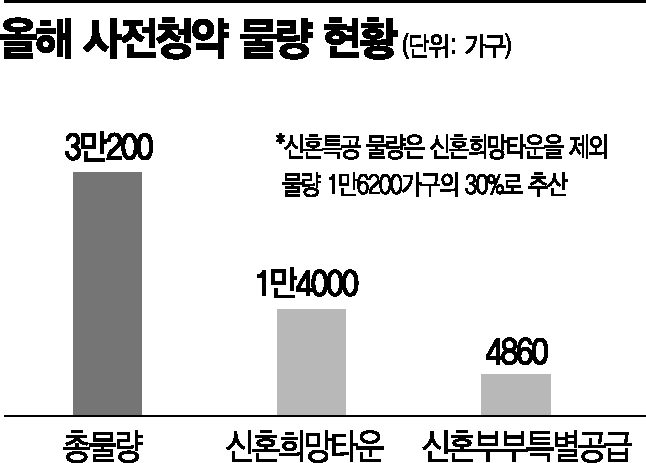
According to the industry on the 9th, the pre-subscription for the 3rd phase new towns starting on the 16th is being criticized for being designed almost exclusively for newlyweds married within seven years. This is because 6 out of every 10 supply units are allocated to 'newlyweds.' The government plans to offer a total of 30,200 pre-subscription units in public housing sites in the metropolitan area, including the 3rd phase new towns, by the end of this year. Of these, 14,000 units, half of the total, are designated as Newlywed Hope Town units, which are given priority to newlyweds, and 30% of the remaining 16,200 units are also allocated as special supply for newlyweds. In total, the units for newlyweds amount to 18,860, which is 62% of all pre-subscription units.
As the general supply units allocated through the point system have significantly decreased, middle-aged people in their 40s and 50s who have accumulated points over a long time have expressed immediate dissatisfaction. On the national petition site, sharp comments have been posted such as, "Are middle-aged people who waited trusting only the 3rd phase new towns not citizens?" and "Should we just give up everything to the young, including newlywed special supply, and live as tenants in the homes of much younger newlyweds, being treated like beggars?" The government explains that the allocation was made based on the high demand from younger generations, but this has effectively excluded real demanders in their 40s and 50s.
Conversely, young people in their 20s and 30s complain about missing opportunities to enter apartments in the Gangnam area. This is because the government regulates that apartments priced over 900 million won in speculative overheated zones select winners only through the point system, excluding special supply. In fact, in the recent subscription for Raemian One Bailey in Seocho-gu, 17,000 people in their 20s and 30s applied, but only two were selected.
The current subscription system is causing not only generational conflicts but also 'division' controversies among the younger generation. So-called 'large corporation dirt spoons' express dissatisfaction, saying they are marginalized in both general and special supply. In a situation where buying a house with earned income has become impossible, the general supply, which heavily relies on the point system, is dominated by middle-aged people, and the special supply is lost due to income requirements, effectively losing chances to win subscriptions.
As conflicts over the subscription system grow not only between generations but also among young people, various solutions are being proposed inside and outside the political sphere, but these are also inconsistent. Jeong Ilyeong, a member of the Democratic Party of Korea, recently proposed an amendment to the Housing Basic Act that would effectively allocate quotas by age group during the housing sale process. On the other hand, 'The Future Institute,' an external think tank of the ruling party, argued in a report that benefits should be given to long-term homeless people in their 40s and 50s.
Experts point out that rather than policies for specific groups, a subscription system that eliminates speculative demand should be created. Kim Deokrye, head of the Housing Policy Office at the Korea Research Institute for Human Settlements, said, "The blind spots of systems designed to accommodate specific groups inevitably cause dissatisfaction among other groups," adding, "Whether young or middle-aged, unnecessary speculative demand aiming for capital gains should be removed, and the subscription system should be reexamined to focus on those who truly need to own a home."
© The Asia Business Daily(www.asiae.co.kr). All rights reserved.

















