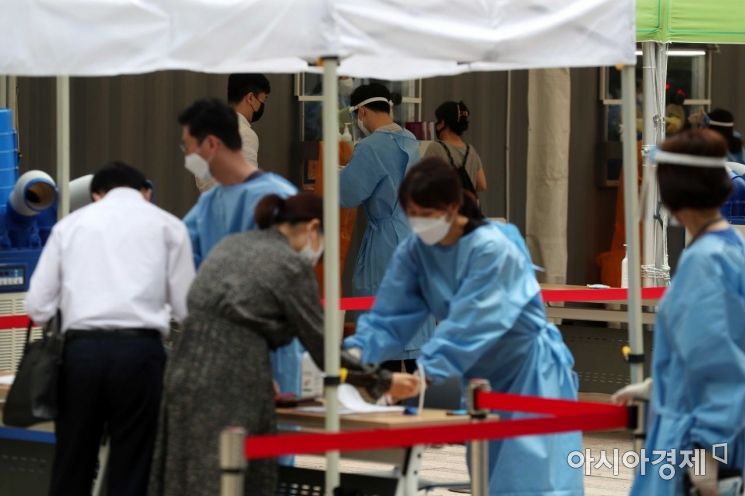
 The number of new COVID-19 cases is breaking record highs day after day. On the 9th, citizens are waiting to get tested at a temporary screening clinic set up in front of Seoul City Hall Plaza. Photo by Mun Honam munonam@
[Asia Economy Reporter Hwang Junho] Among the promising post-COVID themes, BBIG (Secondary Battery, Bio, Internet, Game), the core sector of Bio·Healthcare emerged as the weakest theme in the first half of this year, increasing concerns among investors.
According to the Korea Exchange on the 9th, the KRX Healthcare Index has fallen 17.7% from the beginning of this year to the present. Last year, this index soared by 89.25%, significantly influencing the stock market rise, but this year it has been giving back those gains. This index is the only one among all KRX indices to record a decline. Following this, the KOSPI 200 Healthcare Index also dropped 18.45%, and the Pharmaceuticals Index fell 12.40%. The KRX Bio K-New Deal Index, which includes stocks related to COVID-19 vaccines, treatments, and diagnostic kits?considered core promising stocks in the post-COVID era and one of the leading projects of the Korean New Deal last year?also dropped by 17.78%.
Since the beginning of this year, investment sentiment has weakened due to COVID-19 vaccine rollouts, leading the indices downward. Samsung Biologics, the leader in healthcare, rose 4.01% compared to early this year, but Seegene (-50.76%), Celltrion Healthcare (-25.90%), Celltrion (-23%), and SK Biopharm (-15.85%) have all recorded significant declines. Cha Dongho, Head of ETF Operations at KB Asset Management, analyzed this as "a result of funds moving to beneficiary sectors such as materials and industrials due to expectations for vaccine distribution and economic reopening."
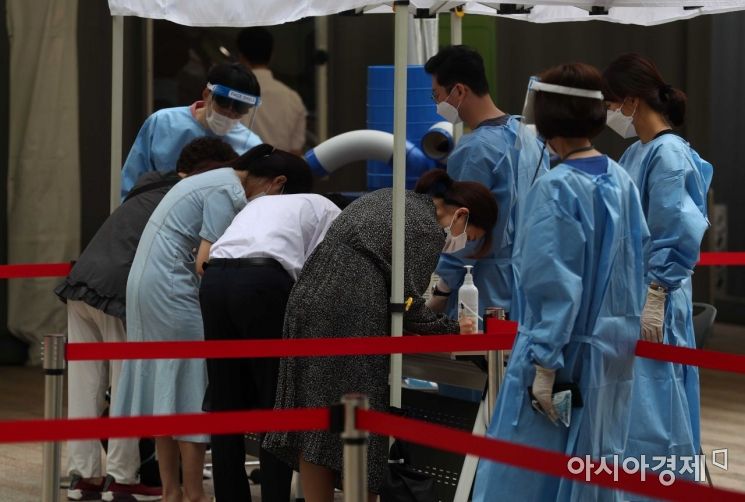 The number of new COVID-19 cases is breaking record highs day after day. On the 9th, citizens are waiting to get tested at a temporary screening clinic set up in the plaza in front of Seoul City Hall. Photo by Mun Ho-nam munonam@
Those who directly invested in these stocks, as well as those who tried to reduce risk by indirectly investing through Exchange-Traded Funds (ETFs), are holding their throbbing heads. The decline in indices is directly reflected in ETFs, with ARIRANG KRX300 Healthcare (-18.53%), TIGER 200 Healthcare (-18.49%), TIGER KOSDAQ150 Biotech (-18.31%), TIGER KRX Bio K-New Deal (-17.77%), and KODEX Healthcare (-17.69%) all showing steep declines.
Excluding inverse products such as crude oil futures inverse ETFs, which invest opposite to the roughly 30% rise in oil prices since early this year (-36% range), or leveraged inverse ETFs like the double inverse KOSPI 200 (Inverse ×2, -25% range) that move opposite to the KOSPI recently hitting 3300, these represent the largest declines among individual theme investment ETFs.
Researcher Ha Taegi of Sangsangin Securities said, "Considering the clinical results of bio companies, it is likely that stock price recovery will occur around next year," adding, "Conversely, the third quarter could be a short- to mid-term bottom, so joining ETFs or healthcare funds could be a good investment strategy."
© The Asia Business Daily(www.asiae.co.kr). All rights reserved.


















