Clarification of Apartment Security Guard Duties
Security, Cleaning, Recycling Organization, Parking Management, etc.
Prohibition of Various Consent Forms Collection, Mobile Parking, etc.
Violations Subject to Fines by Residents' Representative Meeting
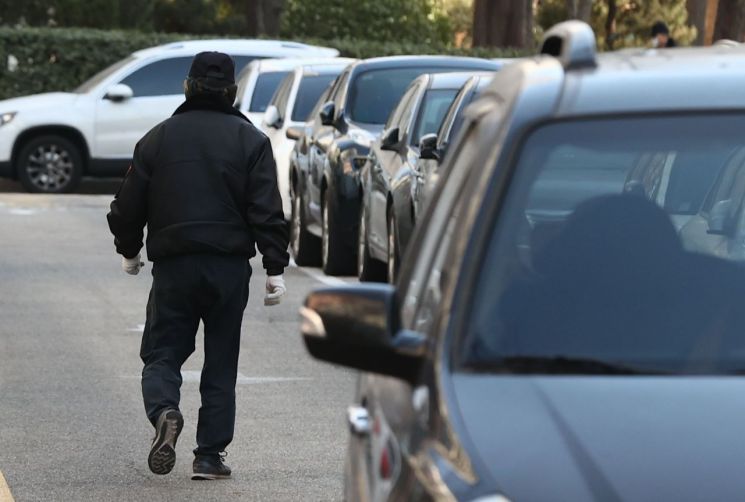
[Asia Economy Reporter Moon Jiwon] Starting from October, the scope of duties for apartment security guards will be limited to security, cleaning and environmental management, sorting and enforcement of recyclable waste separation, parking management, and so on. Activities outside the scope of duties, such as collecting various consent forms, general office work at the management office, and delivery of parcels, will be strictly restricted.
The Ministry of Land, Infrastructure and Transport announced on the 9th that it has proposed the amendment of the "Enforcement Decree and Enforcement Rules of the Apartment Housing Management Act" for legislative notice and will promulgate and enforce it on October 21.
The amendment clearly defines the scope of duties for security guards in apartment complexes and other collective housing. Originally, security guards in collective housing could only perform security duties under the Security Services Act, but with the amendment of the Apartment Housing Management Act, security guards can now perform necessary management tasks for collective housing as prescribed by Presidential Decree, in addition to security duties.
The duties that security guards in collective housing can perform beyond security include ▲cleaning and environmental management ▲sorting and enforcement of recyclable resources separation ▲parking management and parcel storage aimed at preventing risks and theft.
Assistance with repairs of common areas or general office assistance such as collecting various consent forms at the management office is basically restricted. Tasks related to individual units and personal property, such as moving and parking private vehicles (valet parking) and delivering parcels to individual households, are also prohibited. The government extensively gathered opinions from related ministries, local governments, labor groups, resident associations, and experts to set the scope of duties for security guards in collective housing.
Even if additional tasks outside the permitted duties for security guards in collective housing are added to the employment contract, only the duties allowed by the enforcement decree can be performed. If a security service provider has security guards perform tasks beyond the permitted duties, their security service license may be revoked. Residents, resident representative meetings, and management entities will also be fined up to 10 million KRW if violations are confirmed.
The Ministry of Land, Infrastructure and Transport addressed concerns that the amendment might worsen job insecurity for security guards by stating, "Reducing the scope of duties is inevitable to minimize conflicts between residents and security guards and to reduce the excessive workload of security guards," and "the scope of duties for security guards was defined after collecting opinions from collective housing sites and stakeholders to minimize job insecurity."
Additionally, the amendment requires the inclusion of provisions regarding secondhand smoke in the standard management regulations for collective housing. This measure was taken in response to increasing disputes among residents caused by secondhand smoke from smoking inside apartment units.
The method for electing officers of the resident representative meetings was also improved. Previously, complexes with 500 or more households elected officers directly, while those with fewer than 500 households elected officers indirectly unless otherwise specified in the management regulations, limiting representativeness. With this amendment, regardless of complex size, the president and auditor of the resident representative meeting will be elected by direct vote, which is expected to strengthen resident autonomy in small and medium-sized complexes.
Kim Kyunghun, Director of the Housing Construction Supply Division at the Ministry of Land, Infrastructure and Transport, said, "This amendment aims to improve the treatment and job stability of security guards in collective housing, strengthen the representativeness of resident representative meetings, and prevent secondhand smoke damage," adding, "We expect it to establish a foundation for coexistence in collective housing."
© The Asia Business Daily(www.asiae.co.kr). All rights reserved.

















