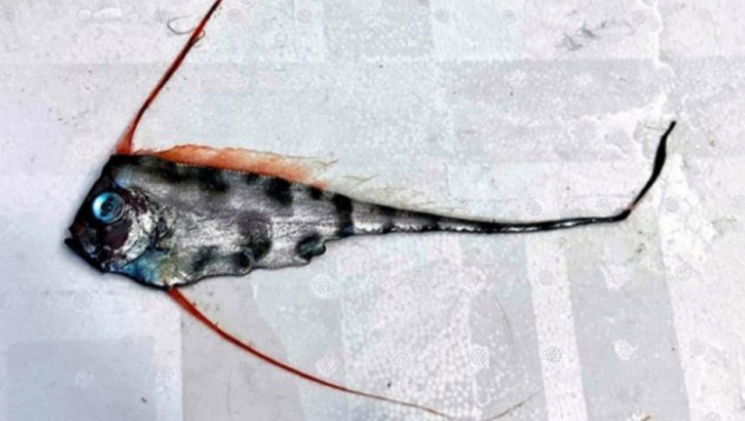
[Asia Economy Reporter Kim Soyoung] A rare deep-sea fish species has been discovered in the deep waters of Japan, raising concerns among some that it might be a 'precursor to a major earthquake.'
According to a report by Asahi Shimbun, the rare deep-sea fish was found in the early morning of the 5th off the coast of Chiba Prefecture, Japan. The fish, caught by a gillnet fishing boat, measured 23.6 cm in length and weighed 33 g, and is said to grow up to about 1 meter when fully grown.
The deep-sea fish discovered this time belongs to the 'Turachi' family, which inhabits very deep waters, making sightings extremely rare. Known as the 'legendary deep-sea fish,' Turachi species live between the surface and midwater layers and are distributed across Korea, Japan's Pacific side of Hokkaido, Okinawa, the central Pacific, New Zealand, South Africa, and the Mediterranean Sea.
Dr. Hiroshi Seno, a fish taxonomist at the Kanagawa Prefectural Museum in Japan, said, "Cases of discovery so far are very rare, so ecological information is not well known," adding, "They inhabit only deep waters, so sightings are also scarce."
Meanwhile, the appearance of the deep-sea fish has sparked concerns in some parts of Japan. In earthquake-prone Japan, there is a superstition that "when deep-sea fish are found, an earthquake will occur."
Scientific evidence suggests that before an earthquake, "chemical substances infiltrate groundwater or gases containing radioactive materials are released," combined with the fact that earthquakes often occur in the sea rather than inland, leading to the superstition that "deep-sea fish sense earthquakes and appear near the coast." In fact, before the massive earthquake that struck northeastern Japan in March 2011, 12 giant cutlassfish, a type of deep-sea fish, washed ashore.
However, related investigations have shown that this is not a significant precursor to earthquakes. A research team from Tokai University in Japan examined the correlation between sightings of deep-sea fish such as giant cutlassfish and earthquakes occurring within 30 days in Japanese coastal waters from 1992 to 2011. They found that the locations matched only 8% of the time.
It is speculated that the timing of deep-sea fish discoveries and earthquakes coinciding in earthquake-prone Japan is merely coincidental.
© The Asia Business Daily(www.asiae.co.kr). All rights reserved.
![Clutching a Stolen Dior Bag, Saying "I Hate Being Poor but Real"... The Grotesque Con of a "Human Knockoff" [Slate]](https://cwcontent.asiae.co.kr/asiaresize/183/2026021902243444107_1771435474.jpg)
















