Ministry of Industry Announces 'K-Battery Development Strategy'
Samsung, LG, SK Battery Trio to Invest 40 Trillion Won by 2030
40-50% Tax Credit on R&D, 20% on Facility Investment... Annual Training of 1,100+ Specialized Personnel
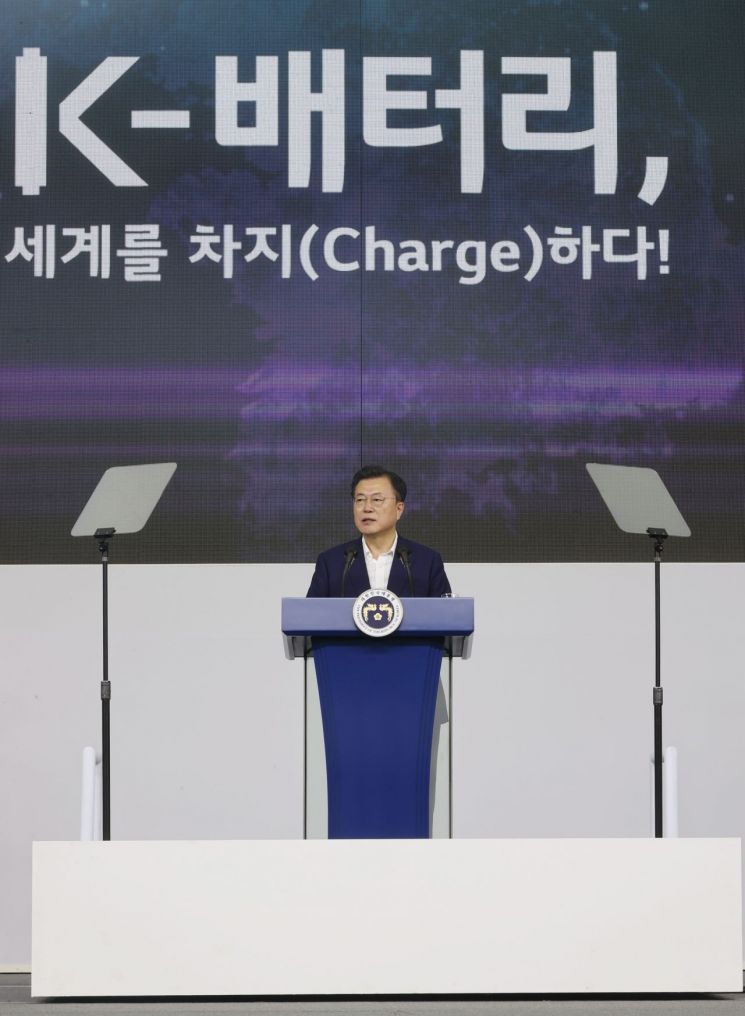 President Moon Jae-in is speaking at the K-Battery Development Strategy Report titled "K-Battery, Charging the World," held on the 8th at LG Energy Solution's Ochang Plant No. 2 in Cheongju, Chungbuk.
 [Sejong=Asia Economy Reporter Kwon Haeyoung] The three domestic battery companies will invest 40 trillion won by 2030 to secure next-generation secondary battery technology. The government will also support large-scale private investment through secondary battery research and development (R&D) support, expanded tax benefits, and training of 1,100 specialized personnel annually. Through this, Korea plans to establish itself as a global battery hub, expanding secondary battery sales to 166 trillion won and exports to 20 billion dollars by 2030, which is 7 times and 3 times the current levels, respectively.
On the 8th, Moon Seung-wook, Minister of Trade, Industry and Energy, announced the joint 'K-Battery Development Strategy' of related ministries at the LG Energy Solution Ochang Plant 2 site, containing these details.
First, to secure next-generation secondary battery technology, the public and private sectors will promote large-scale R&D. The three battery companies?LG Energy Solution, Samsung SDI, and SK Innovation?and material, parts, and equipment companies will invest 40.6 trillion won by 2030. Half of this, 20.1 trillion won, will be allocated to next-generation secondary battery R&D.
The government will support the development of next-generation secondary battery technologies such as all-solid-state, lithium-sulfur, and lithium-metal batteries. To this end, a preliminary feasibility study worth 306.6 billion won will be conducted from 2023 to 2028. A 'Next-Generation Battery Park' will be established for small and medium-sized enterprises to support research, demonstration evaluation, and commercialization of next-generation secondary batteries.
Efforts will also be made to secure overseas raw materials for a stable supply chain. The government will support private overseas material mineral development projects, strengthen cooperation channels with resource-holding countries, and improve stockpiling systems. Related technology development and facility construction will be promoted to recycle secondary batteries and recover raw materials such as lithium and nickel.
The three battery companies and the government will jointly contribute 80 billion won to create an innovation fund. Cooperation between demand and supply companies will also be strengthened, centered on specialized material, parts, and equipment complexes.
Additionally, tax benefits for secondary battery investments will be expanded. New technical items related to national security and future competitiveness will be established under the Restriction of Special Taxation Act, providing tax credits of up to 40-50% for secondary battery R&D costs and up to 20% for facility investments. Incentives such as exemption from overseas business closure requirements will be provided for advanced industries under the revised Return Law.
Training of more than 1,100 specialized secondary battery personnel annually will also be promoted. Specifically, the number of core personnel with master's and doctoral degrees in design and advanced analysis will increase from 50 to 150, and 50 specialists in used battery management will be trained. At the undergraduate level, a secondary battery track will be established in related majors, and specialized secondary battery education programs will be newly introduced regardless of major.
Furthermore, the used secondary battery market will be revitalized. The entire process of 'secondary battery collection → gathering and transportation → storage → sale → performance evaluation → utilization and productization' will be fostered as an industry. New private and public markets where secondary batteries can be newly applied, such as drones, ships, machinery, and public energy storage systems (ESS), will be created. New business models such as secondary battery rental and replacement services will also be developed.
Minister Moon Seung-wook of the Ministry of Trade, Industry and Energy emphasized, "Batteries are a core industry leading the future trends of electrification, wireless technology, and eco-friendliness in industry," adding, "The government will spare no comprehensive support to nurture it as another key industry comparable to semiconductors."
© The Asia Business Daily(www.asiae.co.kr). All rights reserved.
![Clutching a Stolen Dior Bag, Saying "I Hate Being Poor but Real"... The Grotesque Con of a "Human Knockoff" [Slate]](https://cwcontent.asiae.co.kr/asiaresize/183/2026021902243444107_1771435474.jpg)
















