Ministry of Culture, UNESCO, and KOCCA Exhibition 'Korea: Three-Dimensional Imagination'
'Parasite' Space Recreated... So Popular Tickets Sold Out
Thoroughly Prepared with Prior Inspection by Film Crew
"Beyond the HMD Barrier, Experience a World Beyond Imagination"
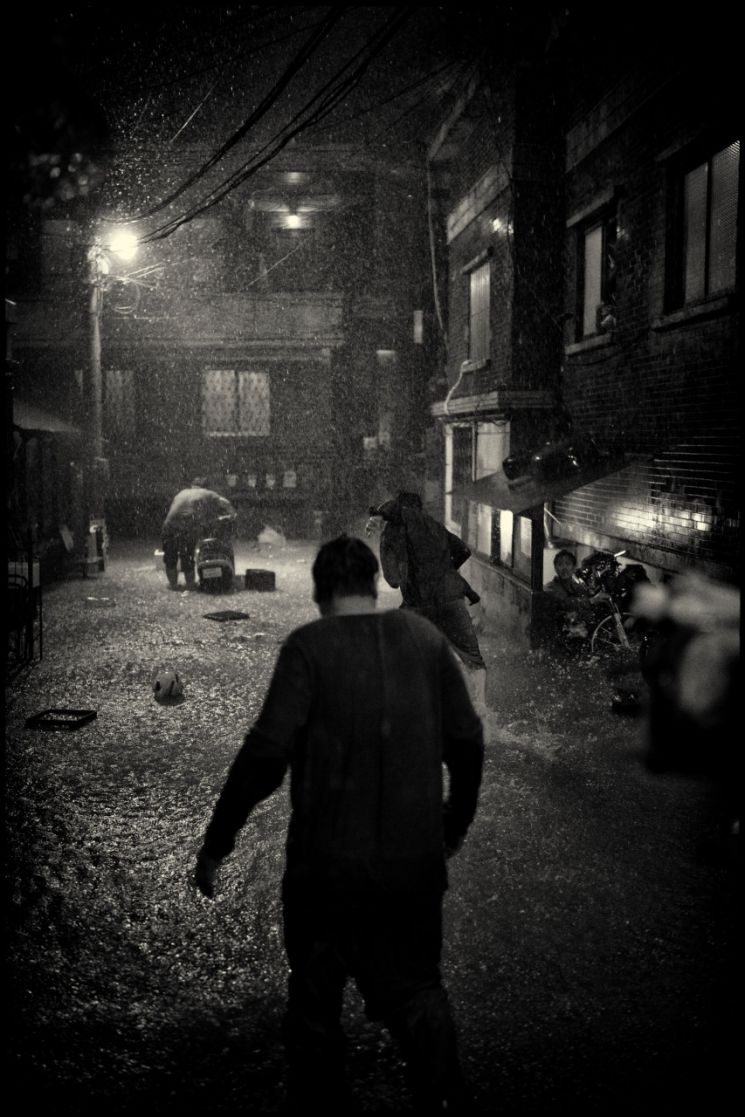
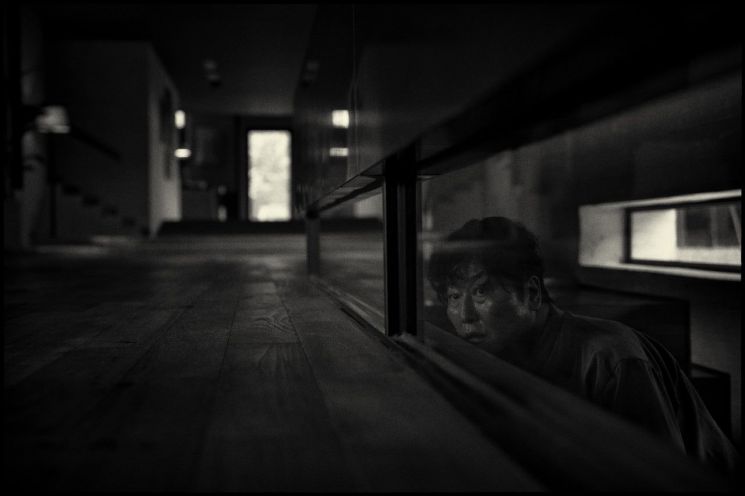
Relentless pouring rain. Three people hurriedly descend a long staircase as if being chased. The destination is a semi-basement house. The rainwater that has entered the house continues to rise, reaching up to the chin. Suddenly, avoiding a flying landscape stone, turning the head reveals a dark staircase. Carefully feeling their way down, a damp basement filled with chilling cold awaits. A man repeatedly bumps his forehead against a button attached to the cement wall. It seems as if he is about to shout, "President Park, thank you for feeding me and putting me to sleep again today, respect!"
Spaces familiar from the movie Parasite have been recreated in virtual reality (VR). Produced as a 4-minute and 30-second piece, it was first unveiled on the 6th (local time) at the UNESCO headquarters in Paris, France. This exhibition, titled "Korea: Three-Dimensional Imagination," was jointly organized by the Ministry of Culture, Sports and Tourism, UNESCO, and the Korea Creative Content Agency. It commemorates the United Nations (UN) designation of the "International Year of Creative Economy for Sustainable Development," sharing imagination about the new future to be reshaped after COVID-19.
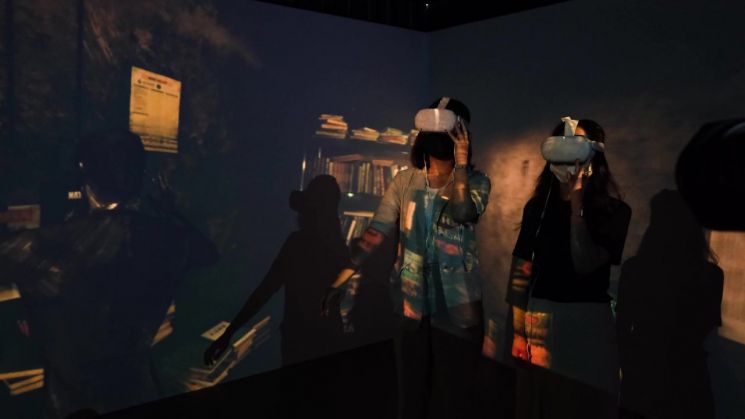
Parasite is an ideal medium. It won the Palme d'Or, the highest award, at the 2019 Cannes Film Festival. It also attracted the largest audience among Korean films ever released in France. Seo Hee-seon, Deputy Head of the Hallyu Business Team at KOCCA, said, "When UNESCO proposed an exhibition of immersive content using Hallyu intellectual property (IP), the first things that came to mind were Parasite and BTS." This exhibition also features the stages of "DNA" and "Zzaleoh" from the online concert "BTS Map of the Soul One," held last October, realized in a three-sided LED cube space.
The response has been so enthusiastic that tickets were sold out well before the closing day on the 16th. Exhibition times for UNESCO staff were hastily arranged. Deputy Seo said, "This is the largest-scale exhibition held at UNESCO headquarters," adding, "We temporarily opened it upon requests from staff who couldn't get tickets, but even those tickets sold out instantly." Ernesto Ottone, Assistant Director-General for Culture at UNESCO, who attended the opening reception, praised, "The global success of Korean popular culture is clearly reflected in immersive content as well." Haifa Al-Muzren, Saudi Arabia's Ambassador to UNESCO, said, "I am happy to meet Parasite again in a new form after watching it twice."
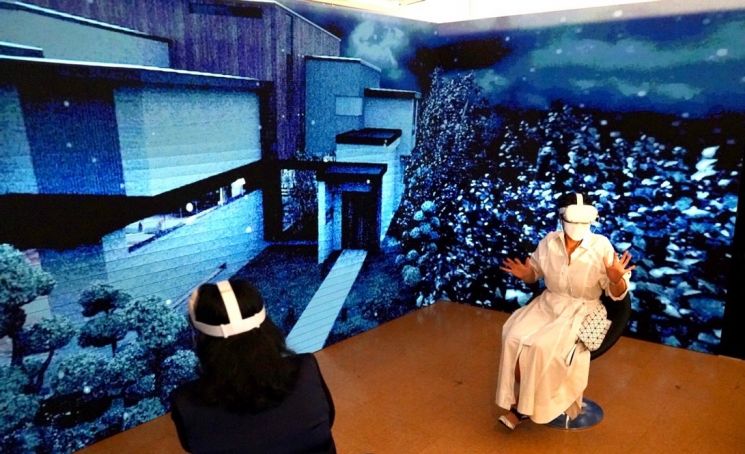
The Parasite immersive content was meticulously prepared to the extent that the film production team conducted prior inspections. At last month's preview, director Bong Joon-ho said, "It is a new experience that cannot be felt in the film." Writer Han Jin-won said, "Just being able to see again the sets and locations that burned the summer of 2018 is a passionate experience." Deputy Seo said, "It seems effective that it was reinterpreted as an art film beyond a simple reproduction of the film space."
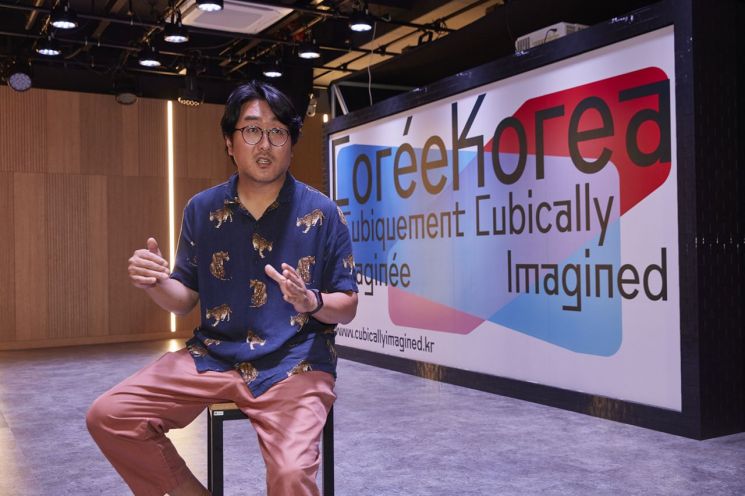
The direction was handled by director Koo Beom-seok. He is a visual effects (VFX) expert who worked on computer graphic lighting for Hollywood films such as The Lord of the Rings: The Return of the King (2003), The Stepford Wives (2004), and The Golden Compass (2007). He said, "I produced it hoping that the audience's gaze would shift among the various characters in Parasite." "If the focus is placed on a specific character, it inevitably leads to subjective interpretation. I wanted to create room for the audience to empathize without damaging the film. So, I thought of spaces representing the personalities of the characters."
Parasite emphasizes its themes through contrasts in space. It compares the residential forms of the lower and upper classes, then shows spatial homogeneity in conflicts among the lower class. These are the semi-basement house flooded by heavy rain and the chilly basement filled with cold air. The lives of the lower and lowest classes were very similar. On the other hand, the so-called belt of trust that seemed to connect the upper and lower classes did not exist.
Director Koo said, "I watched the film countless times to avoid missing any point I wanted to convey." "I thought about what might not have appeared because it was tailored to reality. So, I focused on surreal expressions and designed a condensed development. However, the technical implementation was not easy. Since there was no familiar visual grammar for the public, I paid a lot of attention to detailed restoration. I received many materials from art director Lee Ha-jun to accurately represent everything from the number of bars on the windows to how many books were on the bookshelf."
The Parasite immersive content will be available from the 16th of this month at the KOCCA online exhibition hall. It is an opportunity to share it with people worldwide beyond non-face-to-face experiences. Director Koo said, "Meaningful results continue to emerge in the VR market," adding, "I hope this work contributes to the growth of VR into a major industry." He also reminded viewers to wear head-mounted displays (HMDs) when watching.
"Many users still play VR videos on monitors using video players that support 360-degree content. Director Bong Joon-ho said, 'If you overcome the barrier of subtitles about an inch tall, you can experience much more amazing films.' The same applies to VR. If you overcome the barrier of HMDs, you can experience a world beyond your imagination."
© The Asia Business Daily(www.asiae.co.kr). All rights reserved.



















