"Help or 'What Do Women Do?'" Netizens Debate
Is 'Bystander' Legally Problematic? 'Good Samaritan Law' Mentioned
"No Obligation to Help Others," Some Media Report 'Conflict Provocation'
Experts Say "Being Accused of Harassment Is an Exceptional Case"
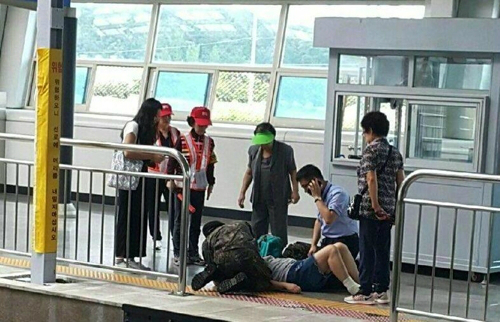 In August 2017, a medic from the Army's 28th Division, who was on leave, performed cardiopulmonary resuscitation on a woman who lost consciousness in the subway, saving her life. Photo by the Army 28th Division
[Asia Economy Reporter Kang Juhee] A community post about a woman who collapsed but was not rescued by the men around her has sparked controversy. The debate arose between claims that men hesitate to help women for fear of being falsely accused of sexual harassment and arguments that ignoring someone in danger violates moral responsibility.
Some have even brought up the so-called 'Good Samaritan Law,' which punishes those who fail to assist people in danger, continuing the debate. However, there are growing concerns that this controversy is escalating into a counterproductive conflict that fuels gender tensions.
Experts explained that being wrongfully accused of sexual harassment in typical emergency situations is an exceptional case.
On the 4th, a post titled "An Incident on the Subway" was uploaded to an online community. It described how a woman collapsed on Seoul Subway Line 3 the previous day, but the men nearby did not help her.
The author wrote, "The collapsed woman was wearing short shorts and rain boots, so some skin was exposed. None of the men in that subway car tried to support or help her," adding, "When the men did not step forward, eventually middle-aged women and young women helped support the collapsed woman and took her out of the subway."
This post sparked heated debates online. Opinions clashed between those who said it is best to stay still to avoid being falsely accused of sexual harassment when helping a woman and those who insisted that helping is the right thing to do. However, comments expressing sympathy for the men’s hesitation to help, such as "You don’t touch a woman who isn’t your family," "Who would step forward when touching a woman is considered sexual harassment?" and "I’ve seen many cases where people got handcuffed for trying to help women," dominated the discussion.
 Stock photo. A community post about a woman who collapsed but was not rescued by the men around her sparked a heated debate among netizens. Photo by Yonhap News
As a basis for the argument that not helping women is justified, a case was mentioned where a man who supported a woman was prosecuted for sexual harassment. On the 8th of last month, a man who helped a woman collapsed in a restroom of a restaurant in Daejeon was wrongfully accused of sexual harassment but was later acquitted. This case illustrates that offering help can sometimes lead to troublesome situations.
However, there are growing concerns that this debate is deepening gender conflicts and turning into a futile argument. Actual comments on related articles included statements like "If a woman collapses, women should help her; why drag men into this mess?", "Women shouldn’t expect anything from men," and "Is it only men’s responsibility to support someone?" which fuel gender tensions.
Some media outlets also appeared to exacerbate the conflict. One outlet mentioned the so-called 'Good Samaritan Law' in relation to this debate, quoting an expert who said, "South Korea does not have a Good Samaritan Law, so there is no legal obligation to help others, and failure to do so is not punishable." This could be interpreted as suggesting that there is no legal duty to intervene, so bystanders can remain passive.
Some citizens viewed this controversy with concern. Lee, a 20-something office worker, said, "Most people are grateful when someone helps them and don’t think about reporting them as sexual harassers," adding, "Generalizing a few misused cases as if they could happen in every situation is an overinterpretation and seems like a malicious attempt to incite gender conflict."
Experts explained that being wrongfully accused of sexual harassment in typical emergency situations is an exceptional case.
Attorney Lee Eun-ui (Lee Eun-ui Law Office) said, "The vast majority of ordinary people in our society do not think they will be accused of sexual harassment in such situations. If no one helps or if someone asks for help, people would definitely step forward," adding, "Whether male or female, it is fortunate if someone intervenes in a dangerous situation, and there is no reason for this to escalate into a controversy. Labeling normal citizens as 'men who don’t help women' or 'women who only expect help' is problematic."
Regarding the case of the man falsely accused of sexual harassment, Lee explained, "It is a regrettable incident, but in reality, there are far more cases where people falsely claim they were just trying to help after committing quasi-forced sexual assault or use the excuse of helping intoxicated persons to harass them. Compared to such cases, those who are wrongfully accused are extremely rare."
© The Asia Business Daily(www.asiae.co.kr). All rights reserved.
![User Who Sold Erroneously Deposited Bitcoins to Repay Debt and Fund Entertainment... What Did the Supreme Court Decide in 2021? [Legal Issue Check]](https://cwcontent.asiae.co.kr/asiaresize/183/2026020910431234020_1770601391.png)
















