Daily COVID-19 Cases on the 6th Near Record High
Second Supplementary Budget Already Announced, 24.1 Trillion KRW Allocated for Consumption Stimulus and 4.4 Trillion KRW for Vaccines and Quarantine
Effectiveness of Cashback Program Focused on Non-Face-to-Face Offline Consumption in Question
"Concerns Over Face-to-Face Consumption Stimulus Clashing with Quarantine Measures"
[Asia Economy Reporters Kim Hyun-jung (Sejong), Jang Se-hee] As daily COVID-19 cases exceed 1,200, the government’s second supplementary budget (supplementary budget) focused on consumption stimulus and economic recovery has come under scrutiny. The original plan to resume the consumption coupon program, which was halted due to the COVID-19 spread, as early as next month now appears inevitably subject to revision.
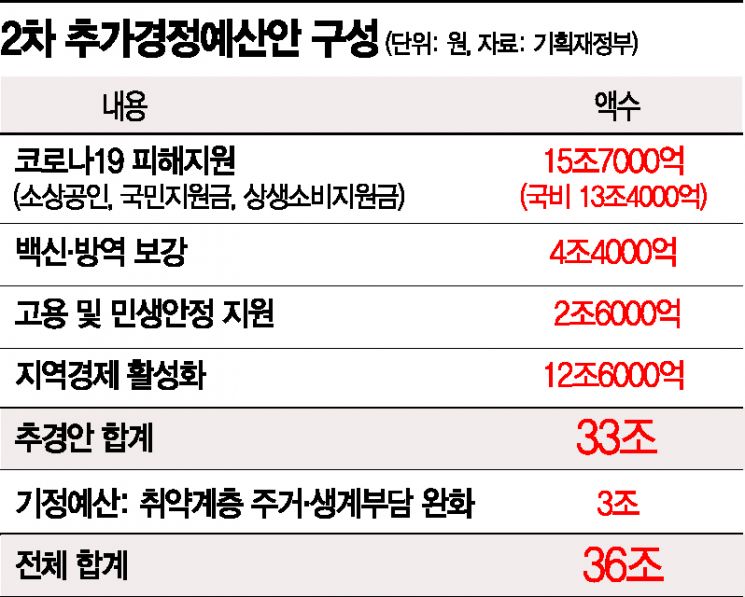
According to the Ministry of Economy and Finance on the 7th, out of the 33 trillion KRW second supplementary budget announced at the end of last month, the budget related to COVID-19 quarantine (including vaccines) is 4.4 trillion KRW, accounting for only 13.3% of the total. The projects include ▲vaccine purchase (1.5 trillion KRW), vaccination (500 billion KRW), and expanded compensation for adverse reactions (18.1 billion KRW) ▲expanded COVID-19 diagnostic testing and support for isolated individuals (1.3 trillion KRW), and compensation for losses of medical institutions (900 billion KRW) ▲establishment of a global vaccine hub and domestic vaccine development (200 billion KRW).
On the other hand, about 24.1 trillion KRW, or approximately 73% of the total budget, was allocated to disaster relief funds for consumption stimulus, consumption plus funds, credit card cashback programs, and regional economic revitalization. Even though the number of confirmed cases was rising to the 700s at the beginning of this month when the supplementary budget was announced, the vaccination rate was also rapidly increasing, leading the government to prioritize ‘consumption stimulus’ over ‘quarantine.’ However, with nationwide confirmed cases reaching 1,212 on the 6th, nearing the highest daily level ever, the government’s approach is increasingly likely to be considered a ‘misjudgment.’
The timing for resuming the consumption coupon program, which was expected to restart once the vaccination rate reached 50% regardless of case numbers, is also likely to be adjusted. The Ministry of Economy and Finance had announced that once the first-dose vaccination rate exceeds 50%, consumption coupons for dining out, sports, movies, exhibitions, and performances would be reissued, and a sports viewing coupon system would be implemented, projecting this to occur in August. It was also reported that in September, when the first-dose vaccination rate is expected to exceed 70%, accommodation and tourism consumption coupons would resume, along with the issuance of railway and bus coupons.
Additionally, the cashback program, which has a budget of 1.1 trillion KRW and limits its target to offline face-to-face consumption, is criticized for being unlikely to effectively stimulate consumption amid the rapid increase in COVID-19 cases. Professor Andong-hyun of Seoul National University’s Department of Economics expressed concern, stating, "Stimulus measures for face-to-face consumption at a time when confirmed cases are in the 1,000s could conflict with quarantine efforts."
© The Asia Business Daily(www.asiae.co.kr). All rights reserved.

















