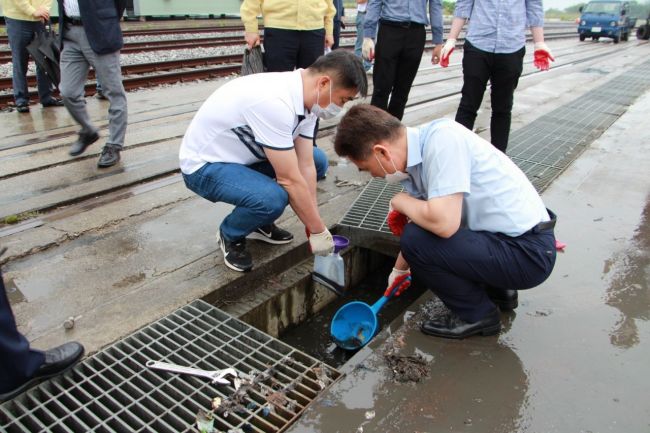
[Asia Economy Honam Reporting Headquarters Reporter Kim Yukbong] Naju City, Jeollanam-do (Mayor Kang In-gyu) disclosed the analysis results of leachate collected during an inspection of the solid refuse fuel (SRF) storage site at Jangseong Complex Logistics Center on the 15th of last month.
According to the city on the 6th, contrary to the Korea District Heating Corporation's claim that the substance was "rainwater mixed with dust on the waterproof sheet," the pollution concentration, including biological oxygen demand (BOD), was measured to be thousands of times higher than normal rainwater.
Additionally, some heavy metals such as lead and mercury were also detected.
During the inspection, the city collected black leachate emitting a foul odor and flowing into the drainage from beneath the stacked fuel piles at five different points and requested analysis from the Jeollanam-do Health and Environment Research Institute.
The requested test components included four heavy metals?lead, arsenic, cadmium, and mercury?as well as nine items such as biological oxygen demand (BOD), chemical oxygen demand (COD), total nitrogen, total phosphorus, and suspended solids.
According to the leachate analysis results from the Jeollanam-do Health and Environment Research Institute disclosed by the city, biological oxygen demand (BOD), an indicator of environmental pollution, was measured at 2,828.4 ppm (mg/L), and chemical oxygen demand (COD) was 1,717.6 ppm.
Compared to the components found in pure rainwater reported by the Korean Society of Clean Technology in 2011, the BOD was approximately 4,040 times higher, and the COD was about 1,145 times higher.
The total nitrogen, a main component of the recurring green algae phenomenon in the Yeongsan River every year, was 176 ppm, and total phosphorus was 10.385 ppm.
Compared to the permissible discharge standards for public sewage treatment facilities, total nitrogen (20 ppm) was about 8.8 times higher, and total phosphorus (0.3 ppm) was about 34.6 times higher.
Regarding heavy metals that directly affect the human body, cadmium was 0.018 ppm, lead was 0.336 ppm, and mercury content was confirmed at 0.002 ppm.
A city official stated, “Contrary to the heating corporation’s claim that it was rainwater mixed with dust, the leachate analysis results from a professional institution detected pollutants thousands of times higher than rainwater, increasing distrust regarding fuel use. The heating corporation must guarantee administrative and citizen observation to ensure fairness rather than unilateral quality inspections and transparently disclose the inspection process and results.”
Honam Reporting Headquarters Reporter Kim Yukbong bong2910@asiae.co.kr
© The Asia Business Daily(www.asiae.co.kr). All rights reserved.
![Clutching a Stolen Dior Bag, Saying "I Hate Being Poor but Real"... The Grotesque Con of a "Human Knockoff" [Slate]](https://cwcontent.asiae.co.kr/asiaresize/183/2026021902243444107_1771435474.jpg)
















