Presidential 4th Industrial Revolution Committee Deliberates and Approves 'Measures to Promote Private Data Purchase in the Public Sector'
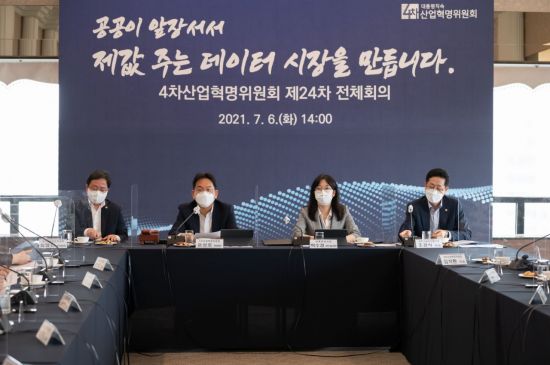 (From left) Choi Young-jin, Vice Chairman of the Personal Information Protection Commission; Yoon Sung-ro, Chairman of the 4th Industrial Revolution Committee; Park Soo-kyung, Science and Technology Advisor of the Presidential Secretariat; Cho Kyung-sik, Vice Minister of Science and ICT.
[Asia Economy Reporter Eunmo Koo] The government is promoting the activation of data-driven administration through improvements in the system and procurement methods related to the purchase of private data by public institutions.
The Presidential Committee on the Fourth Industrial Revolution held its 24th plenary meeting on the afternoon of the 6th at the Press Club on the 20th floor of the Korea Press Center in Jung-gu, Seoul, and announced the "Measures to Promote the Purchase of Private Data in the Public Sector."
Recently, as data utilization has become widespread not only in companies but also in the public sector, the purchase of private data is also showing an increasing trend. However, due to a lack of experience in purchasing and utilization, there are differences in the classification of data product types and pricing methods, and the exact scale of private data purchased by the public sector is not accurately grasped.
The measures prepared to improve this situation are the measures to promote the purchase of private data in the public sector. The 4th Industrial Revolution Committee has prepared 12 major action tasks to resolve inconveniences experienced by public institutions in the process of purchasing and utilizing private data. The committee expects that if public institutions take the lead in purchasing private data at fair prices and utilize it properly, it will support strengthening the data distribution and transaction ecosystem and activating data-driven administration.
First, the committee will systematize the purchase system of private data. To this end, it plans to specifically stipulate matters related to data purchase separately in the budget formulation and execution guidelines. In addition, a data price estimation standard that sufficiently reflects private opinions will be prepared to respect market-based pricing. Along with guidelines that can be referenced at each stage from data ordering to post-management, a standard contract will also be provided.
Furthermore, the procurement method for private data will be specified. A procurement system will be established according to the type of data product so that purchase contracts can be made appropriately. Public institutions will be encouraged to purchase and utilize private data as much as possible, and standards to promote private data purchase, such as separating orders for data purchases above a certain scale from service projects, will be established.
To support the sale and commercialization of private data, a data demand forecast will be conducted in the public sector to investigate and announce the demand for private data purchases. Through this, the public sector will be able to predict data purchase demand and scale, and data companies will receive help in sales marketing and management strategy establishment.
Finally, to stimulate demand for private data, consulting to support data utilization in the public sector will be expanded, and public big data analysis reference models that local governments and others can commonly use will be continuously discovered and disseminated. Also, capacity-building programs necessary for data utilization will be prepared and implemented under the leadership of data-driven administration officers in each institution.
In addition, detailed content regarding private sector suggestions to promote the use of pseudonymized information will be announced in the future in cooperation with related ministries such as the Personal Information Protection Commission.
Yoon Sung-ro, chairman of the 4th Industrial Revolution Committee, said, "To promptly implement the 'National Data Policy Direction (Korea Data 119 Project)' announced last February, we hold a joint public-private data special committee every month to derive concrete action tasks and encourage implementation by each ministry through follow-up inspections." He emphasized, "In particular, this review agenda is a meaningful achievement as it addresses the demands of private data companies hoping for appropriate market prices considering the characteristics of data and resolves difficulties in purchasing data in the public sector."
© The Asia Business Daily(www.asiae.co.kr). All rights reserved.
![Clutching a Stolen Dior Bag, Saying "I Hate Being Poor but Real"... The Grotesque Con of a "Human Knockoff" [Slate]](https://cwcontent.asiae.co.kr/asiaresize/183/2026021902243444107_1771435474.jpg)
















