Stalled at 29.9% Vaccination Rate Relative to Population
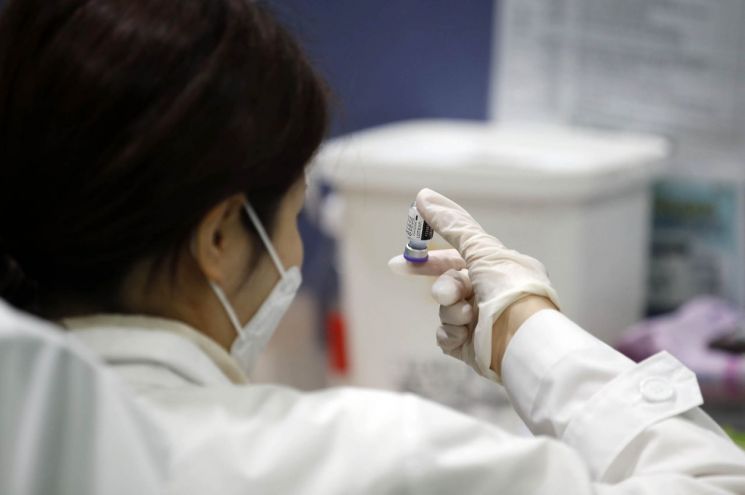 On the 21st of last month, medical staff at the Gwangju Buk-gu Vaccination Center were preparing the Pfizer vaccine. (Photo by Gwangju Buk-gu Office)
[Asia Economy Reporter Chunhee Lee] Recently, as the number of confirmed cases has sharply increased, concerns about the fourth wave of the pandemic are rising. However, vaccination efforts to prevent it have slowed down, with the second day since the start of vaccinations seeing no first-dose recipients, raising worries.
According to the COVID-19 Vaccination Response Promotion Team on the 5th, no new vaccinations were administered the previous day. As a result, the number of people who received the first dose of the COVID-19 vaccine remained at 15,347,214 for the second consecutive day. The vaccination rate relative to the population also stayed at 29.9%.
Since the start of COVID-19 vaccinations on February 26, the days with zero first-dose recipients have been only twice: on March 21 and on this day. In early to mid-last month, 9.62 million people received their first dose over three weeks, but in the recent two weeks, only 310,000 were vaccinated, showing a sharp slowdown in first-dose vaccination speed.
The vaccination rate has also remained in the 29% range for 16 consecutive days since it rose to 29.3% on the 19th of last month, when 216,320 people were vaccinated in one day. In the previous three weeks, the vaccination rate surged vertically from 11.3% to 29.3%. The health authorities explain that they are focusing on second-dose vaccinations, but the number of second doses administered has not significantly increased either. Particularly, unlike Pfizer, which receives weekly supplies, AstraZeneca (AZ) has concentrated its existing supply on first doses, and the supply of 835,000 doses scheduled for the first half of the year through the COVAX facility has been delayed, causing difficulties in supply management.
Considering the 11-week interval for AZ vaccine doses, about 400,000 people should have received their second dose in the past two weeks. However, the actual number of second-dose recipients is only 140,000, less than half. Currently, the government has only 294,100 doses of AZ vaccine remaining. This is far from enough to cover the approximately 500,000 people whose second-dose interval falls this week.
The authorities plan to overcome this by using heterologous (mix-and-match) vaccinations. The 952,000 people scheduled for their second AZ dose this month will receive their second dose with Pfizer. This approach not only resolves the supply shortage but also gains momentum as research shows that heterologous vaccination is more effective in prevention than receiving two doses of AZ vaccine alone.
Moreover, with the AZ vaccine age restriction raised to under 50 years old, the focus of vaccinations in the second half of the year is expected to shift to messenger RNA (mRNA) vaccines such as Pfizer and Moderna. The mRNA vaccines scheduled for introduction within this year amount to a total of 98.89 million doses, including approximately 59 million doses of Pfizer and 39.89 million doses of Moderna planned for direct import.
© The Asia Business Daily(www.asiae.co.kr). All rights reserved.

















