Illegal Conversion of Neighborhood Living Facilities into Residential Use
Building Owners Gain Benefits by Reducing Parking Spaces and Other Tricks
Only Current Owners Face Enforcement Fines, Causing Unfair Damage
Thoroughly Check Building Register Before Sale or Purchase Contracts
[Asia Economy Reporter Ryu Taemin] Recently, cases of damage have been rapidly increasing where so-called ‘Geunsaeng Villas’?commercial buildings or offices illegally converted into residential housing without permits?are being sold or purchased under the false pretense of being residential homes. In particular, the issue has been pointed out that the enforcement fines for illegal use changes are imposed on the current owners of Geunsaeng Villas at the time of detection.
Geunsaeng Villas are a type of illegal housing created by converting the commercial parts of neighborhood living facilities into residential use. According to the Building Act, neighborhood living facilities must be used as commercial spaces necessary for daily life, such as retail stores. Due to differences in parking lot and floor restrictions compared to residential standards, use changes are practically not allowed. According to the current Seoul City standards for installing auxiliary parking lots, neighborhood living facilities must provide one parking space per 134㎡ (facility area), whereas multi-family and apartment houses must provide at least 0.5 parking spaces per household based on area standards. Regarding floor restrictions, multi-family houses are limited to three floors or less, and multi-unit and row houses are limited to four floors or less under the Building Act, but neighborhood living facilities have no separate floor restrictions.
The reason for the increase in Geunsaeng Villas is to maximize development profits. From the builder’s perspective, obtaining permission as a neighborhood living facility allows for reduced parking area requirements and the construction of taller buildings, which is advantageous in terms of cost. Later, by installing cooking facilities and converting the space into residential use, the appearance resembles that of a regular house, leading many buyers to unknowingly purchase Geunsaeng Villas without realizing they are illegal buildings.
The problem is that when the illegal building status is detected, enforcement fines are imposed not on the original builder who committed the illegal act but on the current owners. If cooking facilities are not removed, enforcement fines amounting to up to 10% of the standard market value must be paid up to twice a year.
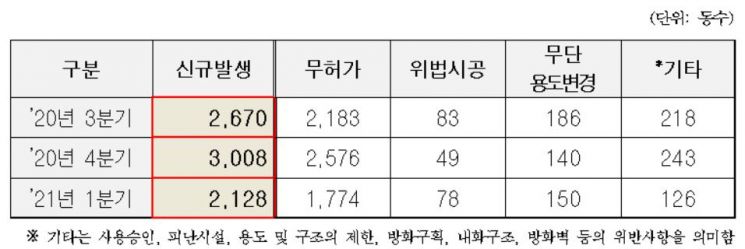
According to Seoul City, in the first quarter of this year, there were a total of 2,128 cases of building law violations across 25 autonomous districts. Among these, ‘unauthorized construction’ accounted for the largest share with 1,774 cases (83%). ‘Unauthorized use changes’ such as Geunsaeng Villas followed with 150 cases (7%). Enforcement fines totaling 3.7 billion KRW were imposed.
Seoul City emphasizes that to prevent damage from ‘unauthorized use changes’ like Geunsaeng Villas, it is essential to check the building register when selling or purchasing the building. The building register records key information about the building such as location, area, structure, and use, allowing confirmation of whether the building is designated for residential or neighborhood living facility use.
© The Asia Business Daily(www.asiae.co.kr). All rights reserved.
!["I'd Rather Live as a Glamorous Fake Than as a Poor Real Me"...A Grotesque Success Story Shaking the Korean Psyche [Slate]](https://cwcontent.asiae.co.kr/asiaresize/183/2026021902243444107_1771435474.jpg)
















