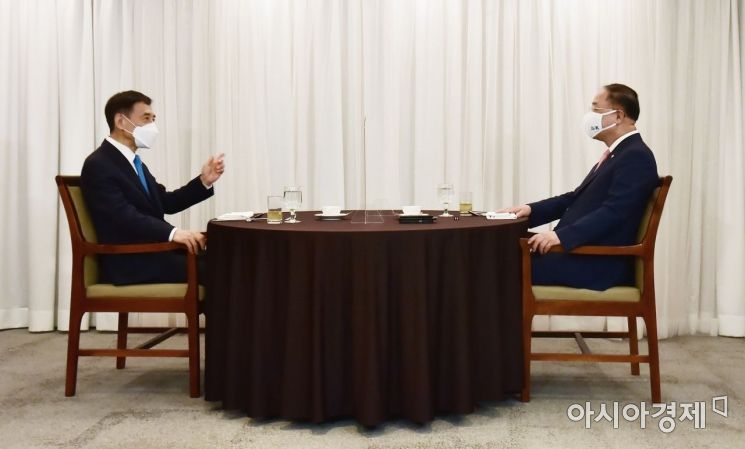
 Hong Nam-ki, Deputy Prime Minister and Minister of Economy and Finance (right), and Lee Ju-yeol, Governor of the Bank of Korea, are having a breakfast meeting on the 2nd at the Press Center in Jung-gu, Seoul. Photo by Moon Ho-nam munonam@
First Exclusive Meeting in 2 Years and 7 Months
Evaluated as 'A New Form of Policy Coordination'
[Asia Economy Reporter Kim Eunbyeol] Hong Nam-ki, Deputy Prime Minister and Minister of Economy and Finance, and Lee Ju-yeol, Governor of the Bank of Korea, met and agreed to raise the benchmark interest rate while maintaining an expansionary fiscal policy for the time being. This meeting was held to coordinate opinions directly between the heads of fiscal and monetary policy amid controversy over 'policy mismatch,' as the Bank of Korea announced plans to tighten monetary policy by raising interest rates within the year, while the government moved to inject funds through a supplementary budget (추경). The logic is to raise interest rates because asset prices have surged rapidly amid a continued ultra-low interest rate environment and a swift economic recovery, while supporting relatively slower recovery areas through fiscal policy. This is also seen as breaking the conventional notion that fiscal and monetary policies must move in the same direction and adopting 'a new form of policy coordination.'
On the 2nd, Deputy Prime Minister Hong and Governor Lee held a breakfast meeting at the Korea Press Center and stated, "Although the economy is recovering rapidly, in a situation where risks such as uneven recovery across sectors, polarization, and financial imbalances are latent, precise coordination and role-sharing between fiscal and monetary policies are more important than ever." They explained that fiscal and monetary policies should be operated complementarily according to the economic situation and their roles. This was the first exclusive meeting between Deputy Prime Minister Hong and Governor Lee in 2 years and 7 months since Hong’s inauguration in December 2018. The event was held in a casual conversation format over breakfast without any attendants.
They agreed that fiscal policy should maintain the current stance for the time being, while monetary policy needs to adjust the degree of easing according to economic improvements. Fiscal policy aims to compensate for the damage to growth potential and consumption capacity caused by the COVID-19 shock and help vulnerable sectors feel the economic recovery, while monetary policy should adjust easing to reduce side effects such as accumulated financial imbalances due to prolonged low interest rates. Given that the Bank of Korea hinted at raising the benchmark interest rate within the year, the government also appears to share this necessity.
Both sides evaluated the current economic situation as "showing a rapid and strong recovery." However, they noted that recovery speed is uneven across sectors and potential risk factors remain. This is why monetary policy, which affects all sectors evenly, will adjust the degree of easing, while fiscal policy will be maintained for the time being. The government and the Bank of Korea expect exports and investment to continue driving a solid economic recovery, but face-to-face services and employment have not yet fully recovered, so difficulties in the livelihood economy, such as job and income reductions among vulnerable groups, persist.
The Bank of Korea’s decision to pursue an interest rate hike within the year stems from the fact that it has maintained the historically lowest benchmark interest rate of 0.50% for over a year since the COVID-19 outbreak, leading to serious capital concentration in asset markets such as real estate and stocks. Easy borrowing due to low interest rates caused asset prices to soar, with household debt exceeding 100% of GDP underpinning this surge. In its financial stability report released last month, the Bank of Korea revealed that the Financial Vulnerability Index (FVI) stood at 58.9, the highest in 13 years since the global financial crisis in 2008 (73.6). A high FVI indicates that the potential shock that could burst in an economic crisis has grown. The Bank of Korea also warned that if financial imbalances caused by capital concentration in finance persist, housing prices could sharply decline due to internal and external shocks.
Meanwhile, Deputy Prime Minister Hong and Governor Lee also exchanged views on the upcoming G20 Finance Ministers and Central Bank Governors Meeting next week. They confirmed the need for cooperation between the government and the Bank of Korea to maximize national interests and discussed related agendas. ▲ Strengthening the global health system ▲ Enhancing communication among G20 countries ▲ Restoring global supply chains and trade systems were identified as key areas.
They also agreed to respond in unison to issues such as resource allocation for crisis response and debt relief for low-income groups, which are being discussed mainly by international financial institutions like the International Monetary Fund (IMF). Regarding major issues in international tax investigations, they stated, "We will actively express opinions to derive reasonable international tax principles."
© The Asia Business Daily(www.asiae.co.kr). All rights reserved.

















