TPS, Positive Customer Perception and Low Prices
Bundled Products as a Strong Weapon
3,150 New Cases in Q2...7 Times Increase
Challenges for Win-Win Remain Amid Strong Sales
Discounts Also Planned for Other Altteul Phones
[Asia Economy Reporter Cha Min-young] "I changed my internet service while signing up for a budget phone." Kim Su-young (pseudonym), in her 20s, recently switched her existing internet and TV services while looking for a combination of unlocked smartphones and budget phones for her mother in her 50s. Just by changing the bundled products, her monthly bill dropped by more than 20,000 KRW, significantly reducing her perceived communication expenses.
KT Skylife, which entered the budget phone business last year, has been on a solid upward trajectory after about six months. This is the result of positive consumer perception of the triple-play service (TPS) bundles combining internet, TV, and mobile services, along with the rising trend in the budget phone market. Attention is focused on whether KT Skylife, which had struggled against IPTV providers, can achieve a turnaround in performance.
Rapid Increase in TPS New Applications
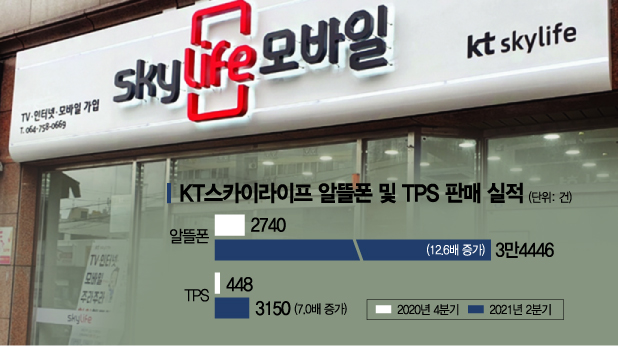
On the 2nd, KT Skylife announced that since launching its budget phone business at the end of October last year, it has been increasing sales of TPS products that bundle satellite TV, internet, and budget phones. As of the second quarter of this year, new TPS applications reached 3,150, about seven times the 448 applications in the fourth quarter of last year. This also represents a 21.6% increase compared to the previous quarter, the first quarter (2,589 applications). New budget phone sales in the second quarter were 34,446, more than 12 times the 2,740 units sold in the fourth quarter, and showed 29.1% growth compared to the previous quarter (26,681 units).

The so-called bundled products benefit from customers' positive perception and affordable prices. Since basic contracts for internet services typically last 36 months (3 years), there is an expectation that the no-contract-based budget phone service can be continuously maintained. This is the so-called 'customer lock-in' effect. In fact, in the budget phone market, there is ongoing concern about frequent carrier changes. The replacement cycle for short-term customers, known as 'migratory birds,' averages about three months.
Kim Cheol-soo, president of KT Skylife, also expressed determination at the beginning of the year during the '2021 LAN Line New Year's Meeting.' President Kim emphasized, "KT Skylife must become a leader of change in the paid broadcasting market through a disruptive approach." This year, the focus is on establishing itself as a TPS operator by expanding subscribers to budget phones and bundled products.
"Plans to Promote Bundled Discounts with Other Budget Phones"
Although the budget phone market has shown strong initial sales, challenges for coexistence remain. Concerns were raised about KT Skylife, a subsidiary of a telecom company, entering the budget phone market. The Budget Telecommunications Operators Association conveyed its opposition to the Ministry of Science and ICT, the regulatory authority, regarding KT Skylife's market entry. While the Ministry of Science and ICT evaluated the move positively in terms of market activation, it imposed additional registration conditions due to concerns about reduced fair competition.
Accordingly, KT Skylife plans to offer wired and wireless bundled products equally to budget phone users by the end of the year. Even if subscribers of other budget phone carriers sign up for KT Skylife TV and internet and request bundled discounts, they will receive equal discounts without discrimination. A company representative explained, "We are preparing specific measures and plan to introduce them within the year."
Despite fierce criticism from the same industry, the company's entry into the budget phone market stems from a sense of crisis. As the satellite TV industry was overwhelmed by the IPTV market's momentum, driven by bundled products and large-scale marketing, KT Skylife also faced subscriber churn. KT Skylife's total subscriber count has declined annually from 4.36 million in 2017 to 4.27 million in 2018, 4.19 million in 2019, and 4.04 million last year. Subscribers to OTS (Olleh TV Skylife), once a revenue pillar for the company, decreased by one-fifth from 1.83 million in 2017 to 1.47 million in 2020. Although the consolidated subsidiary Skylife TV's revenue has steadily increased, concerns about the core business have grown.
Amid expectations that OTS subscriber churn will continue this year, there is speculation that the transition to TPS will partially offset these concerns. Kim Seung-hoe, a researcher at DS Investment & Securities, noted, "The results of the TPS business, which has been the focus since entering the budget phone market, are becoming apparent, and it appears to be appealing to younger customers through overlapping discounts."
© The Asia Business Daily(www.asiae.co.kr). All rights reserved.
![Clutching a Stolen Dior Bag, Saying "I Hate Being Poor but Real"... The Grotesque Con of a "Human Knockoff" [Slate]](https://cwcontent.asiae.co.kr/asiaresize/183/2026021902243444107_1771435474.jpg)

















