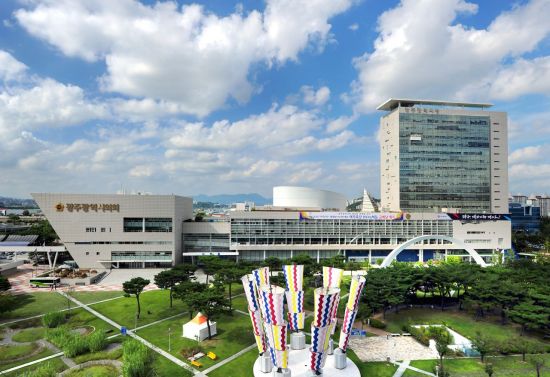
[Asia Economy Honam Reporting Headquarters Reporter Yoon Jamin] The Gwangju Innovation Promotion Committee, directly under the Mayor of Gwangju Metropolitan City, has delivered a recommendation plan titled ‘Activation of Renewable Energy Supply for Realizing a 2045 Energy Self-Reliant City’ to the Gwangju City government.
According to Gwangju City on the 29th, this recommendation plan was prepared as the necessity for policies promoting a carbon-neutral energy self-reliant city that can stimulate the production and consumption of renewable energy was raised to achieve the goal of a ‘2045 Carbon Neutral Energy Self-Reliant City’ related to the ‘Gwangju-type AI-Green New Deal’ announced by Gwangju City last year.
The recommendation plan includes 14 innovation tasks in three main directions: ▲strengthening the implementation system for realizing a 2045 energy self-reliant city ▲building infrastructure for accommodating renewable energy and decarbonization ▲sharing benefits of renewable energy through citizen participation.
First, to strengthen the implementation system for realizing a 2045 energy self-reliant city, a regional energy plan will be established to expand renewable energy generation, and the achievement level of implementation will be analyzed annually and announced to citizens.
A Honam region super-metropolitan energy-economic community will be formed in connection with Jeonnam and Jeonbuk, which are rich in renewable energy sources, to actively participate in establishing development strategies for the Honam region, support energy transition, and actively foster local talents who will lead technological convergence.
Second, to build infrastructure for accommodating renewable energy and decarbonization, new power infrastructure technologies such as direct current distribution and energy storage systems (ESS) will be introduced in line with the activation of renewable energy and electric vehicle supply such as hydrogen and solar power. Additionally, platforms such as next-generation power storage systems for stable storage, supply, and control of distributed renewable energy sources will be established.
To enable the use of renewable energy produced through the construction of intelligent power grids and to secure the stability of existing power transmission and distribution networks, support will also be provided for the development of direct current transmission and distribution system technology and the establishment of test beds.
Along with the construction of large-scale hydrogen supply facilities such as hydrogen production bases, hydrogen distribution infrastructure will be expanded, and an energy data platform linked with the Gwangju AI Data Center will be established for big data analysis of consumer power patterns including renewable energy production, supply, and consumption. Furthermore, a Honam region renewable energy integrated operation center will be attracted to execute the energy-economic community.
Lastly, to share the benefits of renewable energy through citizen participation, an energy transition fund will be created to support the development of renewable energy power plants and job creation, transitioning to an eco-friendly energy infrastructure system that directly benefits citizens.
Citizen awareness transformation projects that allow direct participation by citizens, such as cooperatives and village enterprises, will be diversified, and for renewable energy generation projects of a certain scale or larger promoted within the region, local residents will be allowed to participate directly and nearby residents’ benefits will be generated.
In addition, a citizen participation-type energy transition and management platform model will be established that analyzes building energy usage patterns and enables citizens to experience the effects of energy efficiency improvement, demand management, energy saving, and production.
Joo Jung-min, Chairperson of the Innovation Promotion Committee, said, “Energy self-reliance must precede the achievement of a carbon-neutral city,” and added, “To realize an energy self-reliant city, the energy production and consumption structure must shift to focus on renewable energy, and we prepared the recommendation plan so that Gwangju City can become a sustainable eco-friendly energy city.”
© The Asia Business Daily(www.asiae.co.kr). All rights reserved.
![Clutching a Stolen Dior Bag, Saying "I Hate Being Poor but Real"... The Grotesque Con of a "Human Knockoff" [Slate]](https://cwcontent.asiae.co.kr/asiaresize/183/2026021902243444107_1771435474.jpg)
















