Top 20% Nationwide Housing Prices Surpass 1.1 Billion Won for the First Time
High-End Housing Prices Significantly Increased Compared to Early Administration
5th Quintile Ratio 8.9... Wealth Gap Deepens
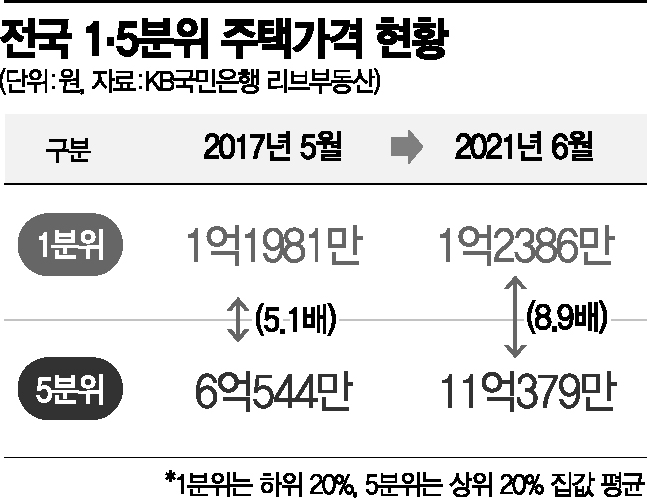
[Asia Economy Reporter Moon Jiwon] The average price of the top 20% of houses nationwide has surpassed 1.1 billion KRW for the first time. Compared to the early days of the current administration (605.44 million KRW), this is nearly double the increase. Accordingly, the quintile ratio, which indicates the price difference between high-priced and low-priced houses, has also risen to an all-time high. Concerns are emerging that the polarization of real estate assets is worsening.
According to the monthly housing price trend time series statistics from KB Kookmin Bank’s Liv Real Estate on the 29th, the average price of the top 20% quintile houses nationwide this month was recorded at 1.10379 billion KRW. This is the highest since the statistics began being compiled in December 2008.
The nationwide 5th quintile housing price exceeded 600 million KRW in February 2017, just before the Moon Jae-in administration took office, then surpassed 700 million KRW in September 2018, 800 million KRW in February 2020, 900 million KRW in August 2020, 1 billion KRW in January this year, and 1.1 billion KRW in June. It took 1 year and 7 months to rise from 600 million to 700 million KRW, but recently this period has shortened to 5 months.
In Seoul, after the average price of 5th quintile houses exceeded 2 billion KRW in December last year, it soared to 2.14272 billion KRW in March, just three months later, entering the 2 billion KRW range. This month, the 5th quintile housing price in Seoul was 2.17749 billion KRW, which is 964.22 million KRW higher compared to the early days of the current administration (1.21327 billion KRW).
On the other hand, the average price of the bottom 20% 1st quintile houses showed minimal increase. As of this month, it was 123.86 million KRW, only 4.05 million KRW (3.3%) higher than 119.81 million KRW in May 2017. The 1st quintile housing price fell to 112.16 million KRW in January last year but has only recently started to rise again. Due to the government’s successive real estate policies, high-priced houses have risen more steeply, while low-priced houses have either fallen in price or shown minimal increases.
As a result, the price gap between the top 20% and bottom 20% houses is rapidly widening. The nationwide quintile ratio of housing prices reached 8.9, the highest since KB’s statistical survey began. The quintile ratio is calculated by dividing the average price of the top 20% (5th quintile) by the average price of the bottom 20% (1st quintile). A higher figure indicates a greater price disparity between high-priced and low-priced houses.
However, the quintile ratio in the metropolitan area has slightly decreased. The metropolitan area’s 5th quintile ratio dropped to 6.1 from 6.2 last month, while Seoul’s ratio fell from 5.0 to 4.9, and Gyeonggi’s from 4.5 to 4.4 during the same period. This is because not only high-priced houses but also low-priced houses in the metropolitan area are rapidly increasing in value. It is interpreted that the buying spree of mid-to-low priced houses in the metropolitan area through “Yeongkkeul” (borrowing to the limit) loans, especially among young people, has influenced this trend. In fact, the 1st quintile housing price in the metropolitan area rose 30.6% over the past year, higher than the 23.7% increase in the 5th quintile housing price during the same period.
© The Asia Business Daily(www.asiae.co.kr). All rights reserved.

















