Various Incentives and Allowance Systems Still Overlapping
Blind Spots Unresolved... Elderly Poverty Rate Three Times OECD Average
Job Creation is Key to Economic Virtuous Cycle
[Sejong=Asia Economy Reporters Kim Hyunjung, Moon Chaeseok] Not only in the United States but also in South Korea, there are increasing calls to urgently resolve issues of overlapping support and inefficiency caused by a lack of coherence in the social security system. With the rapid pace of low birth rates, aging population, and elderly poverty issues intertwined, institutional reform is urgently needed, but it is difficult to make changes to the current system, which has been multilayered over a long period to meet diverse welfare demands.
Moreover, as the political sphere raises the idea of a ‘basic income’ providing additional cash support on top of existing welfare, concerns about so-called ‘Korean-style over-welfare’ are growing. Although the controversy differs from the U.S. debate on over-welfare due to the contraction of the job market and insufficient private sector job supply, there are calls for the government to take proactive measures such as restructuring the welfare system and strengthening private sector job creation.
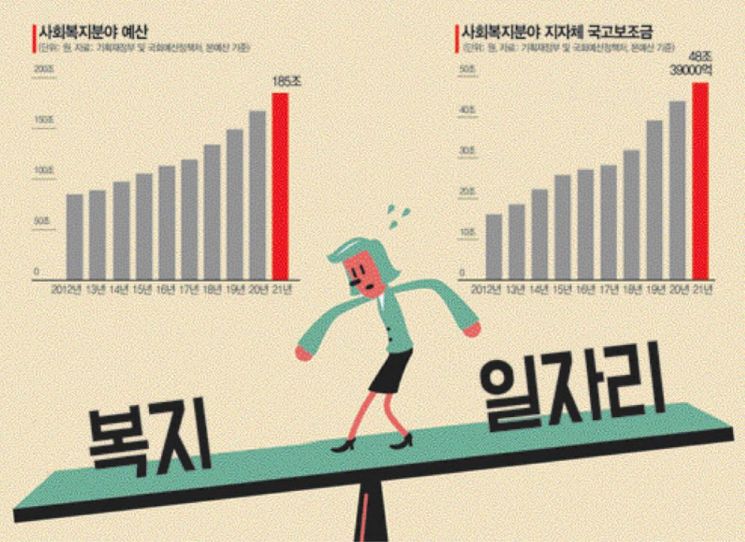
◆Massive Fiscal Spending... Overlap and Blind Spots Persist= Korean-style ‘over-welfare’ is evident in astronomical expenditures. According to the Ministry of Economy and Finance on the 28th, the total government expenditure in the social welfare sector based on this year’s main budget is 185 trillion won, a 10.8% increase from last year’s 167 trillion won. Compared to 10 years ago in 2012 (84.8 trillion won), it has increased by 118.2%.
Although spending has surged, efforts to address overlapping support and blind spots have hardly progressed. The Earned Income Tax Credit (EITC) and Child Tax Credit (CTC) systems notably overlap with existing Basic Livelihood Security and Child Allowance systems. The Basic Livelihood Security system, introduced in 2014 to guarantee minimum income for those aged 65 and older, also overlaps with the existing Basic Pension and National Pension systems. These accumulated problems arose because new systems were introduced to support specific groups without modifying the existing framework.
However, welfare blind spots have not been fully resolved either. The National Pension, introduced in 1988 and operated for over 30 years, has not significantly increased pension recipients due to low social insurance enrollment (69.8% as of 2020). Consequently, the elderly poverty rate reached 43.4% in 2020, three times the OECD member average of 14.8%. The recent increase in platform workers has also raised concerns about expanding blind spots in pension, employment, and industrial accident insurance.
As local governments’ welfare project scales grow, moral hazard issues persist. Local governments freely expand and implement financially burdensome projects without effective central government control, and the central government is unable to even grasp the details. According to the recent audit report on the ‘Operation Status of Welfare Project Consultation and Coordination System’ by the Board of Audit and Inspection, many local governments agreed with the Ministry of Health and Welfare on low benefit levels for specific welfare projects but later increased the benefit levels without consultation. Gangwon Province agreed in 2019 to provide a monthly childcare basic allowance of 300,000 won but raised it to 500,000 won in 2022. Chungnam Province increased the annual farmer and fisherman allowance from 600,000 won in 2019 to 800,000 won in 2020.
Kim Woo-rim, Budget Analyst at the National Assembly Budget Office’s Social Administration Project Evaluation Division, emphasized, "To prevent indiscriminate overlapping support and excessive competition among local governments, it is necessary to establish efficient role allocation principles between central and local governments and improve the consultation system for new or changed social security to effectively manage projects." He added, "It is also necessary to establish principles for applying standard subsidy rates to enhance rationality and apply differentiated subsidy rates reflecting differences in local governments’ financial capacity and policy demand."
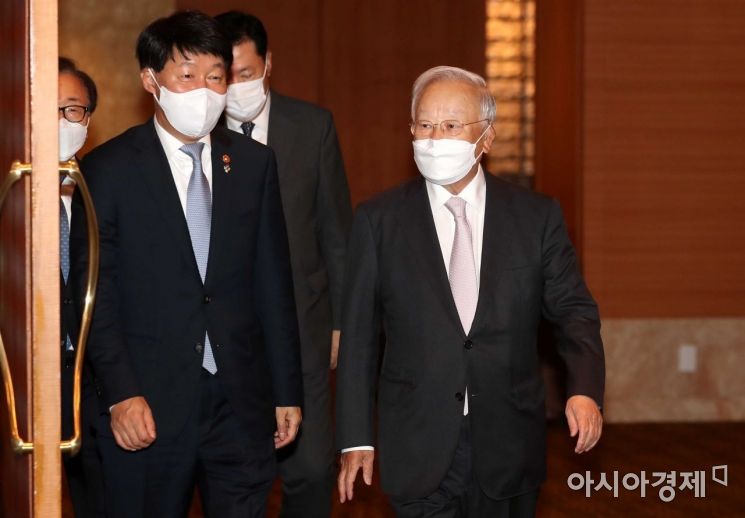 Minister of Employment and Labor An Kyung-duk and Chairman of the Korea Employers Federation Sohn Kyung-shik are attending the '30 Major Companies Human Resources and Labor Executives (CHO) Meeting' held on the 28th at Lotte Hotel in Jung-gu, Seoul. Photo by Moon Ho-nam munonam@
◆Private Employment is the Solution... Government Voices Support= As the scale of government welfare projects grows annually and their share of the total national budget increases, calls to consider fiscal burdens are gaining strength. According to the Ministry of Health and Welfare’s ‘3rd Medium- to Long-term Social Security Financial Projection,’ social welfare expenditure, which was 11.1% of GDP in 2018, is expected to rise sharply to 16.3% in 2030, 25.3% in 2050, and 28.6% in 2060.
There is growing support for the argument that private sector-led job creation and increased disposable income are key to a virtuous cycle of economic recovery, ahead of central government fiscal expansion and welfare enlargement. The government is also emphasizing this point. On the 28th, Minister of Employment and Labor Ahn Kyung-duk held a meeting with HR and labor executives from 30 major companies including Samsung Electronics and Hyundai Motor, urging them to actively utilize open recruitment systems rather than frequent hiring to alleviate youth employment difficulties and expand jobs. He explained, "I ask companies to have a more proactive awareness and use of the public recruitment system so that young people’s anxieties and difficulties can be resolved."
Professor Sung Tae-yoon of Yonsei University’s Department of Economics stressed, "If unemployment benefits and other supports are maintained at current levels even after the COVID-19 situation improves, it may weaken people’s motivation to work and reduce performance." He added, "Support should be provided in a way that improves work conditions when people work at an appropriate level." He further emphasized, "Unemployment benefits should be linked to employment support systems, going hand in hand with acquiring human capital and skills needed by employers."
© The Asia Business Daily(www.asiae.co.kr). All rights reserved.
![Clutching a Stolen Dior Bag, Saying "I Hate Being Poor but Real"... The Grotesque Con of a "Human Knockoff" [Slate]](https://cwcontent.asiae.co.kr/asiaresize/183/2026021902243444107_1771435474.jpg)












